The story I’ve been trying to tell, since we looked at Drawing Down the Moon, isn’t just the story of how I became a witch – but the story of how it became possible for me to be a witch. That story begins in Triumph of the Moon, where Ronald Hutton shares with us all the ingredients that would lead to the birth of Wicca, from the Masons to Margaret Murray. In Search of the New Forest Coven told us about a small group of theatrical performers, who would go on to retired civil servant named Gerald Gardner.
Witchfather told us the story of Gerald, who took his experiences in southern England and used them as a basis for what he believed to be a religious revival. Doreen Valiente Witch shared the story of the woman who used her gift for poetry to write beautiful liturgy, prayers, and ritual texts. In High Priest and Drawing Down the Moon, we saw what happened when Wicca came to the United States. Raymond Buckland got the train rolling, and the rest of America took it from there.
And now, at last, we come to the story of Scott Cunningham – the man who literally wrote the book on solitary practice, and in so doing, changed what Wicca was. You no longer needed a coven, you could be Wiccan on your own. Raymond Buckland and Doreen Valiente may have seen where the wind was blowing, but it was Scott Cunningham who planted the flag for solitaries, and made this form of Wicca possible.
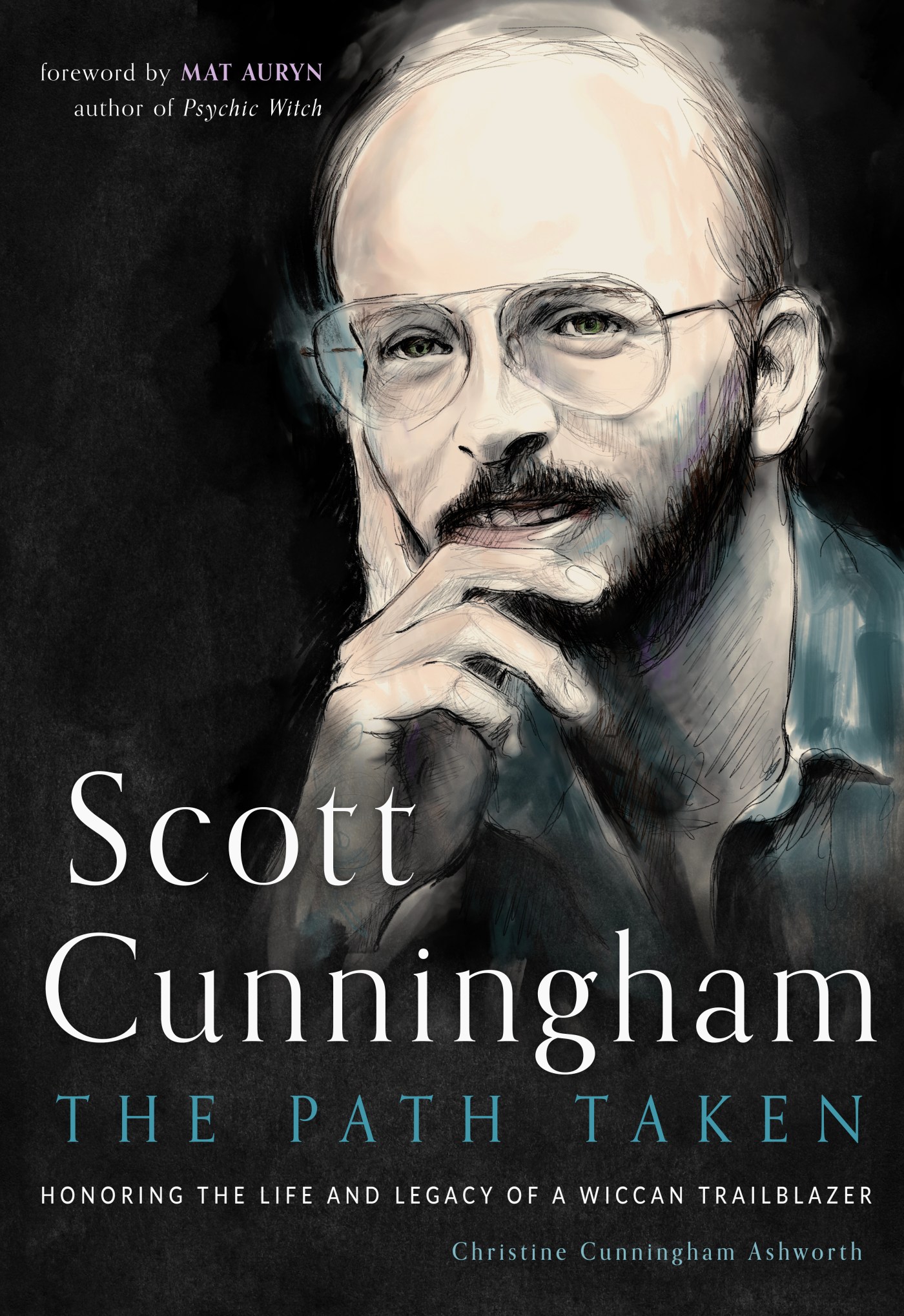
But who was Scott Cunningham, beyond the pages of his books? No one really knew for sure… except for one woman. His sister, Christine Cunningham Ashworth. Two years ago, she came out with Scott Cunningham: The Path Taken, both a memoir and a tribute to her late brother. All of the other biographies we’ve looked at, those writing them have only a passing relationship with the person on the cover. But Ashworth literally grew up with Scott Cunningham. And I can’t think of a better way to wrap our look at Wiccan history than with this.
And so we go.
***
I think the thing that really hits different with this book is how extremely personal it is. Most chapters are split into two parts, with the bulk being Ashworth’s memories and stories of what it was like to be in the Cunningham family circa the 1960s and 1970s. Then there are contributions from all sorts of modern witches, sharing their stories about how Scott’s books impacted them.
Ashworth gives us a glimpse into what it was like to grow up with Scott, and how magic was a part of his life even from a young age – he was the kind of guy who could use pizza cheese as a form of divination, and turn out to be accurate in his predictions. He was experimenting with magic in his teens, at a time when the Satanic Panic was turning the Craft into something to be feared, rather than embraced. And he would spend his entire literary career standing against that fear, doing his part to make the world a safer place for all witches.
What also surprises me about the book, I have to admit, is how American it is. Since I read Witchcraft Today, I have been immersing myself in 1950s Britain, so to speak. Sure, Raymond Buckland spent 90% of his life in America, but he still spent his childhood in England. It’s a different culture across the pond, after all.
Needless to say, after spending so much time reading books about English people, Ashworth’s descriptions of her childhood are so American as to be a bit jarring: she grew up in the 1960s, when McDonald’s was still fairly new and kids still played outside. They lived in a quiet suburb where everyone knew each other. It isn’t quite the world I grew up in, because I lived in apartment complexes for the first 10 years of my life, but it’s similar.
What I didn’t expect but probably should have: Scott watched the original Star Trek live when it came out in 1966. He grew up in a family of Methodists, and performed in the church choir. I know it’s hard to imagine someone like him, as devout a Wiccan as there ever was, growing up Christian. But that’s what he was, and while Ashworth doesn’t discuss that in much detail, it’s still interesting to read about.
Ashworth reveals surprising facts about Scott: that he was gay and celibate for the last few years of his life, his marvelously dry sense of humor, his skill at gift-giving and gift wrapping, and how caring of an older brother he was. Witness, for example, this exchange between him and Christine shortly before Christine’s wedding:
“He held my shoulders and really looked at me. “You sure you want to do this? I can drive the getaway car if you want to get away. You know, to somewhere that Calgon can’t take you.”
“Ha ha. Of course, I want to do this.”
“Why?”
I thought for a moment. “Because when I looked into the future, I could see us in a home office somewhere, both of us with gray hair and wrinkles, banging away at our typewriters and taking care of each other. That’s why.”
He smiled and gave me a hug. “That’s good enough for me.”
What a wonderful, thoughtful man. Christine was truly blessed to be able to call him family.
Another of my favorite bits from this book: the bit in chapter 7 where holidays are discussed. Scott’s favorites were Halloween and Christmas (also two of mine, I will admit) and of course, when he entered the Craft, those loves transferred over to Samhain and Yule. Near the end of that section, Ashworth writes: “I wish he hadn’t been quite so discreet, so circumspect with his witchery. But I also understand why he did what he did. In the ’70s, it was barely acceptable for men to have long hair. To be gay and interested in witchcraft and Wicca? Not acceptable.”
I did the math, and he’d be turning 70 next year if he were still present in this incarnation. I wish he’d lived to see how publicly being a witch, at least in some parts of this country, is no longer something to be frightened of. I’ve openly worn my pentacle necklaces and related witchy clothes in public, and I even formally told a coworker that I’m a witch just recently. (He said, “Are you a light witch or a dark witch?” I answered, “Light witch.”)
But the thing is, I was only able to have that conversation in part because Scott Cunningham, through his books, made that possible. As Ronald Hutton notes in Triumph of the Moon, that first generation of Wiccans were all right-wing. As Hutton says, “Their spiritual interests marched closely with three different emotional aspects of right-wing ideology: nostalgia for a better past, elitism and suspicion of the masses, and a desire for a free market, in magic and sex as in economics. A dislike of the modern world united many of them.”
It took Doreen Valiente’s and Raymond Buckland’s relative liberalism, and moving the Craft to the United States at the same time as the civil rights movement and second-wave feminism were beginning to leave their mark on the country, for Wicca to grow and shift into something more left-wing. By the time you get to the 1980s, when Scott Cunningham was writing, the Craft had established itself as part of the counterculture, firmly against the conservative revolution spearheaded by Ronald Reagan.
Of course, the work is not complete. As recently as 2011, Z Budapest was still holding trans-exclusionary rituals at major pagan conventions, and in the Year of the Goddess 2025, trans witches of all kinds are still trying to find space for themselves in a religion built for only two genders.
But thanks to Scott Cunningham, the path is clearer now than it has ever been before. In reading this book, I’ve come to believe that he would’ve loved our current era… at least up to a point. As his sister says, we still have far to go. But I believe we’ll get there. The gods are on our side.
It’s a tragic story, the one Ashworth has to tell. But of course it is – the book starts with one of the last conversations she had with him before he died, and once we hit the chapters where they move out and begin their adult lives, the ending becomes truly inescapable. Much of the book is like this – not just Scott’s decline, but Mrs. Cunningham’s as well, from MS.
But even in the midst of the darkness, there is light. Scott’s close relationship with his mother, and how her skill in the kitchen led to some of his books on food and magic, or the way she and Scott would go to the movies, and watch horror films. There’s even a recipe included, for Gigantor Cookies. (Named for the ‘60s cartoon, natch.) I’ve added it to my Book of Shadows.
But the end comes. Ashworth’s prose in this part is heartbreaking to read, and not just because she admits to crying while writing it. In a way, it almost feels like I’m peeking into her diary, even though I’m not. It’s raw, deep, and personal in a way that defies description. But with that comes beauty – the times she writes of talking to Scott’s spirit, and him answering, in that strange way the departed do.
As a Wiccan, I believe that we go to the Summerlands to rest and recover from our latest spin on Earth, and that in time we are reincarnated… but I’m not sure the entire soul moves on. Some piece, surely, must remain – otherwise, how would we be able to speak to our beloved dead? Which itself is comforting, since it means that our dead have only gone from this plane of existence. Elsewhere, they still live.
It’s not until near the end of the book that we learn how Scott became Wiccan. The man was insatiably curious about Nature, and so he asked questions, which led him to research, and eventually, to Wicca. Ashworth writes, “It wasn’t a “conversion” in a religious sense. It was more a “turning toward” practices that helped him solve natural mysteries, that helped him feel connected to the world. Scott, who had from his youngest days been enthralled with Nature, finally found a Nature-based religion that spoke to his soul. His research, his studies with others, his innate intellectual curiosity then compelled him to share what he had learned.”
I think this is what we Wiccans mean when we come into the Craft and say that we’ve “found home.” The second chapter of Drawing Down the Moon is called “A Religion Without Converts” for a reason – at long last, we start listening to the voice that’s been whispering to us all this time, giving us little hints.
For example: I’ve always been fascinated by the moon. As a kid I’d watch Bear in the Big Blue House on Playhouse Disney, and my favorite scenes were always the ones where he’d go out onto the balcony and talk to Luna – aka, the moon. And being the impressionable young wolf I was, I picked up the habit… as if I somehow realized the Goddess was listening.
It took me a while until I heard Her voice though. My obsession with My Little Pony: Friendship is Magic, a TV series that features two goddesses, one in charge of the sun and the other in charge of the moon, was yet another hint from the Goddess that She was out there. And, well, Luna’s long been one of my favorite characters from that show, and Nightmare Night (the Equestrian equivalent of Halloween/Samhain) is her favorite holiday.
But once I did, and I began writing the ritual that would become the Claiming, I turned to Scott Cunningham for help. In Solitary Practitioner, he includes a ritual for self-dedication, and at one point I was going to perform the whole ritual, just as he’d written in the book. I was gonna go out into the empty patches of grass within the village, stand in the light of the full moon, and introduce myself to the gods…
And then I realized I wasn’t sure I’d be able to get out to the meeting point in the dark without tripping over anything. So I changed gears, rewrote most of the ritual to take place in my kitchen, and Claimed myself there instead… but I still kept some of Cunningham’s words.
Toward the end of the ritual, I repeated these lines three times, the ones Cunningham wrote in his script: “O great Goddess, O great God, make me one with your essence.”
And my gods responded, “We have, we will.”
And my life was never the same again.
Thanks for everything, Scott. For pointing the way forward, and helping me find my place in the Order of Things. Wherever you are now, I hope you’re happy there.
Blesséd be. ❤


Leave a Reply