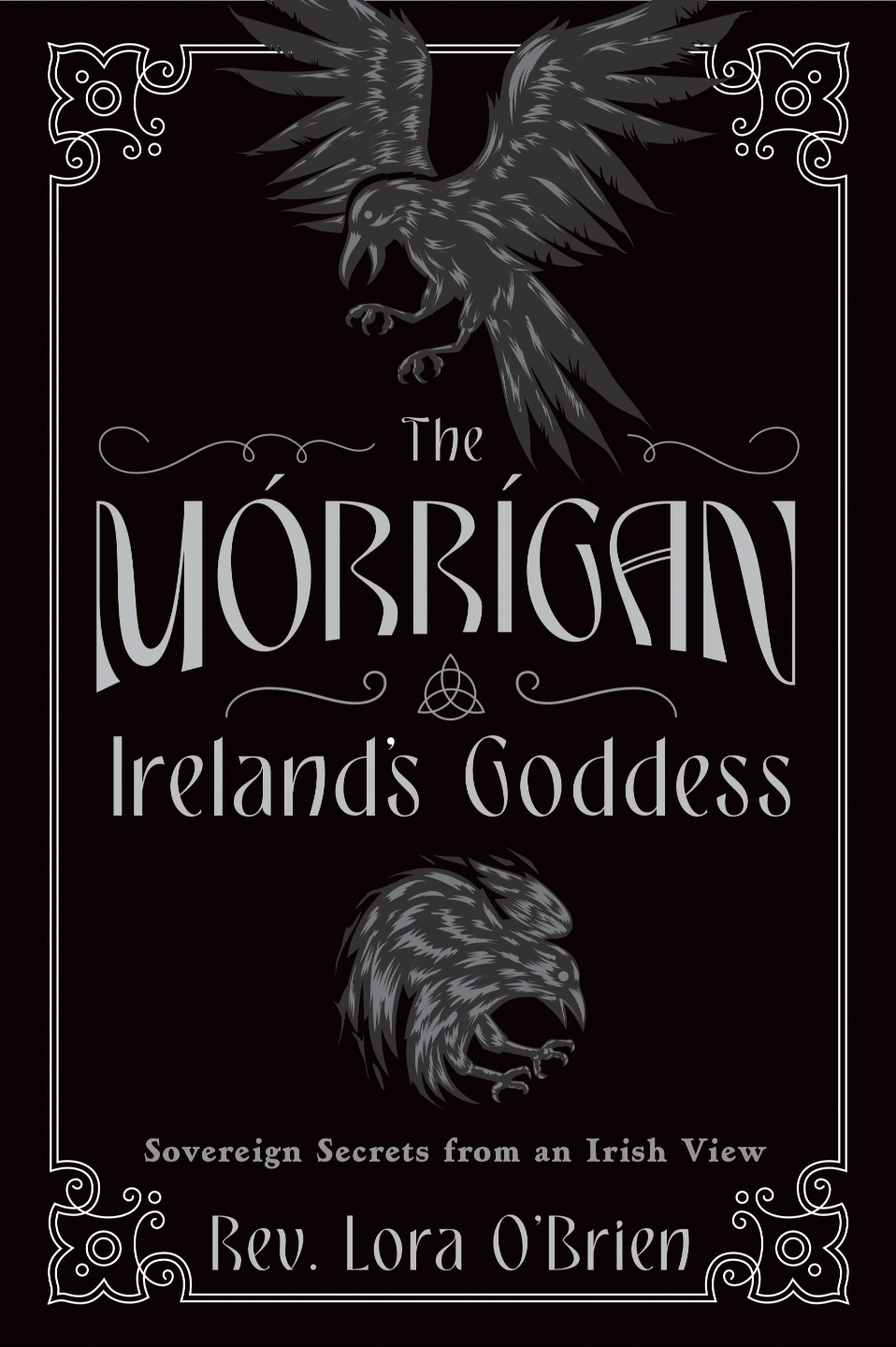
I know, I know, I can’t believe I’m reading another Lora O’Brien book either. I really thought, after speeding through Irish Witchcraft at warp 9 back in April, that once I was done with that particular train wreck that I would never have to read another word of their nationalistic, condescending, infuriating prose again. I certainly didn’t want to when I wrote the post about it four months ago.
But sadly, the first sentence of that post remains true: you really, really can’t go anywhere within the Iripol community and not run into them. They are omnipresent, because they have spent the last couple decades making a name for themself and putting in the work to become an essential resource.
I ran into this exact issue in Salem earlier this year: on my last trip to Coven’s Cottage to buy Stephanie Woodfield’s Morrígan oracle deck, (which is, by the way, fantastic and if you don’t yet have one, I highly recommend it) I saw another of LOB’s books on one of the shelves: A Practical Guide to Pagan Priesthood.
This immediately set me with a dilemma. I’ve written here before about how I feel the Great Queen has been nudging me in the direction of becoming a priestess for most of this year, but actually figuring out how one does that is difficult – this isn’t like Christianity, where if you want to become a pastor, there’s a million and one different ways to do it and a universe of resources to tap into.
Practical Guide, from all appearances, would at least give me a firm grounding and help me take the first steps on that particular journey… but did I really want to take the advice of someone who, through their words alone, made me feel small and insufficiently pagan?
My wife encouraged me to buy it anyway, on the theory that I might still learn something, even if I vehemently disagree with the author on virtually every other subject. And it was that same theory that led me to buy this week’s book, The Morrígan: Ireland’s Goddess, as well. After reading several wonderful books about TGQ written by Americans, maybe reading a book about Her from someone who is Irish as well will reveal things that Courtney Weber, Stephanie Woodfield, and Christopher Penczak’s books couldn’t?
Only one way to find out.
Boy was I wrong, when I said a few months ago how this book wouldn’t be worth your time. I’ll go ahead and admit it right now: I was mistaken! This is your worth your time – not because I think that only an Irish person can tell the story of the Morrígan, but because O’Brien relates even the details we already know about her with a depth that not even Morgan Daimler and Courtney Weber (both of whom are quoted in the opening pages) can match.
This is, to be clear, a lot of material – just discussing all the various recensions of the Cattle Raid of Cooley takes several pages, but O’Brien does a superb job making it all seem accessible, writing in a light, conversational tone with a certain amount of snark, particularly toward Cú Chulainn, for whom they evidently have very little time. (Which, having seen his portrayal in retellings of the Cattle Raid, I can understand. The guy was the first jock.)
One interesting bit in the first section is chapter 5, “Sovereignty, Then and Now.” As Morgan Daimler does in her book Raven Goddess, O’Brien first defines sovereignty as the ancient Irish would’ve known it:
“Flaith in ancient Ireland denoted lordship, sovereignty, rule, reign, kingdom, realm, but also “of deity,” and “liquor, esp. ale or beer; milk.” The Dictionary of Irish Language also notes: “in Old Irish the underived noun flaith ‘sovereignty’ was also used to denote the ruler, an animate entity.”
“Both ruler and rule are there along with divinity—and with sacred liquid connections embedded in there too. The king (or queen, e.g., Medb) served as a judge, leader in war, and was also responsible for offering sacrifices and engaging with the Otherworld, acting as a bridge between the Tuath, people or community, and the gods. A kingdom’s welfare relied on the sovereign’s physical, social, and mental condition, affecting peace, stability, weather, and abundance. This was our fír flatha—sovereign’s truth. Conversely, the gáu flatha—sovereign’s lie—led to strife, bad weather, pestilence, and famine.”
Also like Daimler, O’Brien goes on to explain that though the definition of sovereignty has changed, the Morrígan’s dominion over the concept has not. They write, “With the Mórrígan we find a guide for navigating our personal and collective boundaries. Her assertiveness and foresight help us build strong, sovereign boundaries in our own lives.”
I really, really like this particular take on sovereignty – it is a form of the concept that is relevant to our world, especially a time when so many people out there seem fit to try and strip our sovereignty from us. O’Brien is fully aware of the context in which she’s writing, making abundantly clear that we are not defenseless in these dark times:
“Following the Mórrígan’s example, this path of embodying sovereignty and maintaining boundaries teaches us to use wisdom and foresight in our lives. We hold and wield some of the ancient power of a female satirist, which was terrifying to the established authorities in her day and could (should) be terrifying again, for those who rule with those sovereign’s lies today.”
That’s the kind of “spiritual warfare” (to quote Pete Hegseth’s pastor) that I can get behind. If this is to be a war, then we all need weapons – magic can be our defense. As John Beckett wrote after the election last November, “We live in difficult times, times that require a choice. I choose witchcraft.” This is our battle, and who better than the Morrígan to guide us through it?
Putting aside battle talk for a moment, what stuns me most about Ireland’s Goddess is how much better of a book this is compared to Irish Witchcraft. Some of this might just be a fact of the passage of time – Irish Witchcraft was written 20 years ago, when O’Brien was younger and, if we’re honest, stupider. We’re all young and stupid when we look back with 20 years of hindsight, why would they be different?
In Ireland’s Goddess, I found none of the condescension and hatred toward modern Neopaganism that made Irish Witchcraft such a drag to read. She is far more welcoming here, and more patient with those who are not exactly like her. She includes discussion questions at the end of each chapter and even exercises and example rituals, some of which are written English. (Which, I’m sure, would be horrifying to the LOB of 2004.)
But most of all, what I took away from this book is that it is an act of devotion to a specific goddess, and one done with as much care and love as possible. O’Brien writes that this is no accident – in her first encounter with the Great Queen, O’Brien says that the Morrígan specifically told her to get the truth of things out, to share accurate information and to make it available to everyone willing to search for it.
I might have problems with some of the methods O’Brien has chosen to go about that work (charging over a thousand dollars for a six-month online class springs to mind) but I can’t deny the theological underpinnings. If they say the Morrígan tasked them with this project, then I believe her.
I won’t say that Ireland’s Goddess completely redeems O’Brien or otherwise renders my earlier opinion about her incorrect, because it doesn’t. I don’t like the way she runs that Facebook group of hers, and still much of her attitude, outside of her books, is deeply concerning – this past spring I attended a free video lecture of hers, and while I got a lot of information out of it that was helpful, it still came with a side of condescension that I didn’t appreciate.
But in the end, I guess what I’m trying to say is that behind the bullshit, the bullying, the nationalism, and everything else that makes her a toxic person, I can still appreciate this book for what it is – a solemn act of devotion that tries to do right by the goddess named in the title.
And for now, that’s enough.


Leave a Reply