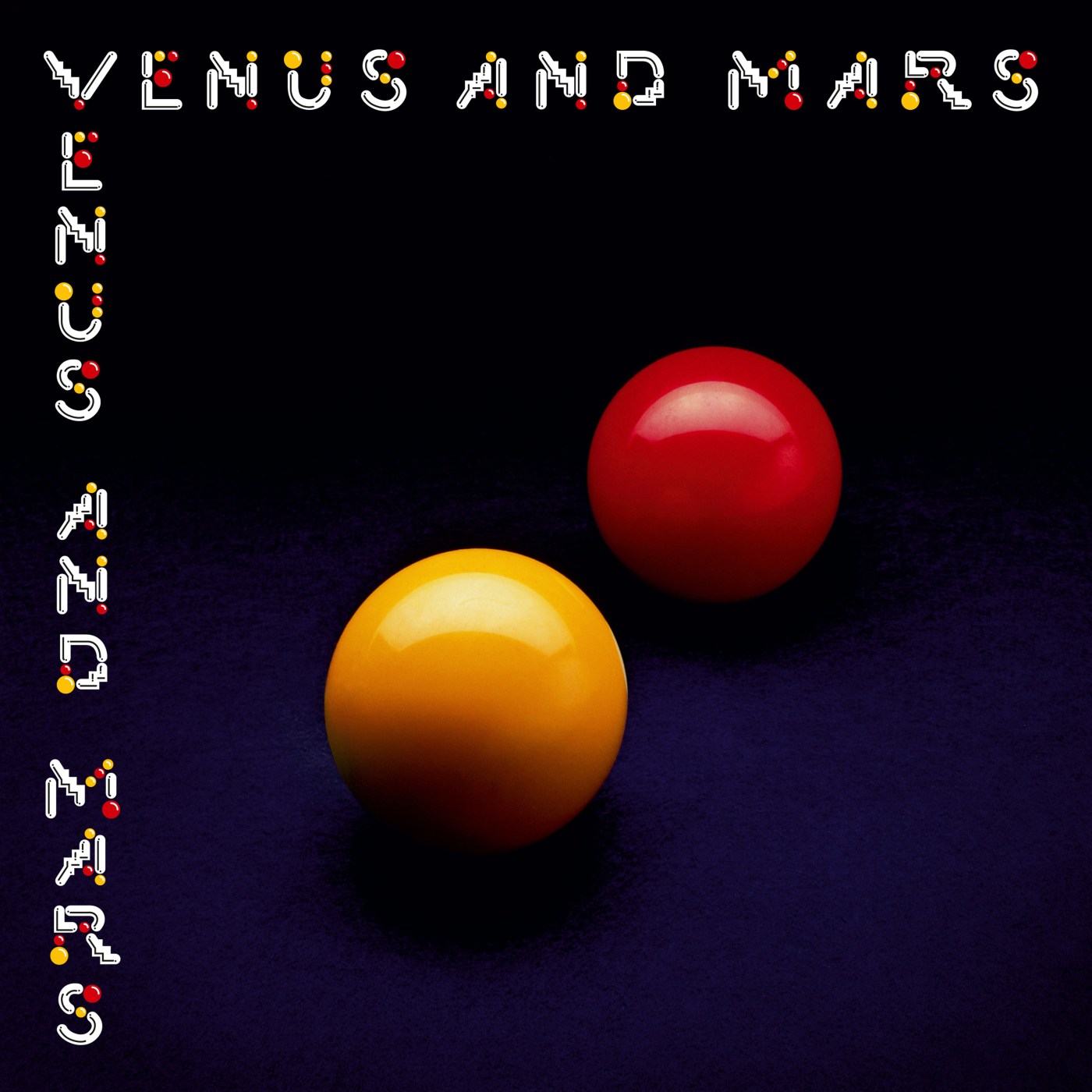
This week, we continue the story of Wings not only hitting the big time, but staying there. Venus and Mars finds Paul eager to capitalize on the success generated by Band on the Run, and so he puts his band to work in places as far flung as New Orleans, creating a package of songs as varied as anything on, say, the White Album.
But he does this, it’s worth noting, with a band that seems to change its lineup every time someone sneezes in the wrong direction. The quintet that made Speedway got reduced to a trio for Band on the Run, and the quintet that made One Hand Clapping loses Geoff Britton for an American named, ironically, Joe English.
By now, we may as well finally deal with the Wings Paradox head-on, since it’s going to keep propping up for the last four years of the band’s lifetime. The Wings Paradox is simple: the band began with Paul’s desire to play in a group again, and start from scratch rather than coast on his Beatleness. Which is not, by itself, a bad thing.
The problem is, Paul was sharing space not only with Linda, but also his own planet-sized ego and tendency toward being a control freak. While I don’t think it can be said that there was any one cause of the Beatles’ breakup, one of leading ones has to be Paul essentially becoming the band’s manager starting from Sgt. Pepper, and kicking into high gear following Brian Epstein’s suicide in 1967.
The thing was, in the Beatles they still managed to create some great music despite Paul’s controlling tendency – after all, his ego was balanced out by John and George being there to puncture it as needed, and with Ringo serving as the glue keeping the band together. But as I talked about with my wife last night, Wings has no one to fill those roles.
As Geoff Britton noted when he left Wings in 1975, “It’s a funny band, Wings. From a musician’s point of view, it’s a privilege to do it. From a career point of view, it’s madness! No matter how good you are, you’re always in the shadow of Paul.”
That’s the problem with Wings: Paul said he wanted a new band to fill the gap left by the Beatles, but he kept getting in his own way by letting himself be ruled by his egotism. Part of the reason he and John worked so well together was because both of them had talent and ambition, and the competition between them made for amazing music. To some degree Linda filled John’s old role as Paul’s musical partner, but it wasn’t exactly the same – she didn’t have that ambition and desire to compete that Paul did, so his ego was left to run more or less unchecked.
Ultimately, the only person who could’ve kept Paul in check was the same guy whom Paul had spent the early ‘70s arguing with: John Lennon. Just look at the whole “Too Many People”/“How Do You Sleep” diss track debacle of 1971. HDYS may be something of an overreaction on John’s part, but his barbed criticisms of Paul in that song, I think, still work because they come from Paul’s best friend. John still cared, even in that difficult moment.
If Wings had a John analogue, (or even John himself, as he was originally supposed to go see Paul while he was in New Orleans but never did) the band might’ve lasted a bit longer than 1979, and they may have been able to keep a stable lineup… but that never happened either.
Still, let’s see what those sessions in the Big Easy resulted in:
‘Venus And Mars’/‘Rock Show’: A two song medley, the first song is one of Paul’s many introductory type songs, in the tradition of something like “Sgt Pepper” or “Magical Mystery Tour.” “Rock Show” is a surrealistic description of, well, a rock and roll concert circa the mid-1970s, the beginning of the arena rock period. I like both of these songs (especially the spoken word section of “Rock Show”) but Paul finds it a bit embarrassing.
Sir, you wrote “My Love.” That is embarrassing. “Venus and Mars”/“Rock Show” is just a bit of mid-70s indulgence. What’s wrong with that? I’d like to know…
‘Love In Song’: A poetic love song that doesn’t tend to get a lot of love these days, Paul wrote it on his twelve-string guitar. Also listen for a bass part played on the same upright bass owned by Bill Black. It’s a melancholic song, this, but I like it.
‘You Gave Me The Answer’: Paul returns to the music hall era, previously explored in such numbers like “When I’m Sixty Four” and “Honey Pie.” It’s cute, and definitely fits the same vibe as similar 1940s musicians like Freddy Nagel, but I wouldn’t call it one of my favorites – these days, it’s most remembered as the title for Paul’s online newsletter.
‘Magneto And Titanium Man’: In which Paul McCartney outs himself as a Marvel fan fifty years before the MCU happened, and writes a story that’s more interesting than any of that franchise’s actual recent output. (Except Agatha All Along, by dint of being about witches.) Not being a comics girl myself, I don’t understand half of what’s being described here, but the tune is good.
‘Letting Go’: A long rocker all about Paul realizing he needs to let Linda have some hobbies and interests of her own, “Letting Go” became a staple of Wings concerts throughout the mid-1970s, and it’s also Paul’s favorite track on this album.
‘Venus And Mars (Reprise)’: Paul really seems to like his reprises, given that this is the fourth one he’s ever done. (The others: Sgt. Pepper, Get Back, and Ram On.) The lyrics here are science fiction themed, as he’d been reading Isaac Asimov at the time, so it feels very of a piece with where sci-fi was going in the ‘70s.
This was the era of Star Trek: The Animated Series, Tom Baker’s seven-year stint on Doctor Who, and who can forget that legendary space opera epic about an evil spaceman and the heroic young man on a quest to stop him… Starcrash, starring David Hasselhoff, Caroline Munro, and Christopher Plummer?
Oh yeah, and that other Star related thing from the ‘70s. Uh… something about a war?
‘Spirits Of Ancient Egypt’: If John was reading Yoko’s books on astrology and possibly exploring the contemporaneous American witchcraft scene, (judging by his lyrics in “Cleanup Time” from Double Fantasy) Paul spent a chunk of the 1970s reading about ancient Egypt, specifically the book Secrets of the Great Pyramid by Peter Tompkins. The book influenced the song, at least as far as its title is concerned – the rest of the lyrics are entirely unrelated, but who cares? That title is wonderful.
‘Medicine Jar’: Wings member Jimmy McCulloch takes lead vocals on this song, an anti-drug song written by his friend Colin Allen. Ironically, McCulloch’s own problems with alcoholism would lead to such incidents as getting arrested for reckless driving in Nashville, and getting kicked out of Wings in 1977. Talk about a tough break.
‘Call Me Back Again’: A bluesy New Orleans soul number, Paul turns in a vocal performance like we haven’t heard since “Oh! Darling” in 1969, which this song more than slightly resembles. Lyrically, it feels like the thematic inverse of “You Won’t See Me,” with Paul wailing desperately for a phone call that will never happen. It is incredible.
‘Listen To What The Man Said’: A classic optimistic McCartney love song, The Paul McCartney Project describes the lyrics thusly: “Even though love may be blind or may cause separated lovers to suffer, the singer believes that love will prevail,” accentuated with a tenor sax solo by Tom Scott, and kiss sound effects by Linda. It was released as a single in 1975, and became a hit. (Me, I’ll always associate it with the time I heard it over the music system at a Dierbergs in suburban St. Louis.)
‘Treat Her Gently – Lonely Old People’/‘Crossroads’: The first two songs are not a medley, but two halves of the same piece that were written more or less simultaneously. As Paul explains, “It wasn’t two separate songs put together. They just fell into each other and I wrote it as I was practising the other, almost.”
It ends with Wings’ version of the theme music from the British soap Crossroads, entirely because the band knew the chords. It works well as an album closer though, and the Wings versions (according to Beatles Bible) would sometimes be used on TV to mark a dramatic ending.
Venus and Mars is definitely an album that Exists. After the stratospheric highs of Band on the Run, anything would be a comedown. The music is solid, and certainly I like it more than I did Wild Life or Red Rose Speedway, but it still feels a bit lacking in ambition and drive. But maybe that’s just me.
One point of interest: 1975 was a year of change for all the Beatles, as their recording contracts with Apple finally ran out that year, allowing them to record for other labels if they so chose. Paul’s final Apple release was Band on the Run, Venus and Mars saw him return to Capitol Records, who had of course distributed Beatles albums in the ’60s. He’s bounced around other labels over the years, but Capitol’s always been his home, and this first release with them is a good place to begin.


Leave a Reply