I’m sure it won’t be news to anyone, particularly my American readers, that we are currently living in very dark times. Ever since Barack Obama took the Oath of Office in 2009, the Republican Party, once the stronghold of “compassionate conservatism” championed by George W. Bush, went fully fascist more or less from the word go – aside from when they decided Mitt Romney should be their nominee for president.
I remember the 2016 election. I remember watching the Republican convention that year and getting a sick feeling of dread in my stomach, which returned that November as I watched Trump run up the score in the electoral college. I remember feeling as though I no longer recognized the country I lived in and called home – how could we go from electing someone like Obama to someone like Trump?
The answer, of course, is because America has always been a white supremacist nation-state – we’ve just had occasional moments where we’ve tried not to be. Obama’s eight years were one of those moments, and Harris’s first term might’ve been too, if she’d won last November. But she didn’t. Instead, America decided it wanted Nazi Germany 2.0, or maybe the American remake of Putin’s Russia. And if I were writing this a little closer to the cataclysm of November 2024 than I was, I’d probably be feeling way more pessimistic than I am.
To be clear, things are very, very bad right now. Trump has been allowed to rule like a king in these last eight months, and he is trying to crush any form of opposition that dares to rise against him, whether it’s coercing CBS into firing Stephen Colbert, sending the National Guard into LA and DC, or stripping funding from PBS and NPR. Goddess knows what the hell he’s gonna try to do with the midterm elections next year.
But the thing is, this country is way too big for him to try and do to it what Hitler did 90-some years ago. His approval ratings are a disaster, especially among the people who are responsible for this whole mess in the first place. So, the question here is not, “What can we, as witches, do to mount resistance?” One is already happening right under our noses! (Or muzzles, if you’re both a furry and a witch like I am.)
Instead, we must ask ourselves: what can we, as witches, do to keep the flames of resistance burning? As I’ve mentioned off and on in the early part of this series, we are not powerless. Amanda Yates Garcia’s memoir gave us one example of how to resist with magic, and Scott Cunningham gave us the tools we needed to effect our own resistance by making Wicca available to all, without the need for a coven. And from the Morrígan, we learned about sovereignty and how we can claim it for ourselves, and take it back from those who would steal it from us.
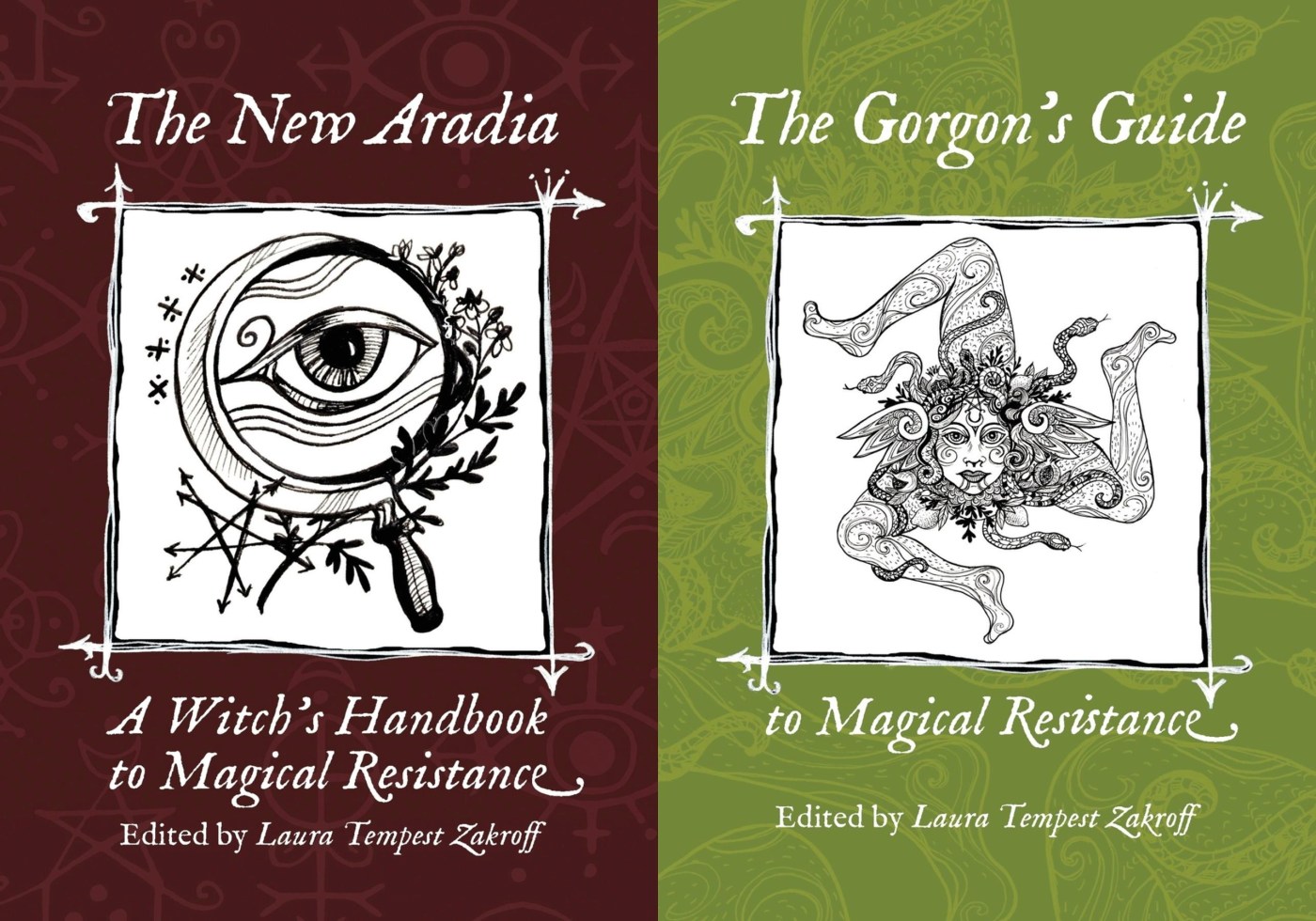
With these two books, Laura Tempest Zakroff and her contributors lead us into the next part of the journey. The synopsis for New Aradia reads, in part, “Wrapped within those pages is the truth that Witchcraft is a revolutionary practice – a means for fighting against social injustices, shifting the balance of power, freeing people from oppression, breaking down political and financial systems that work against the people and nature itself.”
So what the hell are we waiting for? Let’s put on our pointed hats, get on our broomsticks, and get ready to do some magic, witches!
The first thing to note about these books is that, unlike every other book we’ve been looking at, these two are not the works one one author. Zakroff does contribute in places (particularly the first two chapters) but otherwise, the bulk of the books are given over to other contributors, which allows for a fascinating range of voices and views about the Craft and how we can use magic as a means of resisting against fascism.
In the essay “Aradia in the New Millennium,” Storm Faerywolf writes of Aradia: “The tale reveals her to be the first witch, sent to earth by her mother, Diana—Queen of the Witches and Faeries—to teach the poor and the oppressed the hidden arts of witchcraft in order to free themselves from slavery and even to torment their oppressors.”
No wonder, then, that witchcraft has been a go-to tool of the oppressed and subjugated for decades! This literally what magic is here to do. Faerywolf continues: “For witches, Aradia is a reminder that our Craft serves first and foremost the underclass; that our very heritage is one of liberation and equality; and also that sometimes in order to survive, we must also fight back.”
I’ve always found it rather ironic that early modern witchcraft was initially propagated by a bunch of well-off white Brits who voted for Conservatives – as we know from Triumph the Moon, Gerald Gardner and those like him (with the exception of Doreen Valiente, of course) saw the Craft as a means of running away from the “liberal” excesses of mid-20th century Britain.
It was only when Raymond Buckland brought Wicca to the US in the early Sixties, and spread it around as well as he could, that witchcraft became the revolutionary tool it is now – even for traditions as far apart as Reclaiming or Z Budapest’s version of Dianic Wicca, there was still a revolutionary element at play, a desire to take back power that had previously been denied.
The New Aradia continues in this vein for much of its contents, mixing short essays with invocations, prayers, and of course, spells – the effect is not unlike a revolutionary’s Book of Shadows. The second book, The Gorgon’s Guide to Magical Resistance, works along identical lines as its predecessor, but with greater spotlighting of trans, queer, and BIPOC voices. As the title suggests, it is inspired by the Gorgons of Greek mythology:
“The Gorgons are beings often described as having snakes in place of hair, large eyes, scaly skin, teeth like boars, claws for hands, and golden wings. […] Some say the Gorgons represent perversion in its three forms: Medusa (intellectual), Euryale (sexual) and Steno (moral). For centuries, witches have been said to be the perverse ones, upsetting the order of society. But what if society needs upsetting?”
“We may not have snakes in our hair, but we hold the power of the Serpent within us. The primal voice within us, the Serpent speaks of creation and change, power and protection, venom and vision. It reminds us that the path of living is serpentine—in moving forward we must also be prepared to spiral back, as well as knowing when to rest and when to strike. The Serpent says to the Witch, “Kiss the air with your tongue, move your body like water, let your spirit burn like fire, and glide upon the earth with ease.”
I really like this imagery, not least because it reclaims the snake from the Christian depiction of them as agents of ultimate evil and instead refashions them as agents of rebellion and revolution against the evils of late-stage capitalism, authoritarian governments, and other forces that would seek to silence anyone who dares to exist in ways they don’t approve of. (Like witches, for example.)
To give you an idea of when this book came out, the first piece (“Martyrdom is the Last Resort” by Alicia Vervain) was written the day of the Dobbs decision. And, well, it’s as clear as day why a second one of these books was necessary – Biden’s presidency didn’t mitigate nearly as much harm as it could or should have.
Which gets at something I’ve been thinking about, reading these books in the current context. They have both aged extremely well – New Aradia was written during Trump’s first term, but aside from one reference to Charlottesville, you could have said it was written six months ago and I would have believed you.
The fact is, the fight against authoritarianism is one that will last for a long time. As this past year has shown, the situation is devolving rapidly, and we can’t rely on voting alone to save us… but that’s where these two books come in. They give us the tools we need to not only fight the good fight, but to build a new, better world in the aftermath.
Revolution, and restoration, must be our watchwords.
Let’s get to work.


Leave a Reply