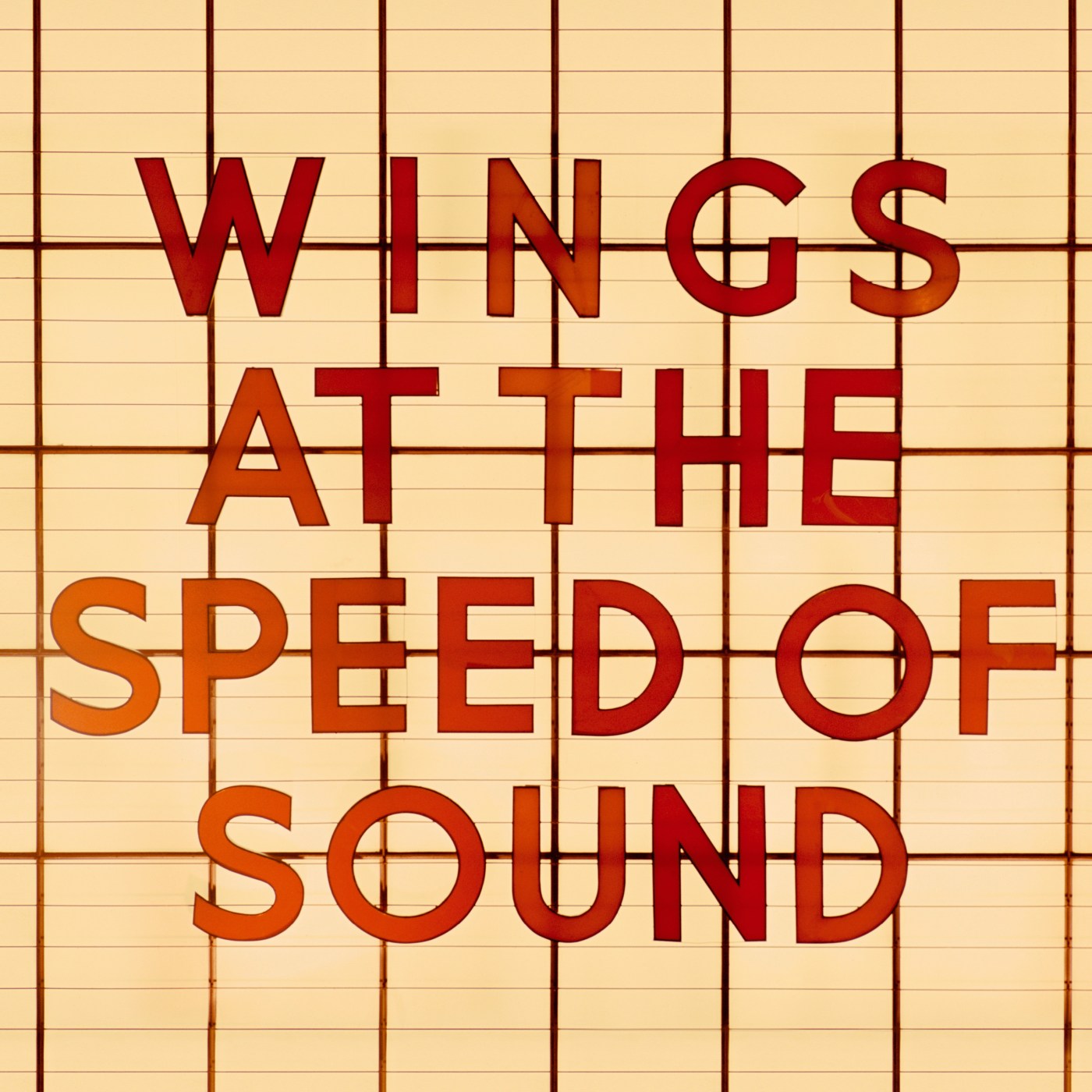
Remember last week when we talked about Paul’s egotism being a huge barrier to Wings’ longevity? That’s still an issue, but he takes steps to address it with Wings at the Speed of Sound, released in March 1976. They were on a world tour at the time (about which more next week) but they were able to fit in some recording at good old Abbey Road.
This album sounds very different from the previous ones owing to the fact that for once, Paul does not sing lead on every song – instead, five of the songs feature lead vocals from everyone else: Linda, Denny Laine, Jimmy McCulloch, and Joe English. By the gods, it’s almost like a Beatles album!
And speaking of the Beatles, an interesting note regarding this album’s chart performance. 1976 was a big year for Beatles nostalgia, as Rob Sheffield notes in Dreaming the Beatles, exemplified by the release of Rock ’n’ Roll Music that summer, and it was a smash hit, despite (or maybe because of) the objections of the ex-Beatles.
However, it only got as high as the #2 spot. So what was the album that kept Rock ’n’ Roll Music from making it to the top of Billboard’s album charts? What else but Paul’s Wings at the Speed of Sound. After six years of trying, Paul McCartney finally managed to surpass his old band at something, which I’m sure must’ve thrilled him.
Let’s see what Wings has for us:
‘Let ’Em In’: While the lyrics are nothing to get too excited about, the melody they are sung to is absolutely fantastic, and the snare drum gives the track an almost military vibe. When it was released as a single later in 1976, it did a lot to boost Speed of Sound’s flagging sales.
‘The Note You Never Wrote’: A song written by Paul for Denny Laine, Paul notes in The Lyrics that the track sounds very like mid-70s Pink Floyd: “The arrangement as a whole is kind of dreamy and Floydian. It’s what we call a ‘Floydian slip’.” And he’s right! That guitar solo really does sound like something David Gilmour would’ve played.
‘She’s My Baby’: Paul returns with a love song he wrote for Linda. When Working Classical came out in 1999, Paul wrote in the liner notes regarding this track: “The song is essentially a series of little enigmatic statements, snatches from a diary that seemed to sum up our relationship at that time.” Very sweet, as things go!
‘Beware My Love’: This sounds to me like a 1970s role-swapped version of “You’re Gonna Lose That Girl” – rather than warning the guy not to mistreat the girl, Paul instead warns the girl not to go out with the guy, whom he thinks is going to mistreat her. It’s a great song, and I’ll take any excuse to listen to Paul’s “rock and roll” voice again.
‘Wino Junko’: Jimmy McCulloch returns for another anti-drug song, marking this as one of only two songs which Paul didn’t write. It’s a solid enough track production-wise, but I don’t think I’m a huge fan of it myself otherwise.
‘Silly Love Songs’: Paul returns with a rebuttal to music critics who didn’t like that he mainly wrote happy, poppy love songs. Given this was the 1970s and Paul was widely viewed as the villain in the story of the Beatles’ breakup, I kind of feel like that might’ve had something to do with how he was critically received. After all, no one complained about a profusion of love songs when John, George, and Ringo were there.
‘Cook Of The House’: Linda’s turn in the spotlight now, focusing on the subject she loved most – cooking. As Paul notes in The Lyrics, “Linda was a very good cook and loved feeding our family and friends, so it was fitting that her song would be ‘Cook Of The House’.” It opens with the sound of bacon frying, and includes Paul playing Bill Black’s double bass, in a song that really does feel like it could’ve been recorded in the 1950s, down to being mixed in mono.
‘Time To Hide’: Another Moody Blues-esque song for Denny Laine, the only member of the band (other than Paul himself) to have more than one vocal spot on this album. This song grooves along very nicely, anchored by Paul’s bass (which is mixed quite loudly on this song) and a harmonica solo from Denny.
‘Must Do Something About It’: Filling Ringo’s old role on Beatles albums, Joe English takes lead vocals on this song, about the inescapable loneliness of being single, and the singer’s desire to change things. English is a solid vocalist, but I don’t think he quite has Ringo’s charm… or maybe it’s all the reverb that makes him seem a bit distant from us.
‘San Ferry Anne’: According to the Paul McCartney Project: “On January 21, 1969, during the “Get Back” sessions, Paul McCartney improvised a one-line tune around the name “San Ferry Ann.” This song (with an E) appears to be Paul returning to that theme with his new band.
‘Warm And Beautiful’: Our final number is a Paul piano ballad of the sort we haven’t had since McCartney back in 1970. Like “Maybe I’m Amazed,” it’s a Linda song, and it’s absolutely beautiful – I particularly like the lines about sunlight and moonlight. I’d’ve played it at my wedding if I could have! (The venue didn’t allow for amplified sound.)
By now, I think it’s pretty clear I don’t seem to have a lot of time for the Wings catalogue – at least, only one of their albums has ever made it into my favorites playlist. The soft rock genre isn’t bad on its own – it’s just fine for listening to on the radio or as background noise, but trying to write about it critically is difficult, because it just doesn’t give me much to do.
Wings at the Speed of Sound, though, may be the first time where the soft rock bent of the band’s music finally works for me. Turns out, only taking lead vocals on five songs, and letting the rest of the band have a moment to shine, enhances Wings’ success rate! Who knew not dominating everything could pay dividends, Paul!


Leave a Reply