When historians are eventually forced to refer to Paul’s life and work in the past tense, (and may that day be a long time from now) I kind of doubt that his film career will be remembered terribly fondly. True, three of those movies (A Hard Day’s Night, Help!, and Yellow Submarine) are stone-cold classics of Sixties British cinema, and one of them (Let It Be) turned out to be a lot better than anyone realized at the time.
Outside of the Beatles era though, the situation is more mixed. Most of his movies are nonfiction, usually documentaries and concert films where he appears as himself. His rare fictional roles include a couple of bit parts in Magical Mystery Tour, the famous live-action cameo in Yellow Submarine, and a brief scene in the Pirates of the Caribbean movie Dead Men Tell No Tales, along with an assortment of voiceover roles in short films.
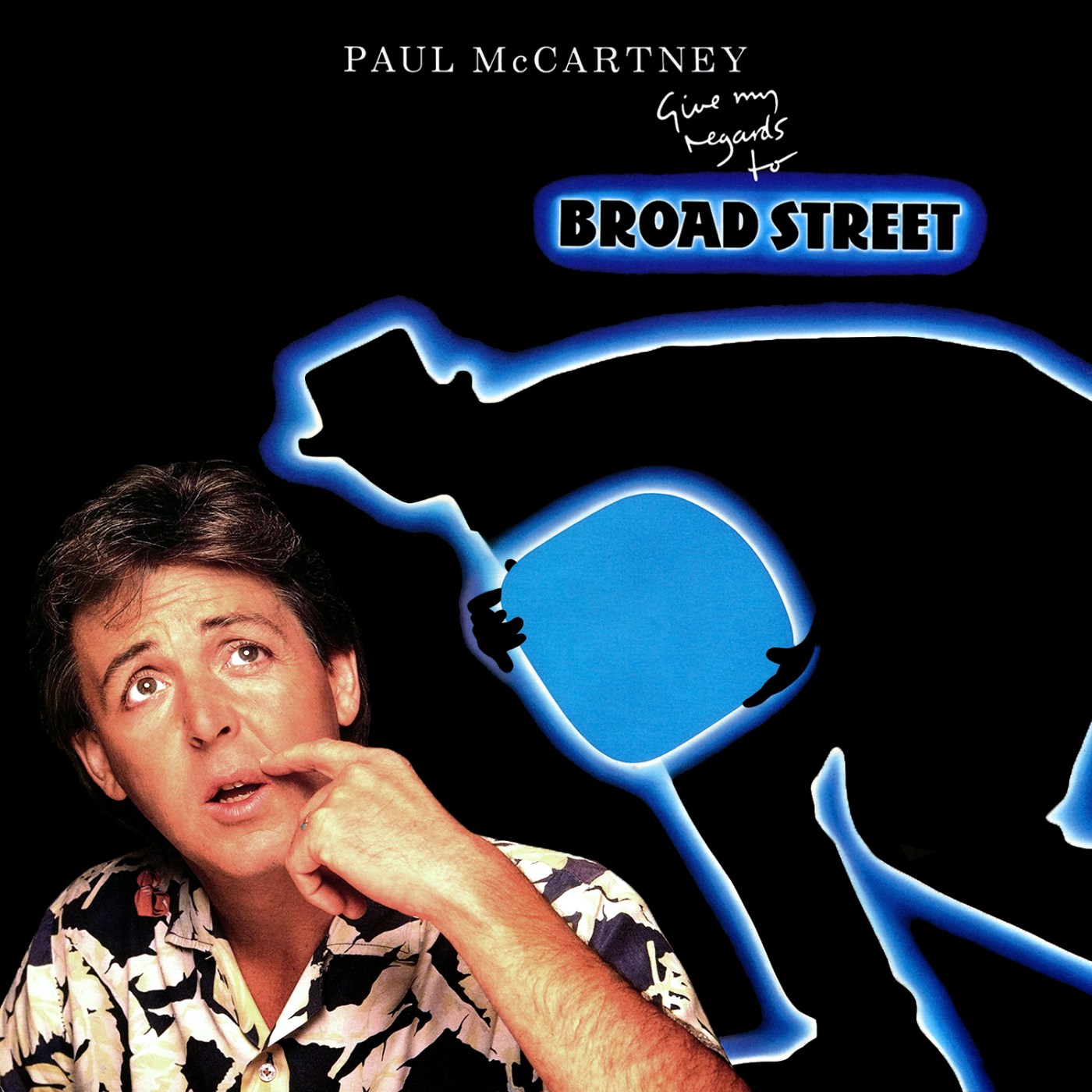
And then there’s Give My Regards to Broad Street. Released in 1984, Broad Street attempts to do for Paul and Linda what A Hard Day’s Night did for the Beatles twenty years earlier: present a fictional day in the life of Paul McCartney. Unfortunately for Paul thought, it didn’t work – part of what made AHDN so great was the chemistry between the four Beatles. Paul on his own, even with Ringo around to assist, isn’t nearly so magnetic.
Indeed, the reviews of the film were so bad that Roger Ebert, the legendary film critic, had this to say about the picture: “The usual thing is to see the movie and buy the sound-track. With “Give My Regards to Broad Street,” I think you can safely skip the movie and proceed directly to the sound track.”
But is the soundtrack as good as Ebert thought it was? Let’s hit play and find out:
‘No More Lonely Nights’: As with the Beatles movie soundtracks, we start off with the movie’s theme song – though notice I don’t use the phrase “title song” there. According to The Lyrics, it took not doing a title drop for him to find inspiration to come up with the rest.
Lyrically, it’s another of Paul’s many love songs, but the real stand-out performer on this track is David Gilmour, best known as the lead guitarist of Pink Floyd. Gilmour spent a large part of the mid-80s recording stuff outside of Floyd – you can also hear him on the songs “The Promise” and “Missing” by Arcadia, a spinoff of Duran Duran.
‘Good Day Sunshine’/‘Corridor Music’: Much like “I’ve Just Seen A Face,” this is another song that just luxuriates in the sheer joy of being in love, and being loved in return. The remake is pretty faithful to the original, down to George Martin playing the piano part. The drums sound a little off to me though… probably because it isn’t Ringo. (He reportedly refused to drum on any of the Beatle re-recordings.)
‘Yesterday’: On the opposite end of the emotional scale entirely, we have “Yesterday,” the most covered song in the history of popular music. I adore this song, and goodness knows I’ve had cause to think of it quite a bit over the years, when applying it to my own relationships.
While the original version from 1965 featured just Paul, his acoustic guitar, and a string quartet, the remake is performed in a different key (F#) and swaps the strings for, of all things, a horn section. It’s at least tasteful (given that this is George Martin) but that’s not the same thing as being good.
Leave it to Paul to come up with an awful cover of his own song.
‘Here, There And Everywhere’: As well as being a Beach Boys pastiche, this is one of my favorite of Paul’s many love songs. The original from 1966 gets pretty heavy rotation in the Mactíre house, I can tell you that much. The remake is similar to “Yesterday,” acoustic guitar and brass. It’s performed in a lower key compared to the original – F# again. And as before, a real step down from the original, quality-wise. Horns are not an adequate substitute for the Beach Boys harmonies of the original.
‘Wanderlust’/‘Ballroom Dancing’: Quite why Paul decided to re-record songs that had only come out two years before I have no idea, but here we are anyway. “Wanderlust” does include Ringo, and is otherwise the same as the version from Tug of War, but with horns.
“Ballroom Dancing” is probably the first remake on an album full of them that actually works, but then it’s hard to screw up basic rock and roll. I still don’t understand why remaking it was necessary, but I like the tape echo on Paul’s voice.
‘Silly Love Songs’/‘Silly Love Songs (Reprise)’: Another re-recording, this time of the hit Wings single from 1976. It’s not bad, but I still prefer the original. It’s then followed by an atmospheric reprise, which I kind of like the sound of.
‘Not Such A Bad Boy’: One of the few originals on this album, it’s a great mid-80s rocker that almost didn’t get used in the movie at all, but Linda and Ringo insisted. Who can blame them? It’s a great song! Sonically, it sounds a bit like something I’d’ve expected to hear on the Eddie and the Cruisers soundtrack.
‘So Bad’: Yet another remake, this time for a song that had come out LITERALLY THE PREVIOUS YEAR. Originally issued on Pipes of Peace, I completely fail to grasp why Paul couldn’t have just used the original recording and lip-synced to a backing track, like in A Hard Day’s Night.
‘No Values’/‘No More Lonely Nights’ (Ballad Reprise): Historically, very good things have Paul McCartney’s dreams – previous incidents have led directly to songs like “Yesterday” and “Let It Be.” “No Values” is no exception, originating in a dream about a Rolling Stones concert where a song involving the line “No values, seems to me that you’ve still got no values…” was involved. And after making sure the Stones hadn’t done it, Paul decided to write it himself. And it works really well!
‘For No One’: In the surprisingly large tapestry of Beatles breakup songs, this one has always been one of my favorites. I love the melody, the horn solo, the lyrics… they were all really skilled at writing break-up songs, Paul especially. On this version, the horns are replaced by strings – the exact opposite of the “Yesterday” remake. It’s a neat effect, and I kinda like it. (The horn solo is still here though!)
‘Eleanor Rigby’/‘Eleanor’s Dream’: This version of the song is very faithful to the original, but Paul takes a much different approach to his vocal work here than he did in 1966. His voice has deepened considerably in the ensuing 20 years, allowing him to hit lower notes here than he could’ve done prior to 1968 or so.
‘The Long And Winding Road’: One of only two songs from this album not to have originated on Revolver, this track was written by Paul in 1968 and first recorded during the Get Back album sessions. It ultimately became the Beatles’ final single, issued in May 1970 alongside the Let It Be album.
You’d think that after hating Spector’s mix of the song for fourteen years, Paul would take the opportunity to record a version with a simpler arrangement, like the various alternate cuts of the original that have been floating around over the last 30 years… but instead, not only is there another horn section, it’s based on Spector’s arrangement, transforming this soulful ballad into a veritable festival of cheese.
Good fucking grief, Paul.
‘No More Lonely Nights’ (Playout Version): A great song wrecked by a terrible dance arrangement that veers into disco in places.
‘Goodnight Princess’: An instrumental track to finish that sounds a bit like something you’d expect to hear from 1930s big band albums – think Freddy Nagel and that whole period. It’s nice, especially if you like George Martin’s arranging skills, and a much-needed break from the entire rest of this album.
“Well that’s it. Thank you for joining us. We hope you’ve had as much pleasure listening as we have had making it for you,” says Paul in the spoken-word opening to “Goodnight Princess.” Since he brought it up, I feel I may as well respond to him directly.
Between the two of us, sir, I think you probably had more fun making this thing than I had listening to it, because if I may be brutally honest? That was one of the worst hours I’ve ever had listening to music. To be fair, there are tracks here that work, and I’m sure you can tell which ones those are by my write-ups.
But those moments of brightness don’t change my overall view of this record: it’s absolutely one of the worst albums I’ve ever listened to, and I sat through John’s Some Time in New York City. Apparently, the film this soundtrack came from was the last time Paul tried to star in a movie of his own making, and even he has acknowledged since that the idea didn’t work.
Gods. What a disaster. It’s extremely Eighties, this album, and not in a good way. No wonder this thing failed to do very much in the US album charts.


Leave a Reply