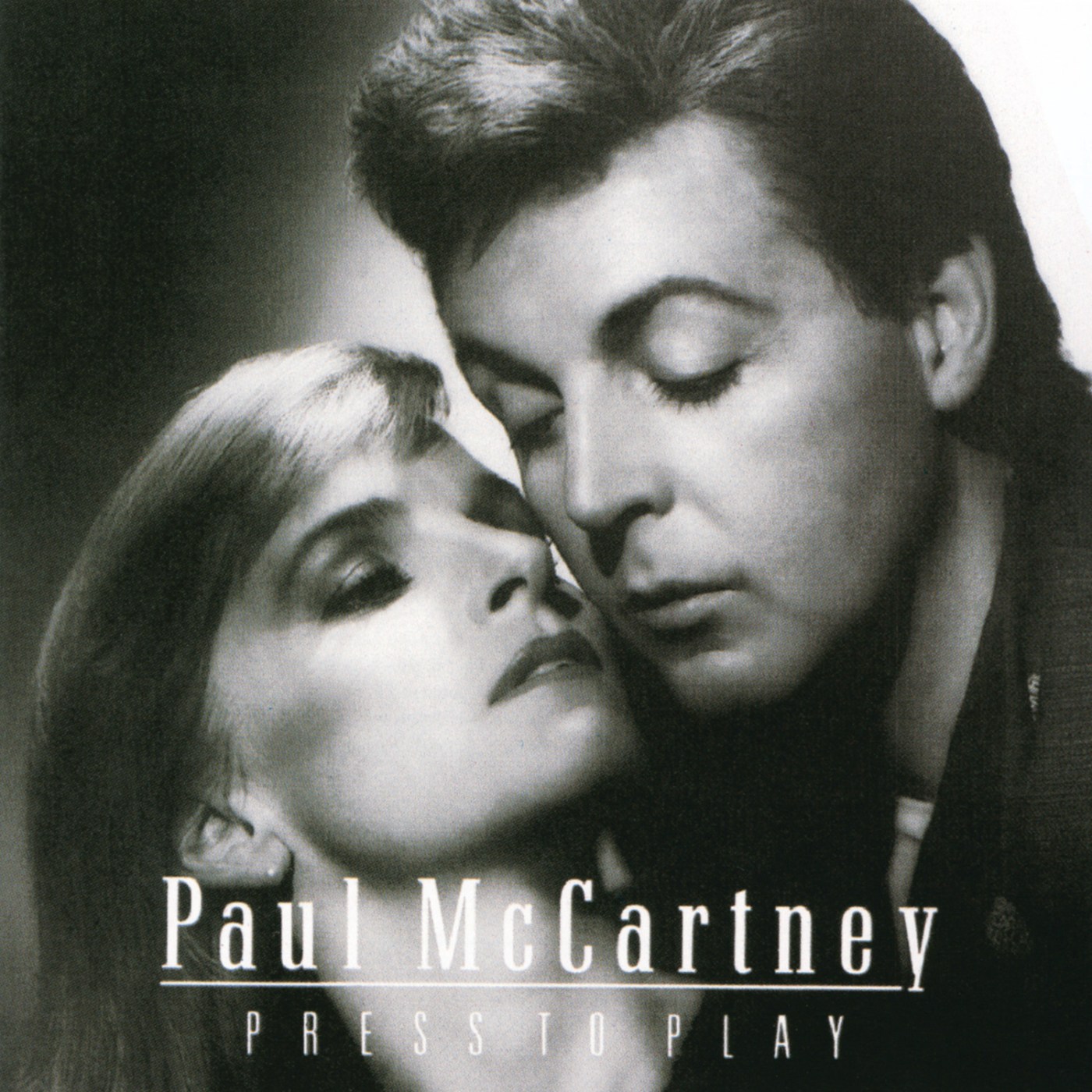
By 1986, Paul seems to have realized that the music world has largely passed him by. To quote Beatles Bible, “Following the critical drubbing and mixed commercial performances of Pipes Of Peace, Give My Regards To Broad Street, and the standalone UK single ‘We All Stand Together’, Paul McCartney needed a critical and commercial hit in order to revitalize his career and reputation. Press To Play found him rethinking his musical direction, bringing a slick, modern feel to his writing and recordings.”
After all, this was the era of bands like Duran Duran, Spandau Ballet, Joy Division, and the Clash, and the time of synthesizers, heavily processed vocals, and electronic drums like the models Simmons made, and Roger Taylor used to great effect on DD’s Rio album. The particular aesthetic of 1980s music was well established by now, so if there ever was a time to update Paul’s sound, 1986 was it.
Let’s see if he pulls it off:
‘Stranglehold’: Co-written with Eric Stewart, this is a wonderful rock song anchored by that wonderful 1980s drum sound and the guitars played by Eric and Paul, to say nothing of the lead vocal. The sax parts feel somewhat reminiscent of Duran Duran’s “Rio,” adding to the glorious Eighties-ness of it all.
‘Good Times Coming’/‘Feel The Sun’: In which Paul repeats his old Beatles trick of combining two unfinished pieces into a cohesive whole. This song is reminiscent of “Good Day Sunshine,” but it’s more reflective than that track was. It picks up dramatically in the last third or so of the song as we move into the “Feel the Sun” portion – I think this one is probably my favorite.
‘Talk More Talk’: A more experimental, surrealist song that sounds a bit spooky at the beginning. The main body of the song sounds a bit like Genesis, which is funny considering both Peter Gabriel and Phil Collins appear on this album.
‘Footprints’: A melancholy winter song now, with Paul playing acoustic guitar. It feels a bit like a 1980s version of “And I Love Her,” sonically speaking, though with a morose set of lyrics about a lonely old man – shades of “Eleanor Rigby” here.
Paul explains, “The song was written on a snowy day. It came from an image of a magpie looking for food out in the snow. Eric and I changed the magpie to an old man, although the magpie came back for the third verse.”
‘Only Love Remains’: It’s not a Paul McCartney album without a ballad, and this one is really pretty. It includes a string section arranged by Tony Visconti, best known for his work with David Bowie, but he’s done work for Paul before – that’s his arrangements on Band on the Run. It lends the song a cinematic quality that meshes quite well with the album cover art – a throwback to 1940s photography taken by George Hurrell.
‘Press’: The album’s lead single, and frankly you can tell because it sounds incredible. I think it might be my favorite track on the album, tied with “Stranglehold.” Like, when you picture the best of 1980s synth pop, this is right up there with early Duran Duran for me, while the guitar solo feels like it’s been lifted out of a Pat Benatar song.
‘Pretty Little Head’: Another experimental song from Paul now, soaked in an otherworldly atmosphere that calls to mind “In the Air Tonight”. Paul’s vocal is decidedly indistinct (kind of like early REM) but who cares? It’s an absolute vibe, this song – I can’t help but love it!
‘Move Over Busker’: Back to the rock side of the equation now, with a song whose guitars are so hot I half expect them to give me second-degree burns! Paul notes, “That’s got a good American rock ‘n roll feel to it.. .There’s a bit of harmless sexism in it: that strong British tradition, you know, of seaside postcards. Nell Gwynne, well you know the archetypal image of her, with her oranges and all!”
‘Angry’: True to its one-word title, this is one of the angriest songs Paul’s written since “Helter Skelter,” but it sounds weirdly happy as well – maybe it’s the presence of rock greats Phil Collins on drums and Pete Townshend on guitar. Paul delivers his lyrics at such a rapid-fire pace I had to look them up to find out what he was singing! I only wish the mix was a bit punchier though – needs more low-end.
‘However Absurd’: A fun thought experiment in Beatles circles is to imagine what the band might’ve sounded like had they continued working together past the 1960s. Obviously, most of these thought experiments stop at 1980, since past that, you’d have to also imagine a world where John wasn’t murdered.
But if there’s a song that best answers the question of what a Beatles song from the 1980s would sound like, I think this one is probably it. As no less than Paul himself has noted, the intro sounds a bit like “I Am the Walrus,” while the end of the song takes the track into a decidedly “Hey Jude”-like direction, with Paul’s vocal drenched in flange effects and synthesizer strings. It’s amazing.
I wouldn’t say that Press to Play is one of Paul’s best works – as I’ve noted before, the 1980s were a rough patch for him. But I think it has a better grasp on what makes the music of this decade sound the way it does than Broad Street did. In its way, it’s just as experimental as McCartney II, but with more polish.
I think in the end, Press to Play is an interesting snapshot of where Paul was at this point in his career – used to being ahead of the curve, he now found himself playing catchup. I don’t think the heavily computerized aesthetic really works for him in the same way as it did for other bands of the time, but that’s okay. Where Paul McCartney is concerned, there’s always more where that came from.


Leave a Reply