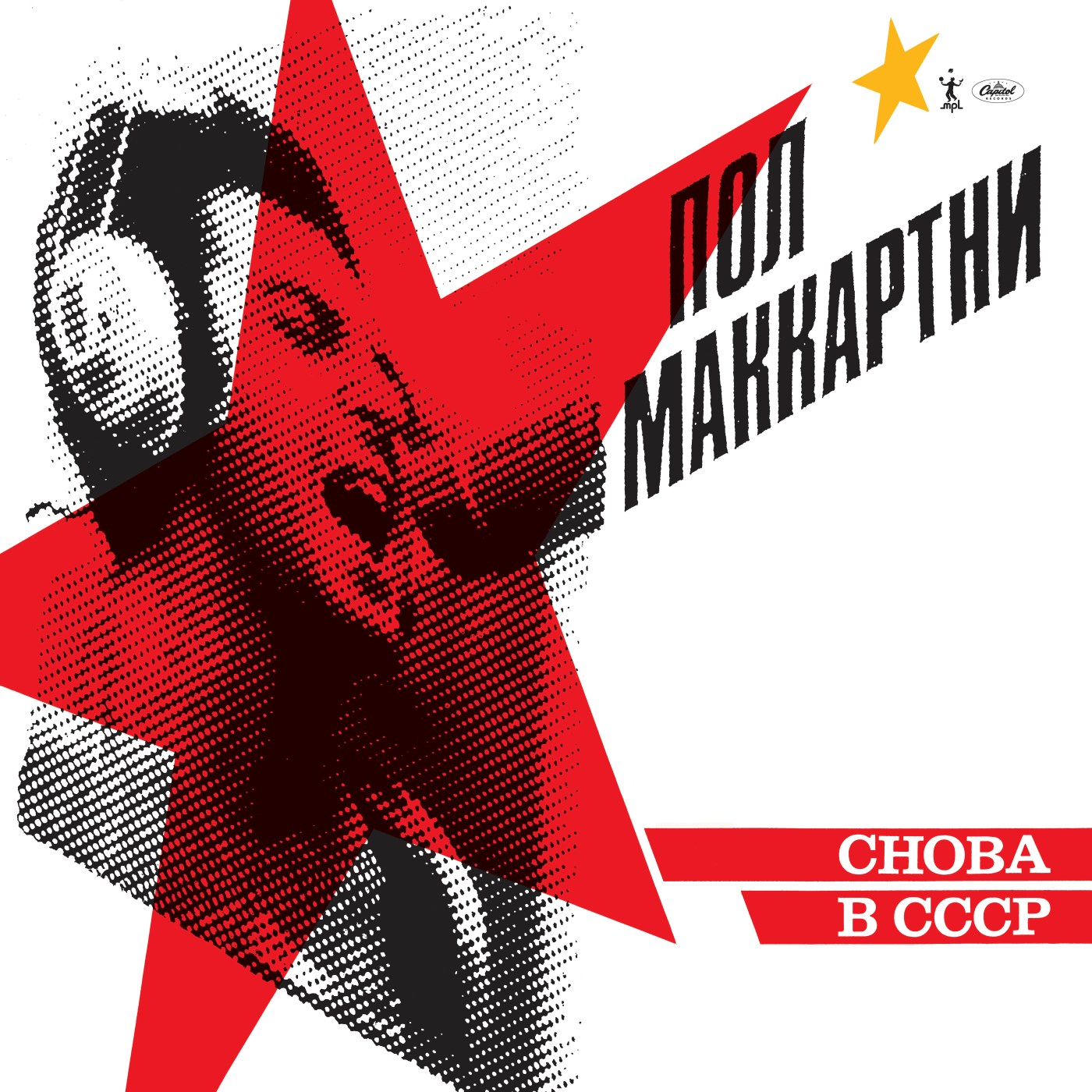
This week, a true rarity in the wider Beatles oeuvre: the first and only album to be recorded and released for, though of course not in, music fans in the Soviet Union. Paul’s name and the album’s title are both rendered in Russian, naturally – in English, this album is called (what else) “Back in the USSR,” though the namesake track from the White Album doesn’t appear here.
What we have is essentially Paul’s version of John’s Rock ’n’ Roll from 1975 – a Beatle covers the rock and roll hits of his youth. Wikipedia notes that “Following a series of jam sessions with various British musicians where they played some of his favourite songs from the 1950s, McCartney decided to record the songs live in the studio.” So, over two days in July 1987, that’s exactly what he did. But where does the Russia stuff come in?
Well. Beatles Bible notes that “Since Western rock music was banned by the Soviet state, music lovers there had for many years been forced to make do with illegal bootlegs, low quality copies or smuggled imports, McCartney wished to give his fans there something that was unavailable elsewhere, and with his manager Richard Ogden discussed the idea of issuing a record.”
And after some discussions with Melodiya, the album was released in Russia in October 1987, with a worldwide edition (with 3 bonus tracks) being issued in 1991, just prior to the formal dissolution of the USSR. It was later reissued in 2019, with the original 1988 tracklist.
So! In the interest of historical accuracy, let’s go through this album as Paul’s Russian fans would’ve heard it way back when:
‘Kansas City’: Astute Beatles listeners will remember that “Kansas City” has been sung by Paul before, all the way back on the Beatles for Sale album as part of a medley with “Hey, Hey, Hey, Hey.” He does it again for this song, turning in a vocal performance that is relatively restrained compared to 1964, but no less attention-grabbing.
‘Twenty Flight Rock’: As we all know, this is the song Paul performed for John shortly after they met for the first time in 1957. He was fifteen at the time, and John (naturally) was suitably impressed with performance. 30 years later, we get to hear Paul play this one in full, and he’s clearly having the time of his life.
‘Lawdy Miss Clawdy’: A Fats Domino song now, AKA the number that introduced the New Orleans sound to the world. Paul, no stranger to Domino and his work, turns in a performance that manages to blend the rhythm of the original with late ‘80s hard rock, and I like it a lot.
‘Bring It On Home To Me’: This song is one of two on this album that also appear on John’s Rock ’n’ Roll. John’s version is a little faster than Paul’s, but I think as a performance, I actually prefer this one to John’s, at least for now. (That may change if Sean Lennon remixes it like he did Mind Games.)
‘Lucille’: This is another song that was recorded by the Beatles and sung by Paul, though it never appeared on a studio album. Instead, it was performed on BBC Radio, seeing only an album release on the first Live at the BBC collection in 1994. (The second volume from 2013 includes a version of the song as well.)
Paul seems to be trying to emulate his earlier performance on this version, and it just about works, but not as well as it might have – his voice has just deepened a bit too much. Still, it’s a spirited performance!
‘Don’t Get Around Much Anymore’: From Wikipedia: “Don’t Get Around Much Anymore” is a jazz standard with music by Duke Ellington and lyrics by Bob Russell. The tune was originally called “Never No Lament” and was first recorded by Ellington in 1940 as a big-band instrumental. Russell’s lyrics and the new title were added in 1942.” Paul’s version may not be particularly jazzy, but it still rocks pretty damn hard! I will also note that this is the first song with a fade, rather than a clean ending.
‘That’s All Right (Mama)’: Best known as Elvis Presley’s debut single, Paul understandably turns in a vocal performance that’s as close to an Elvis impression as he can get – and that’s pretty far, thanks to how his voice has changed. It’s pretty good!
‘Ain’t That A Shame’: The other song to have been performed by both John and Paul, Paul’s version is dominated by piano to a greater degree than John’s was, though I think I still prefer John’s version performance-wise. In terms of mixing though, Paul’s is better. Also note the echo on Paul’s vocal before the two big solos!
‘Crackin’ Up’: Per the Paul McCartney project, “Crackin’ Up” is a song written by Ellas Bates, better known professionally as Bo Diddley. It serves as the opening track of Bo Diddley’s second studio album, “Go Bo Diddley,” released in July 1959. According to Mark Lewisohn in “The Complete Beatles Chronicle“, The Beatles performed “Crackin’ Up” regularly between 1960 and 1961, with Paul McCartney on lead vocals.” We don’t have any recordings of those 60s performances, but we do have this, and Paul clearly knows the material very well.
‘Just Because’: The second of two Elvis songs on this album, the King recorded this song at Sun Studios but it wasn’t actually released until after he made the jump to RCA, where it appeared on his eponymous debut album. Paul’s version replicates Presley’s take, as before.
‘Midnight Special’: From Wikipedia: “Midnight Special” is a traditional folk song thought to have originated among prisoners in the American South. The title comes from the refrain, which refers to the passenger train Midnight Special and its “ever-loving light.” It’s a more restrained performance here than we’ve had, but I like it! Quoting the liner notes, “Paul’s easy-action version retain elements of its original blues roots by way of his nimble acoustic guitar pickin’.” Just listen to that solo!
It’s hard to say where this album fits in the larger tapestry of Paul’s career, since it really is just a quick covers album he threw together and decided to release in Russia for thrills. But as a loving tribute to the early days of rock and roll, I think it’s a good one. Certainly, it suits Paul’s musical instincts better than Press to Play did.
Next week, we close out the 1980s with Flowers in the Dirt, the album that sees Paul collaborate with another Elvis (Costello) and break out of the slump he’d been in since 1983.


Leave a Reply