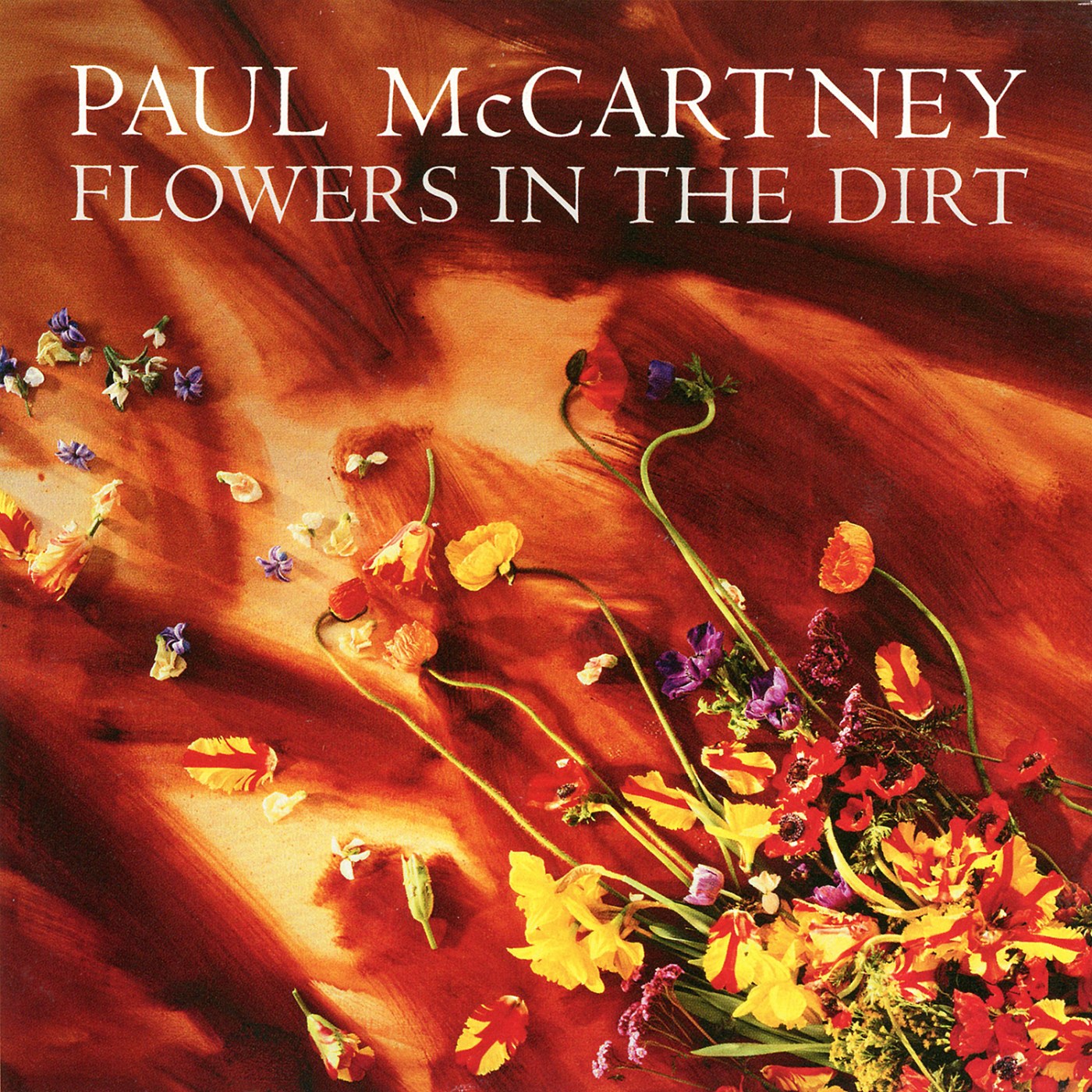
1989 represents something of a turning point in the wider arc of Paul McCartney’s solo career, at least to me. It’s the first glimpse of a career renaissance that, while it doesn’t truly start until 1997’s Flaming Pie, still shows that Paul has plenty left in the tank, musically speaking. Even on this album, working with Elvis Costello seems to spark some life into Paul’s work, and at a critical time.
In some ways though, Flowers in the Dirt also marks an ending. It’s the end of the career slump that he’d been stuck in for most of the 1980s, and it’s the last album where we’ll get to hear the person I’ve come to think of as mid-stage Paul, in terms of his singing.
Let me break this down: Early Paul, the choir boy who can go from a screaming Little Richard number to a touching ballad in the span of an afternoon, can be found on Beatles releases stretching from their very first single in October 1962 to Sgt. Pepper and Magical Mystery Tour albums from 1967.
Mid-stage Paul begins roughly with “Back in the USSR” from the White Album, as that’s when his voice notably deepens – it’s also evident on “Get Back,” “Let It Be,” and “Oh! Darling.” This remains consistent for the next twenty consecutive years, with only a slight shift in the 1980s. Come the ‘90s, we’ll get to hear late-stage Paul – everything from Flaming Pie to McCartney III. (One could argue that his increasing creakiness from around Kisses on the Bottom marks a fourth stage – but we’ll get to that later.)
For now, back to Flowers in the Dirt proper. Nobody really liked Press to Play very much, but Снова в СССР proved to be a success for Paul himself, creatively speaking. But it was working with Costello that would prove to be the spark that lit the match – Costello, Paul has said, reminds him very much of John, and their songwriting process was reminiscent of what he and John did together in the Sixties.
And, well, they met in 1982, just a couple years after John died. Perhaps John watching his grieving friend from the Otherworld, pushed Mr. Costello toward him to, as the old line goes, “take a sad song and make it better.”
Let’s see what they got up to:
‘My Brave Face’: If there were still such things as New Beatles Songs in 1989, this track really does sound like something that John and Paul would’ve written together. It is very easy for me to imagine a version of this song as a kind of late-Eighties update of “We Can Work It Out,” with Paul taking the verses while John sings the descending parts, since they fit his whole “a bit of darkness to counter Paul’s sunshine” schtick so well. It is absolutely fucking magnificent, and a tribute to Costello’s skill that he was able to fill John’s shoes so smoothly.
Seriously, go and listen to this demo take. Costello sounds so much like John that Paul freaked out a little. It’s *amazing.*
‘Rough Ride’: A blues number this time, which Paul worked on with Trevor Horn of Frankie Goes to Hollywood fame. (And Yes fame. And The Buggles fame.) Maybe it’s the brass and the rhythm, but it feels more like a jazzy number to me, to say nothing of what Paul does with his vocal. He goes up and down through his range, even throwing in some scatting in.
‘You Want Her Too’: More of Paul and Costello here, which means it is, if possible, even more Beatles-y than “My Brave Face” was. And that isn’t just my opinion, Paul kept talking about it! This time, we have a circus-y opening guitar part that sounds reminiscent of “Being for the Benefit of Mr. Kite,” a bridge section that while it doesn’t evoke any particular Beatles track, sounds like something they’d do, and of course, Paul and Elvis sing this song together as a duet, with Elvis pulling out a spectacularly snide vocal that sounds like he has John’s spirit inhabiting him.
Lyrically, the two singers are competing over a girl again, like on “The Girl is Mine.” This sounds like what a Beatles version of that track would’ve been.
‘Distractions’: A gorgeous love ballad with strings by Clare Fischer, best known for his work on Prince’s record label. The song centers around, well, all the things that keep us from spending time with our loved ones – boy, does it hit differently now that I’m a married woman whose life is filled with such things. Also listen for a guitar solo that reminds me very much of the one from “And I Love Her.”
‘We Got Married’: On the subject of weddings, here comes Paul with a song written specifically for married couples – inspired by not just him and Linda, but John and Cynthia too. He writes in The Lyrics, “I wrote this song many years after our wedding, and I started to think more universally, imagining every man and every woman getting married. It’s really the story of any marriage, not necessarily mine – though a lot of it could be mine.” It’s a beautiful sentiment, and I feel it more strongly now after my own wedding.
(And yes, that’s David Gilmour on guitar again, taking a break in between Floyd albums.)
‘Put It There’: Inspired by something his dad used to say, this is a tribute to both Jim McCartney and, I would argue, fathers in general. According to Beatles Bible, “The song was lightly produced, with few overdubs aside from an orchestral arrangement by George Martin. McCartney added knee-slapping percussion, seated on a stool at his Hog Hill Mill studio.” Sometimes the simplest approaches are the best ones.
‘Figure Of Eight’: This is the first version of two, a co-production with Trevor Horn and Steve Lipson. Sessions for the song were contentious, in no small part due to Horn and Lipson making significant changes to the song without Paul’s authorization (where have I heard that before). Paul wound up remaking the song with members of his live band instead, and that’s the one that went out as a single.
‘This One’: A rocking love song built around a pun, between the similarity between “This one” and “this swan.” Paul notes, “The song is basically a love song – did I ever say I love you? And if I didn’t it’s because I was waiting for a better moment… ‘There could never be a better moment than this one.” It’s cute!
‘Don’t Be Careless Love’: A spectacular melody written by Paul and Elvis Costello that goes in some very strange and dark places. Costello said in 2015, “One of the most beautiful melodies that he had brought to our writing sessions and into which we had inserted the horrifying images of a nightmare. It was probably the weirdest song we’d written together.”
But the really impressive thing about this song? It’s Paul doing a falsetto vocal unlike anything he’s ever done before or since, and all in one freaking take. Absolutely everyone was impressed with that, and why wouldn’t you be? He’s Paul McCartney, he can do anything.
‘That Day Is Done’: The final Costello collab, this song is decidedly funereal – which makes good sense considering it was about a funeral held for Costello’s grandmother. When he brought it in for Paul, something incredible happened: “He said, “It needs something like this…” and he just sat down and played the chorus. It was sort of like a moment, like Let It Be, the creation of a semi-secular gospel song.” That, folks, is Paul’s talent in a nutshell – the guy just pulls great musical moments from nowhere and before you know it, you have a classic.
‘How Many People’: Per Beatles Bible: “The song was dedicated to the memory of Brazilian trade union leader and environmentalist Chico Mendes, who was assassinated on 22 December 1988. It was, however, written prior to Mendes’s death.” It was written in Jamaica while Paul was on vacation, which explains the reggae-esque feeling of the track.
‘Motor Of Love’: Clocking at six and a half minutes, this song is the recipient of another bit of Impossible McCartney Magic. Chris Hughes, who produced the track, said: “We ran down the track, and literally, as it got to the blank bit, he started playing, and humming, and played it and finished it and rounded it off into the track. It was astounding, it was one take.”
It’s the most soft-rock coded song on the whole album for me, but what keeps it from being as awful as, say, “My Love” from Red Rose Speedway is the heart and soul Paul puts into his vocal performance. Who cares if the backing sounds like something you’d hear at a dentist’s office? That voice is incredible, babes!
‘Ou Est Le Soleil?’: Paul dusts off his love of French for this song, which apparently means “Where is the Sun?” He explains, “A very wacky thing where we decided to make something up. Trevor said ‘Have you got anything for one of the verses?’ I said ‘Well I’ve got this really silly idea…’, which is like just some French words that say ‘Ou est le soleil? Dans la tête. Travaillez.’ Those are the complete lyrics. So we’ve got this silly French dance track now, which I love!”
The end result really is something that sounds like Frankie Goes to Hollywood – it’s silly and goofy, but who cares? You could slide this in next to some of Duran Duran’s “night version” remixes and it wouldn’t be a bit out of place! I just wish it had a clean ending though, rather than a fade.
When it was released in June 1989, Flowers in the Dirt revitalized Paul’s reputation, topping the charts in his native UK. This was followed by the swift assembly of a new live band for a world tour, his first since the giant Wings one in 1976. The results would be chronicled on the live album Tripping the Live Fantastic.
As for my thoughts? Flowers is a fantastic album, but in a completely different way from Tug of War – it’s a reminder of what exactly Paul can do when everything comes together in the right way. He used to be a Beatle, after all, and after spending most of the ‘70s and ‘80s running away from it, it’s a genuine relief to see him embrace his past.


Leave a Reply