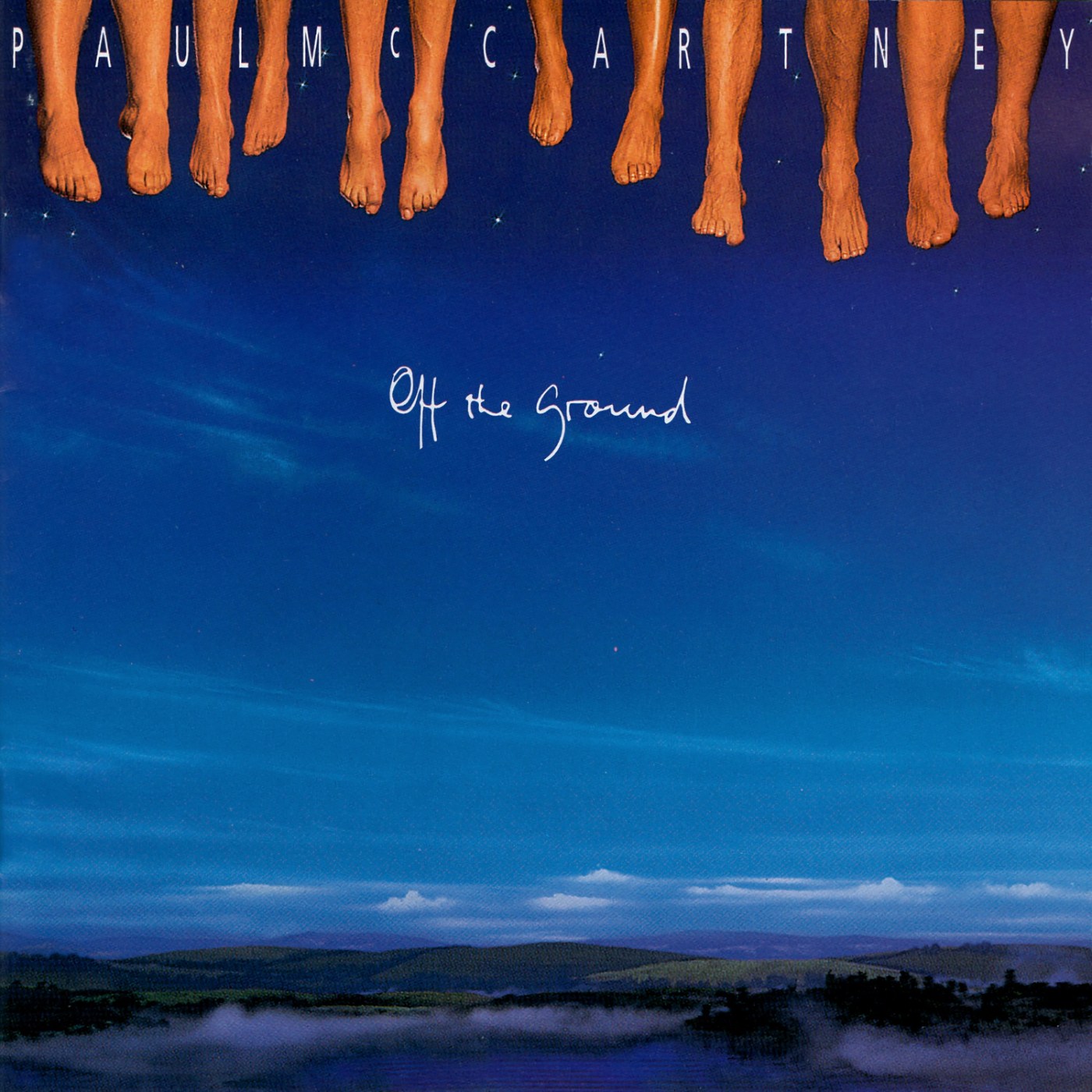
By the time this album was released in February 1993, Paul had just hit his 50th birthday. In fact, the age difference is alluded to on the cover of Paul is Live. Featuring Paul parodying the Abbey Road cover, not only is he wearing the same suit as on the original (while being barefoot) the license plate on the Beetle in the background has been changed to read, “51 IS,” rather than “28 IF.”
Hitting the big 5-0 will go on to have ramifications for how Paul’s voice sounds later in the decade, as it’s around the 1990s that his range starts to narrow into something more mature, and less choir boyish. This process happens surprisingly quickly: just listen to his performance of “Here, There, and Everywhere” on the Unplugged live album, and he really has to try and hit those high notes that he was able to do with no issue in ’66. Time has caught up with him at last.
Still! Paul wasn’t going to let a little thing like age slow him down. Buoyed by the success of his 1990 world tour, Paul went back into the studio in 1991 with his touring band to cut a new album. Rather than doing painstaking layered recordings like he’d been doing since Help! with the Beatles, Paul decided to get back to playing live-in-studio – an approach that had also suited him well on Снова в СССР.
Let’s see what he gets out of it this time:
‘Off The Ground’: The title song for the album starts us off, though it wasn’t originally meant to be. On this song, Paul “Wix” Wickens convinced Paul to enter the ‘90s and do some work with modern computer technology, rather than committing everything to four-track tape. Initially reluctant, Paul went for it anyway, and the end result was this fabulous breezy rock song with just a bit of funk to it. Paul’s daughter convinced him to name the album after the song, and lo, the rest was history. Welcome to the Nineties, Paul!
‘Looking For Changes’: Historically, Paul and political songs have had a mixed success rate, to say the least. For every all-time classic like “Blackbird,” there’s a real clunker like “Give Ireland Back to the Irish,” a 1972 Wings single that tried to be Paul’s response to the same Bloody Sunday attack in Derry that inspired John’s “Luck of the Irish,” except it was a complete disaster, musically and lyrically.
The good news is, “Looking For Changes” is about something Paul actually understands – vegetarianism. At the time, Paul noted: “Protest songs are quite hard to do. Love songs come easier, at least to someone like me, but in this case I’d been looking through magazines like The Animal’s Voice and Animal Agenda, pretty heavy magazines that show some of the experimentation that goes on in the name of cosmetics, and started to write the song after I saw a picture of a cat with a machine implanted in its head.”
The end result? A protest song with a sense of humor and Paul’s first recorded use of profanity, just to grab your attention and get the point across. Now that’s more like it.
‘Hope Of Deliverance’: This is one of those songs where it suddenly becomes very clear that Paul’s voice has begun to audibly change. It’s much lower now compared to anything on, say, Flowers in the Dirt. Lyrically, it’s a lovely optimistic song, and I find that Paul’s deeper voice gives the track a bit more gravitas than it would’ve had even four years earlier.
‘Mistress And Maid’: It’s another one of Paul’s story-songs, co-written with Elvis Costello. Sadly, though, Costello doesn’t actually appear on the track, which is really too bad because I think it kind of needs his Lennon-esque vocal stylings on the choruses. It’s a decent song, but probably not my favorite of the McCartney/Costello catalog.
‘I Owe It All To You’: France has always been a recurring fascination of Paul’s, as we’ll remember from the song “Michelle” on Rubber Soul, to his brief jaunt to Nice to film the “Fool on the Hill” part of Magical Mystery Tour. But now, the country itself gets its own song.
As Paul explains: “I’d been to a place in the south of France — the kids took us there for Linda’s birthday. I drove past this sign which said Cathedrale Des Images.[…] They have dozens of projectors and they throw these images on the walls suddenly the whole place lights up and it’s an Egyptian temple.”
The imagery of this song really is spectacular, I love it.
‘Biker Like An Icon’: The first song recorded for the album, and would you believe it’s a first-take recording as well? Paul’s always liked songs about cars, but this song about bikes started from Linda talking about cameras, and then it just went from there. I love it, it’s a story-song with grit to it.
‘Peace In The Neighbourhood’: A breezy R&B song, this is actually the rehearsal take – they wanted to do another one, but they ended up just sticking with the demo instead. What I like about this song is Paul doing one of his earliest moments of, as my wife often says, using his middle aged vocal range to his own advantage. He doesn’t sound like he’s 40 anymore, and he doesn’t try to.
‘Golden Earth Girl’: A ballad for Linda, centered around nature and the many treasures found on our wonderful planet. It includes an orchestral arrangement by Carl Davis, who’d worked with Paul on his classical album Liverpool Oratorio.
‘The Lovers That Never Were’: The second and last McCartney/Costello collaboration, and it was in fact the very first song they wrote together. Costello is a particular fan of the demo version, released back in 2017 on the expanded version of Flowers in the Dirt. (Personally I’m partial to the album version, especially that huge drum sound.) It’s a shame their partnership didn’t go on for very long, but what a promising way to begin… and to end.
‘Get Out Of My Way’: One of the great things that comes from Paul just going into the studio and play live to tape is you get songs that feel raw. This was his attempt at writing a straight-forward rock song, it’s got a hard-driving beat that would be impossible to capture in a traditional overdub-heavy recording process, to say nothing of that guitar solo!
‘Winedark Open Sea’: Nothing much to say here, just Paul alluding to Homer (as in the ancient Greek epics, not Simpson) for a song that sails along as easily as a boat does through the titular waters.
‘C’Mon People’/‘Cosmically Conscious’: Our final track is actually two! Sneaking in a hidden song is something Paul’s done since Abbey Road. That was the original idea of “Her Majesty,” after all, as original pressings of that album didn’t add it to the tracklist like they do now. It’s a trick he’ll do again on 2005’s Chaos and Creation in the Backyard.
“C’Mon People” is a bright and optimistic song with Paul finally deciding to embrace his past as a Beatle, down to an orchestral score by George Martin. He noted at the time, “I think of it as very Sixties, a bit Beatley; I used to resist any Beatles influences in my writing, thinking that I’d done that bit in my career and that maybe I should now do something completely different, but that means denying some stuff that might be very good.”
And he’s fucking right. When you’re a Beatle, and there are only three of those left now, (Paul, Ringo, and Pete Best) you’re not going to be able to avoid referring to them even in your solo projects. The choruses on this song in particular are practically crying out for some John/Paul/George three-part harmonies, if you ask me.
Speaking of the Beatles, “Cosmically Conscious” reaches right back to the band’s India period of early 1968, as that was when this song was written. It was inspired by phrases that Maharishi Mahesh Yogi would often say, including the title phrase.
An interesting tidbit from the Paul McCartney Project: “Cosmically Conscious” has been played live only once, during the Change Begins Within benefit concert in April 2009. This event raised 3 million dollars for the David Lynch Foundation’s cause of teaching one million children the technique of Transcendental Meditation (TM).” Which ought to be of interest to my friend, and noted Lynch fan, Freezing Inferno. 🙂
Off the Ground didn’t exactly set the world on fire when it came out in early 1993, and I don’t really understand why. PAUL FUCKING MCCARTNEY turns in one of his breeziest albums in years, with its US release coming 29 years to the day since the Beatles’ first Ed Sullivan appearance, and all it did was the top 5 in the UK album charts.
Well, okay, the album was unexpectedly huge in Germany of all places, where it got to #2 on their official albums chart. But still! What the hell, rest of the planet?!
What I like about this album is its secret ingredient: the touring band. Wings might’ve had some success in the 1970s, but as I’ve said before, Wings was also a group dominated by two conflicting desires of Paul’s: the need to play with other musicians and collaborate with each other, and the need to be In Charge at all times. This is how you get to Wings largely feeling like Paul’s backing group until he finally started letting Denny Laine sing.
With the touring band, you don’t have that problem. The band’s entire job is to back Paul up, and while that obviously works great in a live context, in a studio setting you get a band that’s already very tight, performance-wise. The pre-Band on the Run Wings albums were very inconsistent, not least because the lineup kept changing on every other record.
But here, the only new guy is Blair Cunningham, who played the drums. Everyone else was used to working with Paul because they were part of the World Tour, or they were married to him, in Linda’s case. So what you get is one of the smoothest listens Paul has ever released, with not a bad song to be found. And yet, it’s criminally underrated!
Oh well. As the ‘90s progress, Paul will remind the world exactly who the fuck he is, and that means getting back together with George and Ringo for the Anthology project – AKA, the thing that launched the second wave of Beatlemania, and led directly to the tidal wave of Beatles releases we’ve been enjoying ever since.
But there are other effects too, and having covered the Anthology in detail already, including the 2020s reboot, that means I get to jump right ahead to the after-effects, which in Paul’s case? This means I get to write about an album I’ve been dying to sink my teeth into.
Next week: 1997’s Flaming Pie.


Leave a Reply