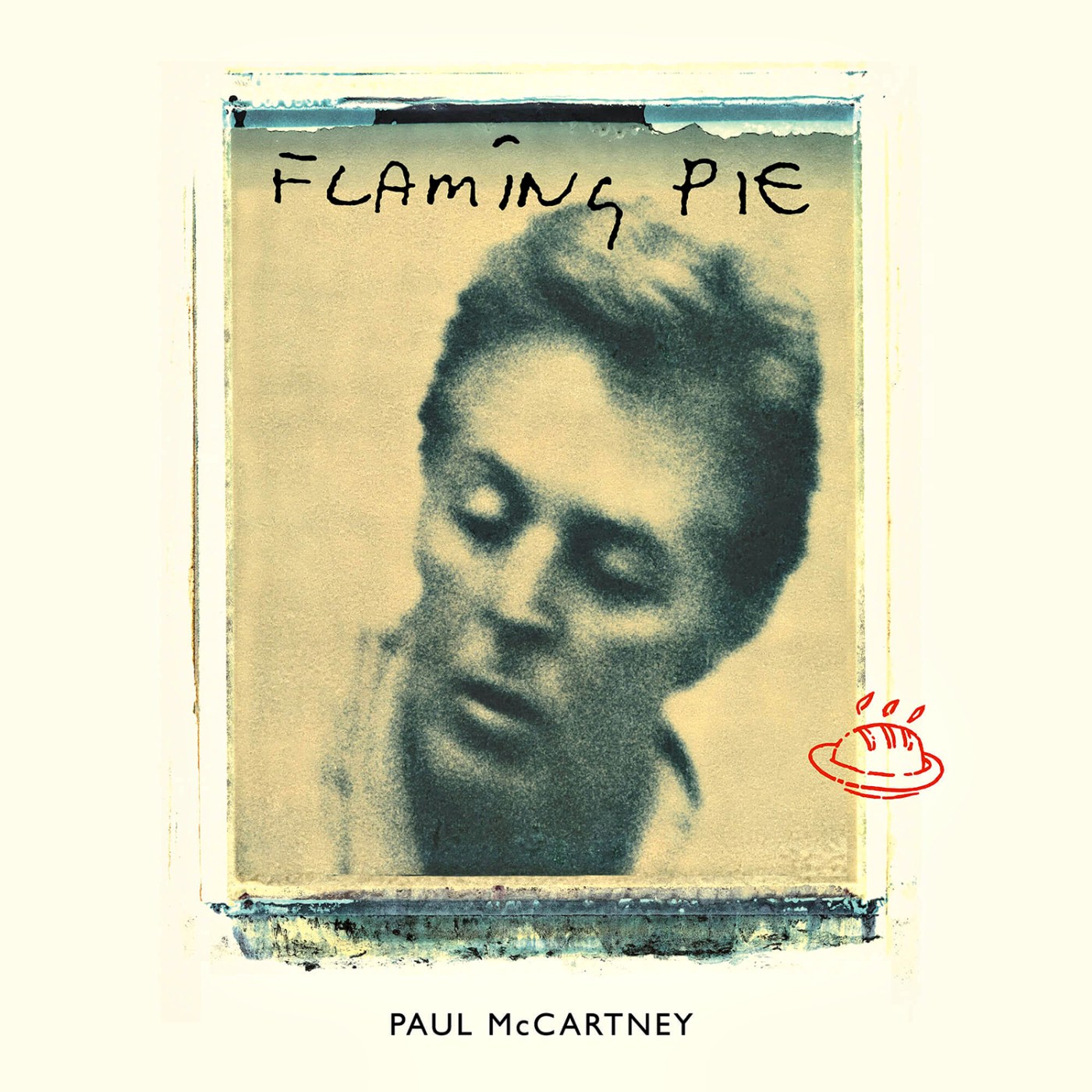
To say that the Anthology project revitalized Paul McCartney’s solo career and his artistic muse is something of an understatement. He said at the time, “I came off the back of The Beatles Anthology with an urge to do some new music. The Anthology was very good for me because it reminded me of the Beatles standards and the standards that we reached with the songs. So in a way it was a refresher course that set the framework for this album.”
Flaming Pie isn’t just a new Paul McCartney album – it’s the first album we have from him where he isn’t afraid to embrace his past as a Beatle for more than a few songs. It’s one thing when he’s just covering old material, like he did on Give My Regards to Broad Street, and quite another when he does new stuff with some Beatle trade marks. On each of his last three original albums, he really had to convince himself that it was okay to do some Beatles-adjacent stuff again.
But by the time of Flaming Pie, he no longer needs that permission. Thanks to the Anthology, there are now two more Beatles songs out there in the world, and the band has once again been made relevant – they’re not just a legacy act like they were in the 1970s, but a cultural touchstone that can speak to people now, whenever they happen to be listening.
So, on this album Paul goes all in on making a record like the Beatles used to do, allowing himself to have fun and not get too worked up about “staying relevant” or “proving himself.” He’s making music for the fun of it, and that leads him to not just turn out one great album, but begin a hot streak that has lasted for nearly 30 years. He doesn’t have to prove himself anymore, he’s fucking Paul McCartney! He can do whatever he wants!
One more note: This is also the album where, for me, Paul’s modern sound truly begins. There were flashes of it on Off the Ground, but Flaming Pie, released when he was 55 years old, is when the Paul McCartney I know and love comes fully formed. As someone who’s grown up listening to 21st century Paul, this is the voice I think of when I imagine Paul McCartney. Not Beatle Paul, not Wings Paul, but Paul as a middle aged to elderly man. This era of his music is my favorite, and I can’t wait to dive into it.
So, let’s get started:
‘The Song We Were Singing’: Fitting the post-Anthology nostalgia mood that he’s in, this song is transparently about the 1960s and all the happy memories Paul has from that time. He wrote it in 1995, around the time that the Beatles were recording “Real Love” and their first attempts at “Now and Then.” Driven mostly by his vocal and acoustic guitar work, for me it conjures a mental image of Paul sitting around a campfire – perhaps the one seen in some of his interview clips from the later Anthology episodes.
‘The World Tonight’: In which Paul finally sits down and deals with, through a layer or two of fictionality, the price of the enduring fame he’s sustained both as a Beatle and a solo artist. He said at the time, “A song about a person sitting at the centre of a circle, and everybody wants something from him? It could almost be me.”
But apart from that, it’s just a great sounding late-90s rock song. His lower register allows him to do shit with his voice that he couldn’t’ve done as a younger man, and when he hits those high notes on this song, it’s really satisfying.
‘If You Wanna’: When Paul was on tour in 1993, he decided to write a song that channeled the vibe of driving across America – or at least, what happens when an English guy does it. And sure enough, it rolls along perfectly – I can very easily imagine someone listening to this song as they drive through, say, Kansas, on a warm summer day with the top down on their convertible.
‘Somedays’: Over the decades, Paul has developed a trilogy about songs regarding various days. 1965 gave us mourning for “Yesterday,” 1971 was all about the brighter days of “Tomorrow,” and now in 1997 we have “Somedays.” It’s tonally closer to “Yesterday,” and though it can be about many things, to me it’s about aging, particularly the line “I laugh to think how young we were.”
And like some of Paul’s most heart-rending songs, it’s just him, an acoustic guitar, and a string arrangement by George Martin. Put those ingredients together and you can never go wrong.
‘Young Boy’: This song was recorded straight after the Beatles session for “Real Love,” with Paul enlisting the help of Steve Miller. The two of them first worked together on the song “My Dark Hour,” which allowed Paul to work out his Beatles frustrations by pulverizing a drum kit. This song is considerably happier, and it’s thanks to James McCartney (Paul’s son) that his father even reignited his work with Steve Miller in the first place. And I’m glad they did!
‘Calico Skies’: Paul was staying on Long Island in 1991 when Hurricane Bob made landfall in New England. A power outage inspired him to write this, a love song that turns into the gentlest protest song ever committed to tape during the third verse. Lovely, isn’t it?
‘Flaming Pie’: This is, for my part, the most Beatles-y song on the whole freaking album. Its lyrics are pleasantly surreal, based as they are on John’s equally surreal explanation of how the Beatles got their name. There’s a prominent piano part that I think may be the same piano from “Lady Madonna,” and it was engineered by Jeff Lynne, who worked on both of the ‘90s Beatles songs.
‘Heaven On A Sunday’: A relaxed little number written while Paul was on vacation, the song also includes a guest appearance from the aforementioned James McCartney on electric guitar. He was a teenager back then, which makes his shared solo with his dad all the more impactful. Early signs of talent, if you ask me.
‘Used To Be Bad’: Another McCartney/Miller collaboration, recorded in the wake of “Young Boy.” It’s a blues number that originated as a jam session, with Paul and Miller trading vocal lines. As Paul put it at the time, “This was just a jam, really. Steve whacked out these blues riffs, I got on the drums and we just went for it – a duet, sung on one mike. We did the vocal in one take.” It says something about how talented these two are that the first take is the one that made the album.
‘Souvenir’: This is another one of Paul’s “soul songs” – songs that he writes with the hope that a Black artist will cover it. “The Long and Winding Road” and “Let It Be” each got covered by Ray Charles and Aretha Franklin respectively, while “Souvenir” was intended for Wilson Pickett.
To truly get the feel of this song though, it helps if you listen to Paul’s original demo track, which includes things like a phone ringing halfway through the song and the sound of a tropical downpour. In the studio, Paul and Jeff Lynne tried to recreate the feel of the demo as closely as they could, so they used it as a guide.
‘Little Willow’: As we all know, one of the things Paul excels at it is writing music that, even if it was written with a specific person in mind, he still makes it accessible to anyone who may need that song at that moment in their lives. “Hey Jude” is the clearest example of this technique, being written to comfort Julian Lennon while John and Cynthia were getting a divorce.
“Little Willow” is working in a similar register, with the hope of cheering up the children of Maureen Cox – Ringo Starr’s first wife. She died in 1994, and though this is a tribute to her, Paul still tries to include everyone else in it as well. He said in 2020, “Even if I’m writing something very specific, I veil it. That’s just my way. It’s the way I’ve developed as a songwriter.” And it’s a way that works very, very well.
‘Really Love You’: Hear that drum sound? It’s Ringo again! This song really is just the Beatles’ rhythm section jamming along, with Jeff Lynne joining in on guitar, and a completely improvised vocal from Paul. It sounds fucking great, and it resulted in a Beatles-related first: a shared credit between Paul and Ringo. Gods, I love those two.
‘Beautiful Night’: This song originated back in the 1980s, around the same era as Press to Play, but Paul (ever the perfectionist) wasn’t happy with it. When Ringo arrived to drum on the Beatles songs “Free As A Bird” and “Real Love,” he and Paul got together to record this and “Really Love You,” with Ringo playing on a recreation of his own kit. And, naturally, it sounds fantastic. Beatle magic still exists, even with only two of them.
Sonically, the song is to this album what “Carry That Weight” and “The End” were to Abbey Road – a grand, epic finale with George Martin doing orchestrations, Paul being amazing, Ringo being spectacular (and even singing!) before reaching a climax with all the big-ness of “A Day in the Life.” But it’s not actually the end!
‘Great Day’: This song is, in fact, the actual last one. “Great Day” is the oldest song on the album, dating back to 1970 and the McCartney period. Given the sonic nostalgia trip that is Flaming Pie though, it serves as an acoustic ditty on par with “Her Majesty,” as Paul himself has stated in the album’s liner notes. Lyrically, it even harks back to 1963’s “It Won’t Be Long,” a song Paul wrote with John, and lead-off track on With the Beatles. Given that John inspired the album’s title, I can’t think of a better way to wrap this album up than this.
Flaming Pie, at least in the (un)professional opinion of this particular Beatlemaniac, is an absolute masterpiece of an album. And the reason why? It’s Paul just luxuriating in being Paul McCartney, and inviting us along for the ride. And believe it or not, this is the first time such a thing has happened.
Ever since his solo career began with McCartney in 1970, Paul’s work has been defined by competition. In the early 1970s he wanted to prove he could make good music without needing John, George, and Ringo, and when he founded Wings he wanted a group that could stand up to, and perhaps even equal, his old band’s legacy. The 1980s, with the exceptions of Tug of War and Flowers in the Dirt, saw him struggle to figure out his place in a music world that had shifted far beyond what he’d known in the 1960s.
But with Flaming Pie, he’s discovered something: Thanks to the Anthology introducing the Beatles to a new generation of fans, (like me) he no longer needs to care about keeping up with what “the kids” are doing today, and just focus on making the kind of music that only Paul McCartney can. There is nothing to surpass or move beyond, he can just have fun with his art.
And that, for me, is what defines the last 30 years of Paul’s music. He’s reached a level of fame where someone else in the music world can say “I talked to Paul,” and absolutely everyone knows who you’re talking about. Being who he is, he still likes to keep in touch with the music world as it evolves and shifts around him, (he’s been known to exchange emails with Taylor Swift) but he is also, somehow, apart from that now, so indescribably huge is the immensity of his fame.
Paul isn’t dead. He is immortal.


Leave a Reply