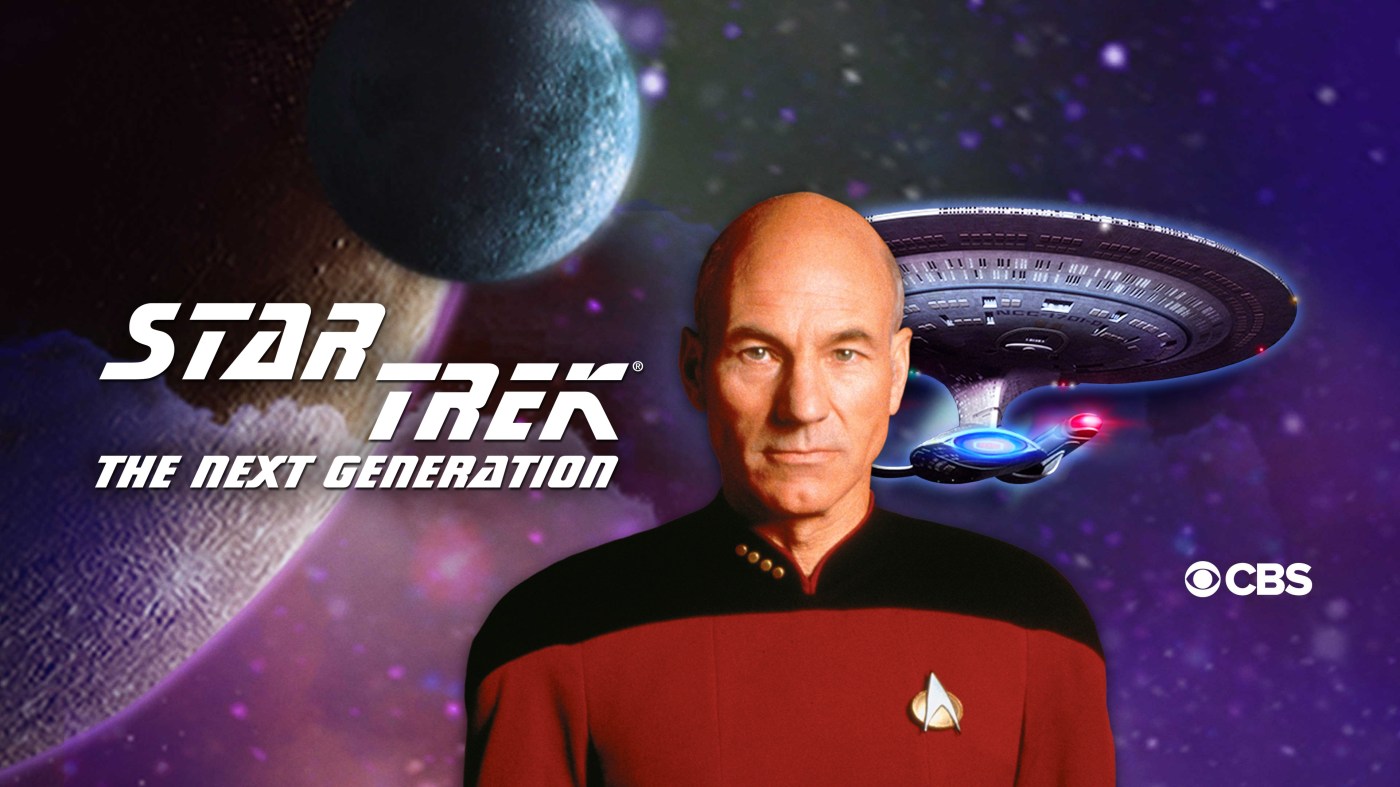
Captain’s log, stardate 80925.1: The Enterprise visits Delta Rana IV in response to a distress call and tries to persuade two colonists who are apparently the only survivors of an obliterated population their mysterious assailants have returned.
If last week’s story was a great showcase for Data, this week allows for Captain Picard to take center stage in one of TNG’s most haunting episodes – ironic, given how bright so much of it is. Some of that brightness is down to Martin Rush, the new director of photography, as LI Underhill explains:
“Rush’s predecessor, Edward R. Brown, used a lot of darkness and shadow, especially very early on in the first season (most notably in “Lonely Among Us”, which for me simply defines the look of the series’ early years). Rush, however, uses a lot of very bright lighting, especially in the interior shots of the Enterprise corridors. […] “The Survivors” is a particularly good showcase for this, considering a not-unsubstantial bit of it takes place during a perfectly beautiful summer location shoot at a Malibu beach house.”
In both of my TNG rewatches, the sheer vibrance of season 3 completely leaps off the screen in a way that makes both of the preceding seasons look a bit drab by comparison. The blu-rays in particular really do a great job at enhancing Rush’s work with the lighting for the Enterprise sets, to say nothing of the gorgeous on-location shoots.
But let’s get back to the main thrust of things. This is an episode that, as Underhill also notes in their piece, finds TNG diving back into the TOS style of storytelling, but does so in a way that feels more like a “return to” a version of TOS that worked more consistently than they believe it did. But for me, I look at it and see it as an exhibition for Picard’s detective skills.
Everyone knows about Data’s love for Sherlock Holmes, and Picard’s love of Dixon Hill – a fictional private eye in the fashion of Raymond Chandler’s novels. But, of course, Picard seems to nurse a love of Holmes as well, given that he dresses in a top hat and tails – more like how he was written in Doyle’s stories, whereas Data goes for Pop Culture Holmes.
In this episode, watch Picard closely when he and Worf go down to the planet for their tea party with Kevin and Rishon. While he already knows something isn’t quite right based on what Riker has said and the battle scene that immediately precedes this, to say nothing of what’s going on with Troi, I really like how he handles the questioning itself:
KEVIN: No, but I don’t enjoy seeing my wife frightened. We’ve told you time and time again, we don’t know why we were spared.
PICARD: But there had to be some reason. In some way, you were different from the other colonists. Your geographical location, your philosophical beliefs, the colour of your eyes. In some way you were set apart from them.
KEVIN: There was a difference. I’m a man of special conscience. While the others were doing what they could, I chose not to fight.
Things really kick into high gear after this scene, starting with the second showdown with the recreated Husnock ship. He knows from his many experiences with Q and assorted other god-like alien races that Kevin is something similar, even if he doesn’t have too many specifics yet – it’s the same analytical thought process that Spock notices in “Unification,” and that he deploys so effectively in “Conundrum” and “Allegiance” to see through the deceptions in those episodes.
It’s this particular quality of Picard’s, along with his exceptional warmth and sense of protectiveness toward the men and women he serves with, that make him my favorite of the many captains we’ve seen on Trek in the last sixty years. I know it’s all the rage these days to favor Ben Sisko, but for me, JLP will always be the cream of the command crop.
What of Kevin, then? I find him fascinating for the same reason I found the War Doctor fascinating in the late Smith era of Doctor Who – both men are avowed pacifists who, for different reasons, temporarily broke their pacifism in order to commit genocide against an attacking alien race. (Or, in the Doctor’s case, two races whose war had spiraled so completely out of control that dual genocide was the only option left.)
What really interests me about Kevin though is that he feels like a near inversion of Q. As the episode’s trope page observes: “Both are very powerful immortal Reality Warpers but while Q is playful, jovial and usually indifferent to the death or destruction that he causes. Kevin is a far more somber and serious character. His is a moral being with a conscience who is clearly tormented not only by the death of his human wife but the fact that he wiped out the entire Husnock race in his grief-induced rage.”
Again I am reminded of the War Doctor. To quote myself a bit:
How in the world could this man be capable of double genocide? It simply doesn’t line up with the guy who, in Genesis, ultimately decided not to destroy the Daleks when they were being created because, as he says at the end of the story, “although the Daleks will create havoc and destruction for millions of years, I know also that out of their evil must come something good.”
He gets there because, after spending several hundred years being a warrior, he’s exhausted and wants it all to stop by any means necessary. And by the end of the Time War, any possible concept of “good side” and “bad side” have been so thoroughly eroded that even a civilian like Cass, in The Night of the Doctor, just assumes that the Doctor is as bad as all the rest of the Time Lords. So the Doctor pushes the button, and damns himself in the process.
While it’s never made clear on TV what the incident that led to the Doctor’s initial decision in the barn consisted of, the novel Engines of War suggests that it was the death of Cinder, his companion in that book, that brought him to end the war in the way he did. It isn’t quite the same thing as Kevin’s decision to destroy the Husnock, but it’s definitely in the same ballpark – two old men who had grown close to someone, only to have them taken away in the middle of a terrible war.
Truly, a heart-rending episode if ever there was one.


Leave a Reply