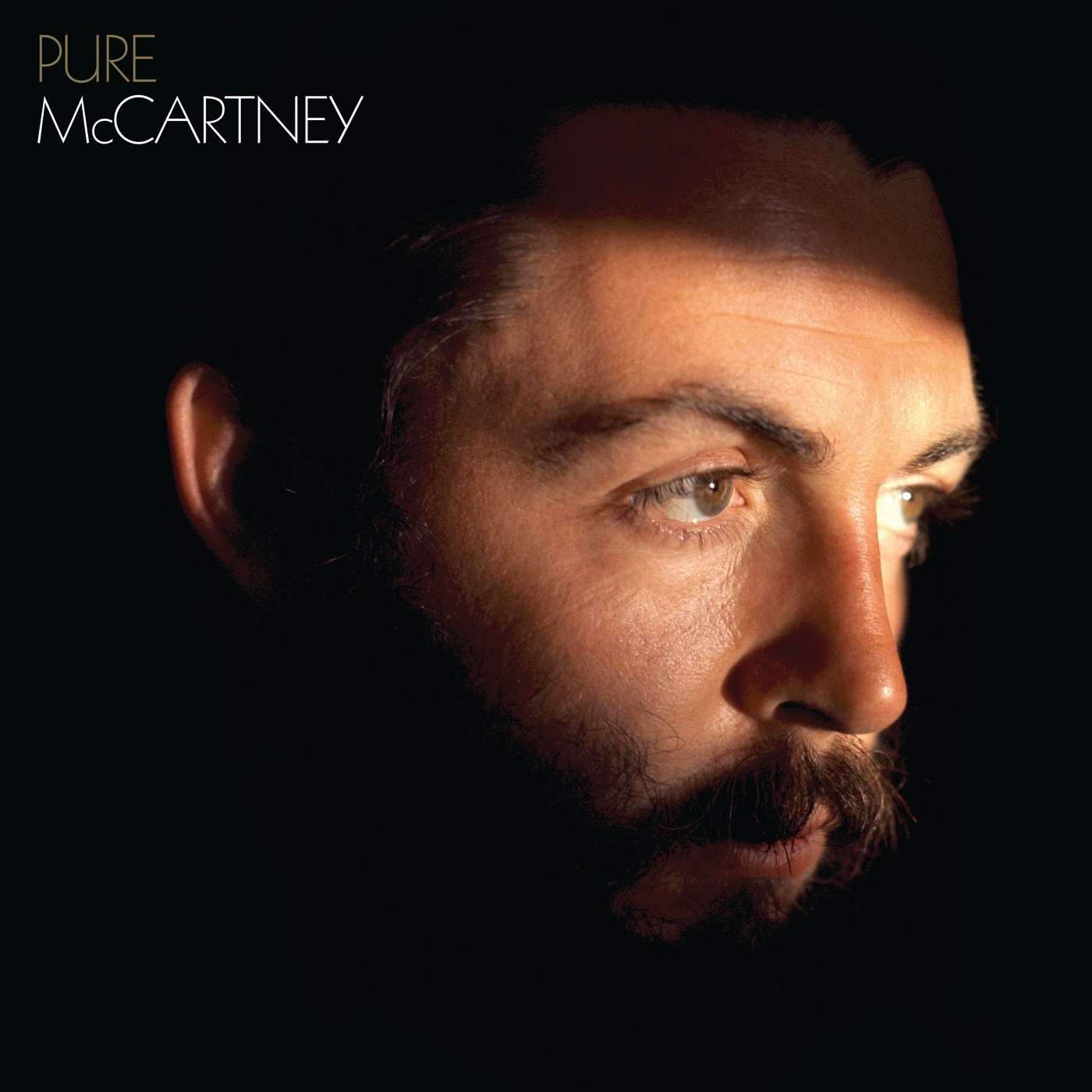
It doesn’t seem right for me to close out our deep dive into Paul’s solo career without covering a couple of retrospective compilation albums, I don’t think. The difficult part is deciding which ones! After all, he’s had quite a few come out since 1978’s Wings Greatest. So I’ve decided, over the next couple weeks, to just do two posts on two such albums: Pure McCartney, a 2016 collection that includes songs from 1970 to 2013’s New, and Wings, the eponymous album by Paul’s other band.
What unites both albums is that rather than having the songs be chosen by some guy from the record company, (and to be fair to Alan Steckler, who chose the songs for the Beatles’ Red and Blue albums, he made some great picks) all the tracks on these two albums were chosen by Paul himself. And if his concert set lists are any indication, the man likes his deep cuts!
Pure McCartney, as noted, covers the entire arc of Paul’s post-Beatles work up to 2013, but unlike most compilation albums, this isn’t strictly speaking a “greatest hits” collection. He writes in the liner notes, “Me and my team came up with the idea of putting together a collection of my recordings with nothing else in mind other than having something fun to listen to.”
The album is available in two configurations: a 39-track 2-disc version, and a 4-disc version with 67 songs. I’ll be writing about the regular version, since that’s what I have in my library. It’s also important to note that none of these songs are in chronological order, so it’s not uncommon to run into a song from Paul’s more recent work alongside something from the ‘70s, when he still sounded like he did in the Beatles.
And so, we begin with Pure McCartney:
Disc 1
‘Maybe I’m Amazed’: By far and away the best love song Paul has ever written, which is no small feat considering how many of them he’s written over the years. In one of the darkest periods of his life, he had a shining light in the form of Linda, and his love for her shines through every note. He even brings back his “Oh! Darling” vocal stylings back!
‘Heart Of The Country’: One of the happiest of Paul’s solo songs, this one really is just him gushing about how much he enjoys living on that farm in Scotland that he bought in the mid-sixties. It’s an acoustic driven piece in the tradition of “Mother Nature’s Son,” but uptempo. I love it.
Jet: In case you thought that “Live and Let Die” was a flash in the pan, here comes Paul with a good-old fashioned early 1970s rock song, named for his and Linda’s Labrador Retriever. Exactly what the song is about has never been made entirely clear. But who cares?! It’s Paul rocking out again in the way that only he can do! This is one you want to play as loudly as possible!
‘Warm And Beautiful’: A Paul piano ballad of the sort we haven’t had since McCartney back in 1970. Like “Maybe I’m Amazed,” it’s a Linda song, and it’s absolutely beautiful – I particularly like the lines about sunlight and moonlight. I’d’ve played it at my wedding if I could have! (The venue didn’t allow for amplified sound.)
‘Listen To What The Man Said’: A classic optimistic McCartney love song, The Paul McCartney Project describes the lyrics thusly: “Even though love may be blind or may cause separated lovers to suffer, the singer believes that love will prevail,” accentuated with a tenor sax solo by Tom Scott, and kiss sound effects by Linda. It was released as a single in 1975, and became a hit. (Me, I’ll always associate it with the time I heard it over the music system at a Dierbergs in suburban St. Louis.)
‘Dear Boy’: Despite what John Lennon believed, this song was actually about Linda’s ex-husband Joseph Melvin See Jr. The lyrics are essentially Paul talking about how much better off Linda is with him, like a long-delayed response to the Lennon song “You’re Gonna Lose That Girl” from Help!. I don’t quite see why John thought this song was about him though – it makes no sense.
‘Silly Love Songs’: Paul returns with a rebuttal to music critics who didn’t like that he mainly wrote happy, poppy love songs. Given this was the 1970s and Paul was widely viewed as the villain in the story of the Beatles’ breakup, I kind of feel like that might’ve had something to do with how he was critically received. After all, no one complained about a profusion of love songs when John, George, and Ringo were there.
‘The Song We Were Singing’: Fitting the post-Anthology nostalgia mood that Paul was in during the late 1990s, this song is transparently about the 1960s and all the happy memories Paul has from that time. He wrote it in 1995, around the time that the Beatles were recording “Real Love” and their first attempts at “Now and Then.” Driven mostly by his vocal and acoustic guitar work, for me it conjures a mental image of Paul sitting around a campfire – perhaps the one seen in some of his interview clips from the later Anthology episodes.
‘Uncle Albert/Admiral Halsey’: One of Paul’s recurring stylistic trademarks is to string together some unfinished works into one piece – this is how you get stuff like “A Day in the Life,” or the Abbey Road medley. It’s one of my favorite early Paul songs, particularly the first half about Uncle Albert. No wonder it became his first number one single!
Another Day: In which Paul writes an observational song about a lonely woman and her miserable existence… and not for the first time! What we have here is basically “Eleanor Rigby” for the 1970s, focused this time on the doldrum daily routine of an unnamed woman. Going by the lyrics, it sure sounds like she suffers from depression, with a dash of suicidality as well. (Her boyfriend is no help either.) Heavy shit indeed, but that’s just part of how Paul operates. For every “Silly love song,” there’s something like this that really makes you think.
“Sing the Changes”: A song by the Fireman, Paul’s experimental music project with the producer Youth. Their most recent release was 2008’s Electric Arguments, the album where Paul “came out of the closet,” so to speak, though the press had known the truth as early as 1993.
‘Jenny Wren’: This is a fingerpicking acoustic song in the tradition of “Blackbird,” down to the bird theme. The solo here is played on an instrument called a duduk, and it was one of the first pop records to use one. It sounds beautiful, and fits the mood of this track very well – sort of a hybrid of “Blackbird” and “Eleanor Rigby,” but with a brighter ending.
‘Save Us’: This is one of two songs on New produced by Paul Epworth, who noted in an interview at the time that his preferred way of working is heavy on improv. For this song, he gave Paul a basic idea of what he wanted (a hard driving rocker) and Paul, being the guy who invented “Get Back” while screwing around at Twickenham in 1969, quickly came up with a basic riff that forms the song’s introduction. The rest, including the words, went from there. And it is, of course, magnificent.
‘Mrs Vandebilt’: A song named for but having little to do with the famous American dynasty, Paul simply has to say about the writing of the track: ‘Mrs Vandebilt’ was a good one. I didn’t know anything about her but I just knew she was like… a rich person.” Still, it’s immediately distinctive, thanks to the “Ho! Hey ho!” hook, and a sax part by Howie Casey, formerly of the Liverpool beat group Derry and the Seniors.
Mull of Kintyre: A gorgeous tribute to the area of Scotland where Paul has owned High Park Farm since 1966, and by some distance, Wings’ biggest hit as a band. It was one of the best selling singles of all time in the UK, where it became the 1977 Christmas number one. When it was released, it sold more copies than “She Loves You” had in 1963. And while I’m Irish, not Scottish, even I know a beautiful song when I hear it.
‘Let ’Em In’: While the lyrics are nothing to get too excited about, the melody they are sung to is absolutely fantastic, and the snare drum gives the track an almost military vibe. When it was released as a single later in 1976, it did a lot to boost Speed of Sound’s flagging sales.
Let Me Roll It: There are love songs, and then there are love songs by Sir James Paul freaking McCartney. No one, and I mean no one, can write them like he can. This is one of his best by far, and it’s been a staple of mine and Sophie’s joint playlist since we got together. And best of all? If you squint you can take it as Paul expressing his love for John, years after their musical argument in 1971. (I like to think of this song as paving the way to their brief reunion during the Walls and Bridges sessions of 1974.)
‘Nineteen Hundred And Eighty Five’: Our grand closer from Band on the Run, and though the lyrics are slight, it doesn’t matter because the song just sounds incredibly awesome even before the epic finale – it’s like the Wings version of “A Day in the Life” from Sgt. Pepper, complete with an orchestra being huge and impressive, plus harmonies that sound like Paul was listening to Brian Wilson again.
Also note how the tempo of the song gradually gets faster and faster as it builds toward to its conclusion, with Paul doing some “Hey Jude” style scatting over his own lead guitar. Then the orchestra comes in with some saxophone, and then… BANG! It’s all over, with an excerpt of the title song’s chorus to play us out.
‘Ebony And Ivory’: One observation I didn’t get to make in the write-up on “What’s That You’re Doing?” is that Paul’s voice goes very well with Stevie Wonder’s. Certainly record buyers thought so too, considering this song, an ode to racial equality, hit the top of the charts in eleven countries. Critics thought it was cheesy in all the worst ways, but the critics are wrong, this song is a fucking classic.
Disc 2
Band on the Run: Recorded with just himself, Linda, and Denny Laine, the song is a triptych, with three sections that sound completely different from each other… not unlike the medley that goes through half of Abbey Road, actually. A lot of the song has to do with freedom and escape, and “If we ever get out of here” was a nod to something George had said during an Apple meeting in 1969.
‘Arrow Through Me’: A funky little song that incorporates the idea of Cupid’s arrow, but inverts it, according to Paul: “The character in the song has been wounded. He’s been cheated on. And it could’ve been a great relationship, could’ve been fantastic. As things stand, you couldn’t ‘have found a more down hero’, because there was nobody more down than me at that moment.”
Notably, this song contains absolutely no guitar parts, it is instead dominated by synthesizer and keyboards.
My Love: A love song from Paul to Linda, in the style of “The Long and Winding Road,” down to Paul trying to do a Ray Charles voice. (But with electric piano, because this is the 1970s.) For me it sounds like an attempt to write “Something,” and not entirely succeeding. But it’s a Linda tribute song now, so I can’t really complain.
‘Live And Let Die’: Paul’s first and only Bond theme, though I read somewhere they wanted to get him for Diamonds Are Forever but it went to Shirley Bassey again. Inaugurating the Roger Moore years of the Bond movie series, the lyrics have very little to do with 007, but who cares?! It’s a great fucking song. Allegedly, the producers originally wanted to have someone other than Paul sing, but George Martin convinced them to stick with Paul’s recording.
‘Too Much Rain’: According to an interview CD, “The actual inspiration for Too Much Rain is Charlie Chaplin’s song Smile. Which he wrote: not many people know he wrote it, you normally think of him as a comedian, but I was always amazed to hear he’d written that you know, beautiful song.”
For Paul, it’s another of his optimistic songs, but it comes from a different place. We all know he was going through some dark times around the time this album was made, and this song feels like a reminder to himself as much as the rest of us.
“Goodnight Tonight”: Wings goes all disco! According to Paul: “That was all based round some rhythm. I do like dance records: when you listen to records, you’re often down a club and want to dance with someone – I like dancin’, actually!”
Though it was a big hit on the singles charts, reaching #5, John Lennon didn’t like it very much – though he did praise Paul’s bass guitar work. It was recorded during the Back to the Egg sessions, but was left off the album.
‘Say Say Say’: The first of two Jackson collabs in Paul’s catalog, this one is easily the best – and insanely catchy. (I can’t listen to this song without getting it stuck in my head.) Paul’s vocals are panned to the left, while Jackson is on the right, while their trade-offs in the verses give the impression that this song is something of a spiritual successor to “The Girl is Mine.”
The single was a smash hit for both Paul and Michael when it was released in 1983. For Paul, it was his best-selling single of the entire 1980s, and his final stateside #1, according to the Beatles Bible. This remix features their respective vocal parts swapped around compared to the original from Pipes of Peace, created when that album was being remastered for the Archive Collection series.
‘My Valentine’: Of the trilogy of songs dedicated to Paul’s wives, “Maybe I’m Amazed” stands out as the best of them all, but this track is a very close second. Lyrically, it’s another of Paul’s weather songs, centered around rain, and it is absolutely gorgeous. Paul’s vocal is soft and tender, melding so perfectly with the acoustic guitar. (That’s Eric Clapton on the solo.)
‘The World Tonight’: In which Paul finally sits down and deals with, through a layer or two of fictionality, the price of the enduring fame he’s sustained both as a Beatle and a solo artist. He said at the time, “A song about a person sitting at the centre of a circle, and everybody wants something from him? It could almost be me.”
But apart from that, it’s just a great sounding late-90s rock song. His lower register allows him to do shit with his voice that he couldn’t’ve done as a younger man, and when he hits those high notes on this song, it’s really satisfying.
‘Pipes Of Peace’: If there’s one thing Paul is known for, it’s a penchant for writing children’s songs. Obviously, “Yellow Submarine” is the biggest one, but his solo career features some as well – “Bogey Music” on McCartney II, or “We All Stand Together,” his Rupert Bear song from around this period.
“Pipes of Peace” combines the children’s song idea with a peace anthem, ala Lennon’s “Imagine,” but with a focus on climate change and the dangers thereof – and this is 1983, back when we had way more time to do something about it than we do now.
In The Lyrics, he mentions visiting Daunt Books in London – I went there close to a decade ago now, when studying abroad in the UK as a junior in college. I’ve kept the bookmark with me ever since, because I loved that place so much.
‘Dance Tonight’: Like the title song from Off the Ground, Memory Almost Full’s lead-off track was recorded and added at the last minute – which sounds impossible to believe, because it does such a perfect job of resetting the mood from Chaos and Creation’s (relative) darkness. Anchoring the track is Paul’s mandolin performance, which Beatrice (his youngest daughter, who was 3 at the time) would dance to whenever he played, forming the basis for the track. And of course, it was the soundtrack for the best iPod commercial ever.
‘Here Today’: This one is a heart-breaker. Paul’s gorgeous tribute to John, featuring just him, acoustic guitar, and strings – like a 1980s version of “Yesterday,” only instead of pining for a lost love, he’s pining for his best friend. When I heard him play it live in 2016, he choked up during the performance… apparently that happens a lot.
Paul’s sorrow at missing John has animated so much of his career over the past 40-some years, from “Here Today” to dusting off “Now and Then” and putting it out as the final-ever Beatles recording. Wherever John is now, I feel safe in saying that he misses Paul just as much.
‘Wanderlust’: Remember “Warm and Beautiful” from Wings at the Speed of Sound? This song reminds me a bit of that, which is funny given that it actually originates from the London Town sessions. Apparently, this track was also supposed to include a guitar solo from George (which would’ve brought all three surviving Beatles back together for the first time) but Paul’s visit to George’s studio turned into a vocal tracking session instead.
‘Great Day’: “Great Day” is the oldest song on Flaming Pie, dating back to 1970 and the McCartney period. Given the sonic nostalgia trip that is Flaming Pie though, it serves as an acoustic ditty on par with “Her Majesty,” as Paul himself has stated in the album’s liner notes. Lyrically, it even harks back to 1963’s “It Won’t Be Long,” a song Paul wrote with John, and lead-off track on With the Beatles.
‘Coming Up’: Paul’s hit single from 1980, it’s a delightful slice of classic McCartney optimism, enlightened with Paul’s heavy use of a vari-speed machine: a favorite trick of the Beatles in the mid-Sixties. In this case, he uses it to make his voice sound younger, just like on “When I’m Sixty Four.”
‘No More Lonely Nights’: The theme song from Paul’s 1984 box office flop, Give My Regards to Broad Street, though notice I don’t use the phrase “title song” there as I did for the five Beatles film songs. According to The Lyrics, it took not doing a title drop for him to find inspiration to come up with the rest. Lyrically, it’s another of Paul’s many love songs, but the real stand-out performer on this track is David Gilmour, best known as the lead guitarist of Pink Floyd.
‘Only Mama Knows’: Just in case you thought Paul couldn’t rock as hard as he could in the Sixties while being in his sixties, here he is proving you absolutely wrong. It’s a story song in the grand tradition of “Eleanor Rigby,” featuring his current live band instead of a string quartet.
‘With A Little Luck’: Another Paul’s sunny optimistic songs, this track was a smash hit for Wings when it was released as a single in March 1978, reaching #1 in the US and Canada, and #5 in the UK. It’s a song that, like so much of the album, is soaked in synthesizers – neatly anticipating the synth-driven music of the ‘80s.
“Hope for the Future”: While Paul is no stranger to the occasional musical commission, “Hope for the Future” has to be the one most likely to come out of left field. It’s a video game theme for Destiny, a sci-fi first-person shooter.
Like “Live and Let Die” before it, the lyrics have very little to do with the actual game, but it does tie nicely into the optimistic vibe that has long defined Paul’s work as a musician. It’s a grand, soaring epic with lyrics that gesture in the same general direction as Paul’s own “Tug of War,” updated for the mid-2010s. Were it not for the namedrop of the game’s title toward the end of the song, you wouldn’t realize this was from a video game at all!
‘Junk’: A simple acoustic ballad, describing the contents of a junk shop. He tried to include it on the White Album and Abbey Road, but the other three Beatles rejected it – so, of course it got recorded for this album. It’s not much of a song, but the melody is nice.
Paul’s eclecticism, both in his song choices and in his work as a musician, remains one of my favorite things about him. He can jump effortlessly between entire genres, from hard rock to new wave, classical, proto-metal, ballads, and far more besides. This album covers only a brief snapshot of that career, but what a snapshot it is! There are not very many working musicians out there who can claim to have a body of work as diverse as this.
I will never be a fan of “Junk” or “My Love,” but that’s just two songs out of 39. The entire rest of the album is solid as it gets, serving as a perfect introduction to his life and work, just like the Red and Blue albums did for the Beatles back in 1973. That such a statement is even possible says a lot about how special this man is.
Long may he continue.


Leave a Reply