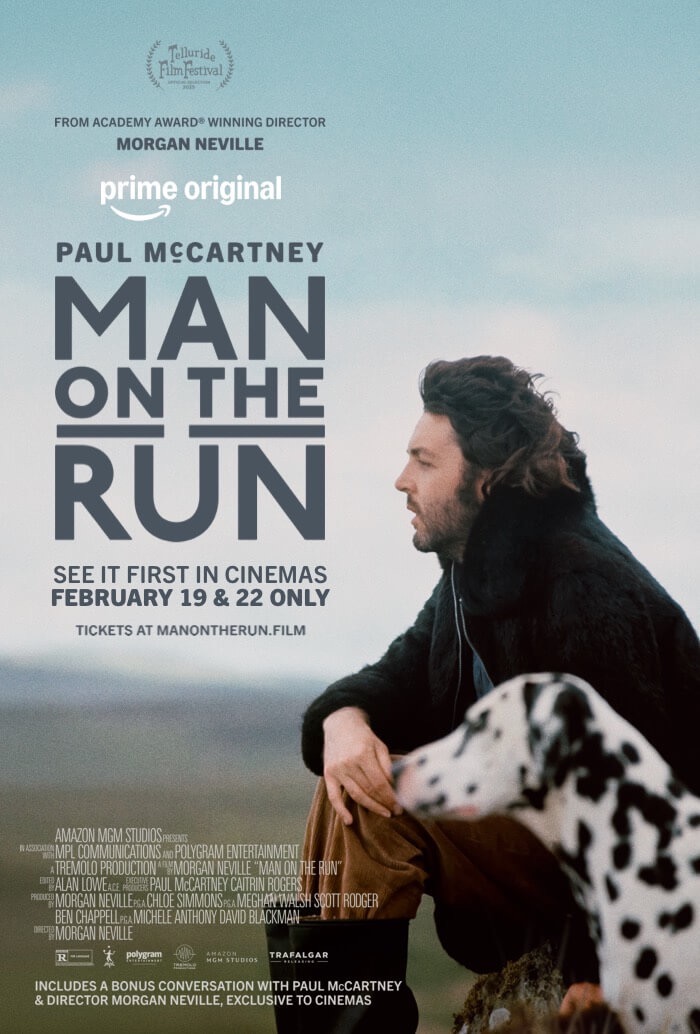
In some ways, Man on the Run feels like Paul’s answer to Imagine: John Lennon, the somewhat confusingly named 1988 documentary in which John, via archival audio, narrates the story of his post-Beatles work. As the title suggests, it isn’t quite a history of Wings, though most of the film obviously functions as one. It’s more the story of Paul McCartney, coming out of the 1960s with no band and a drinking problem, trying to find out what the hell he was going to do with his life.
It starts, quite literally, where the Beatles end: a rapid montage set to the final track on Abbey Road zips us from the Cavern to the break-up, and from there begins to tell the story of a decade in the life, beginning and ending with two McCartney albums, and all the wild rides in between.
As a Wings documentary, it isn’t particularly comprehensive: only a few albums are highlighted, with much of the film focusing on the early-seventies until around 1976 or so, when the band was on the giant world tour that resulted in the Wings Over America album. There are no talking heads, just voices: Paul himself, of course, both as he sounds now and as he sounded then, along with Linda, Denny Laine, and all the rest of the revolving door that was Wings’ lineup.
What surprised me about the movie was that it was rated R, because it doesn’t feel like an R-rated movie. Sure, there are more than a few fucks thrown in, but otherwise it largely seems relatively wholesome – moreso than other Seventies rock documentaries would be, what with the mountains of archival footage from those various Wings tours.
The other surprising thing? It’s unflinchingly honest and raw from Paul, which is something of a shock given that he’s always tried, at least since the 1990s when he became the Beatles’ brand ambassador, to present himself and his work relatively cleanly. But here, the voices of the band are allowed to at least gesture to one of the band’s essential paradoxes: Paul’s stated desire to be an anonymous fella, while at the same time not really letting go of his essential Beatleness.
Another subject that gets covered in a surprising amount of detail: Paul’s drug bust in January 1980, right as the band was arriving for a tour of Japan that never happened. (As if foreshadowing this, video footage of Paul apologizing for canceling some earlier Japanese tour dates is shown earlier in the movie.)
We see archive footage of the Japanese customs officer finding the bag of pot, along with news clips of TV coverage of the story. His long time spent in jail, we are told, was the impetus for Paul’s decision to abandon Wings and return, once again, to making music on his own.
One of the more illuminating aspects to the film involves not the voices of the principal musicians, but their children. Stella and Mary McCartney each have roles in this film, with Mary and Stella each offering spirited defenses of their late mother, correcting the record that so pervaded the ‘70s where Linda was Paul’s boss. “She’s his ruler, his guardian,” says one woman in archival interview footage.
Another one of the film’s pervading themes is the fact that the band existed, for much of their existence, in the shadow of the Beatles. “Live and Let Die” is used to underscore a section where Paul is pervaded with questions and requests for a Beatles reunion, juxtaposed with Wings’ 1976 tour of the United States proving to be a smash hit even without a boost from John, George, and Ringo.
While most of John’s appearances in the film center around his fight with Paul in 1971, the breakup lawsuit, and the dismissal of Allen Klein, any story of Paul’s life after the Sixties though is always going to come around eventually to one thing: John’s murder in 1980. This film is no exception, presenting it as one of the key moments in Paul growing up from his Beatle days.
And remember what I said about surprisingly unflinching honesty? That infamous interview clip from the day after the killing where Paul tells a reporter that John’s death was “a drag” is shown in full, but this time with commentary from Sean Lennon, who states outright that Paul’s alleged cold reaction came more from absolute shell shock than anything else.
Everyone knows, and Paul re-tells, the story about John hearing “Coming Up” on the radio and realizing he should get back to making music again, but in another clip, Sean mentions that his dad’s copy of McCartney was quite worn, suggesting it had been played a number of times – that’s the kind of anecdote you don’t see much in Beatles books.
And while I thought the track selection on the film’s accompanying album was slim, we can all rejoice – it turns out there’s way more music here than was found on the album: sixty two songs, as per the ending credits. (Kinda makes you think they could’ve added more stuff to it, doesn’t it?)
Is it the best documentary you’ve ever seen? Not really, but frankly, at this point who cares? Paul’s late-career Wings evangelism stage (as Variety puts it in their review) shows to me that he’s coming to terms with all sides of his career, not just the 1960s. No one needs it to be revelatory – this is Paul McCartney, giving us his side of the story, while he still can. At his age, who can blame him for thinking about his legacy?


Leave a Reply