Well, here we go again.
30 years after the original Anthology project reignited Beatlemania, brought the band back together again for the first and only time, and sealed my fate as a lifelong fan of the group, 2025 has turned out to be the year of Anthology 2.0. The docuseries has been restored and released on Disney+, with a brand new ninth episode featuring footage of Paul, George, and Ringo making the original Anthology series in the ‘90s, adding a touch meta-ness to proceedings.
Furthermore, not only is the book from 2000 seeing a 25th anniversary reprint, but the CDs have been remastered, the reunion tracks have been remixed by Jeff Lynne, and there’s even a new fourth album out, comprised of outtakes from across the band’s history. And for the very first time, all three reunion tracks are grouped together at the very end of disc 2, with “Now and Then” joining its older siblings at last.
This isn’t just a cash-grab re-release project either, despite what the Beatles subreddit thinks. I prefer to conceive of this as an updating of the Anthology project, one that will hopefully spawn a new generation of fans like the original did in 1995. The Anthology is as part of the wider Beatle story as anything from the ‘60s, since it serves as proof that no matter what, the world just can’t let the Beatles go.
So, to that end, I thought it best to bring Off the Beatle Track back for a limited run, covering all of the new Anthology-related releases. Over the next few weeks, we’ll look at the remastered versions of the original trio of albums, the new fourth album, all 9 episodes of the restored docuseries, and the reprinted book, giving this mammoth project a much more comprehensive overview than I managed in the original series.
We begin, naturally enough, with Anthology 1, the first album in the original trilogy of releases in 1995 and 1996. I won’t do track-by-track breakdowns for the OG trilogy this time, since the original posts are all still there, but I will do an overview of the remastered audio, since I think there’s a lot more going on under the hood than it would first appear.
First though, some extremely nerdy notes about packaging: The four albums now come in a light blue slipcase that’ll be familiar to those of us who bought the Japan Box or the mono and US album remasters from the 2010s – dimensionally, the slipcase is the same depth as two of the original ‘90s jewel cases stacked on top of each other.
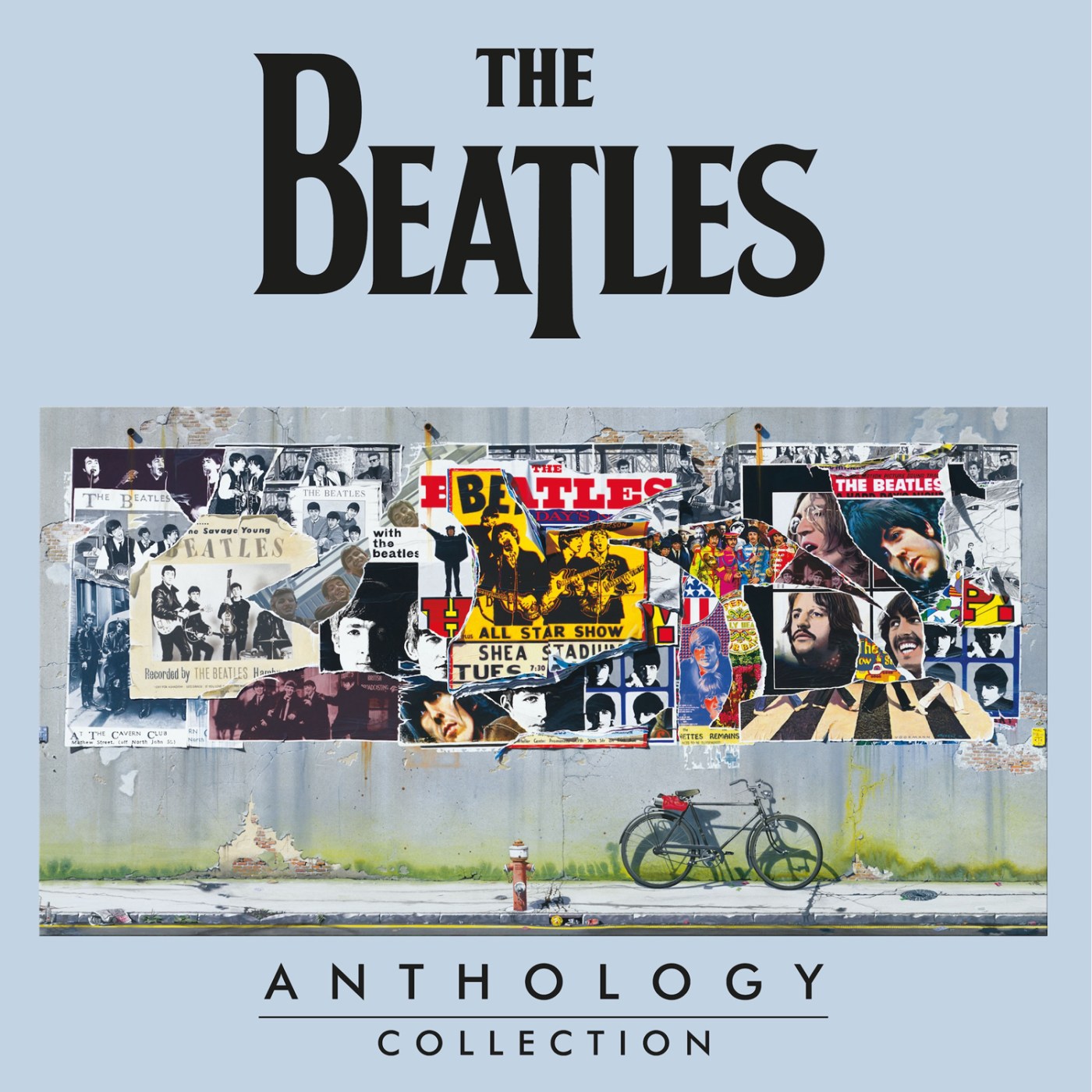
As for the CDs themselves, they are presented in digipak format the same time, as standard for Beatles releases since the ’09 remasters. Visually, this means one album is half as thick as the original jewel case, making it much easier to store. Flip it open and you’ll see not Klaus Voorman’s poster art, but the illustration of the wall that the poster is in front of, complete with bicycle.
Opening the right flap gets you a shot of the full poster, with the CDs resting in two pockets. Pocket 3 (with an illustration of the Granny Smith Apple logo on the front) contains the CD booklet, featuring an introduction by Derek Taylor on volumes 1-3 and sleeve notes by Mark Lewisohn. Anthology 4 has an intro by Derek Taylor assembled form an interview conducted in 1996, while the sleeve notes are by Kevin Howlett, who also wrote the notes for each of the 2009 stereo remasters.
On to the music, finally: The remasters of the original trio of Anthology albums were carried out by Giles Martin, who got his start in Beatleland with the original Anthology in the ‘90s, so it’s wonderful to have him back for this new take. As before, the album begins with “Free As A Bird,” billed as the first new Beatle song since the band broke up in 1970.
This is the second time Martin has worked on the ‘90s reunion songs – both of them were remixed in 2015 for the 1 reissue series, with extensive cleanup work and in places, the use of different vocal and guitar lines from the original remix. This, though, is a straight remaster as it was originally heard in 1995, but with more low end to it than the original CDs had.
This sort of increased low-end pervades much of Anthology 1. While most of the songs are in mono, there’s still plenty of restorative work to be done that wasn’t possible in 1995. A good example of what I mean is the Quarrymen’s performance of “That’ll Be The Day.”
On the original release from 1995, the performance sounded pretty much exactly like you’d expect – a spirited performance of Buddy Holly’s classic, marred by the low fidelity of the disc it’d been recorded on to, to say nothing of its age. The remaster still sounds like that, but there’s clearly been a lot of tweaking and polishing done to the song.
It still doesn’t sound anything like an EMI recording (and never can, no matter what the morons on the Beatles subreddit think about the MAL process) but there’s depth to it now – the drums come out more, you can hear the guitar better, and John’s singing has more body to it. While I don’t think we’ll ever get to hear this song in stereo, even a better-sounding mono recording is still worth celebrating.
This being a remaster rather than a remix, the stereo field is largely exactly the same as the original CDs – this is most evident on “My Bonnie,” where Tony Sheridan’s vocal is still panned hard left or hard right, depending on where in the song you are. The mono songs are all still in mono, they just sound better than before.
One of the surprises on Anthology 1 was the recording of “All My Loving” from their first appearance on the Ed Sullivan Show. The original version from 1995 was presented in mono, but the new version (as well as having better equalization) seems to be in stereo – presumably via the MAL process.
This kind of stem-generating technique also allows for a vastly reduced volume of screams – they aren’t entirely removed, but they are considerably quieter than on the original version from 1995, so you can hear the band much more clearly. Just listen to the very beginning of the track – Sullivan’s introduction is now in stereo somehow, and the first verse of the song has much quieter screams compared to the 1995 CDs.
The story of Anthology 2 is less about restoring the quality of sub-par recordings than making what is here sound like a vast improvement compared to the original CDs from the 1990s. The demo of “Yes It Is” early on disc 1 is much louder on the 2025 CD than the original, while “Real Love” has more low end, particularly when the first chorus hits.
The live material, sadly, is presented almost entirely in mono rather than MAL!stereo as the “All My Loving” recording from Anthology 1 was, which is a shame – I feel like the songs from Blackpool Night Out could’ve benefited tremendously from being converted to stereo. (Nothing is saving the Budokan tapes though.)
The proof of concept for this is the performance of “Help!” from the very end of the show – the original recording from 1996 was presented entirely in mono, the new version is in stereo, and this change means the song sounds incredibly different. Ringo’s drum part in particular sounds like it is just dying to be isolated and sampled in a hip-hop song. So if you can do that, Giles, why not the rest of ‘em?!
After that though, the rest of the live of the material is something of a disappointment. The Shea Stadium version of “Everybody’s Trying to Be My Baby” at least has more body to it now, but it’s still in mono, which isn’t great when poor George spends most of the song being barely audible. Spreading the instruments around might’ve helped, just sayin’.
One interesting wrinkle that comes when revisiting the Anthology albums after so many years is something that only happens when we get to albums 2 and 3: the cross-pollination between these and the Super Deluxe versions of the studio albums. As an example, take 11 of “Taxman” sounds largely identical to the album master minus a few guitar overdubs and some alternate backing vocals from John.
On Anthology 2, that version is presented with the entire band over on the left while George’s vocal is in the center, and the guitar solo is panned hard right. But the same version of the song is also available on the Revolver set, where it’s mixed entirely differently – the instruments are all in mono, while the vocals (treated with ADT, I believe) are both on the left and right channels, so George appears on both sides. It’s an odd effect, but it’s also a much better listen, at least to my ears, than the Anthology versions.
So why does this cross pollination happen? Basically, there’s a limited number of Beatles session recordings that would also be considered worthy of release by Giles, Paul, Ringo, Sean, and Olivia. No one at Apple would put, for example, 9 takes of the boys rehearsing the rhythm track for “Help!” because, unless you’re a bootlegger, there’s very little there to make it worth the while.
So, while the super deluxe sets do contain a massive amount of material that aren’t also on the Anthologies, the cases where two versions of the same song that differ mainly in how the track was mixed fascinate me. (But then again I majored in audio production in college, so of course I’d be into that shit.)
Take, for example, the Esher demo version of “Glass Onion.” The panning on the original release from the 1996 version of Anthology 3 was quite wide, with John’s vocals and acoustic guitar tracks on the left and right channels, since he double-tracked himself. The version of the demo as heard on disc 3 of the 2018 White Album remix has much narrower panning, and lo and behold, that’s the version of the song Giles uses for the 2025 remaster of Anthology 3, just cut down slightly to match the 1996 recording.
While I wouldn’t say the remaster of the original Anthology trilogy is a dramatic revelation compared to the original CDs from 1995, I will say that it’s a much smoother listen in terms of EQ, particularly on Anthology 1. As an example, the 1995 mix of “Leave My Kitten Alone” on disc 2 had a metric fuckload of treble, the new master sweeps those away for a more balanced sound.
On the other side of the coin, Anthology 3 benefits incredibly from the increased low-end, particularly on the recordings from the Apple Studio sessions in January 1969. Everything sounds better now, particularly the unadorned take of “The Long and Winding Road” that Spector used in 1970. If they’d put this out as a single, it would’ve been worthy of the #1 spot that it got on the Billboard charts!
If I didn’t already own the original CDs, I’d buy the new ones first – this really is a well-done remastering job. Giles stays out of the way for the most part, letting the music speak for itself. And in the end, isn’t that the point of the exercise?
Next time, we jump forward 30 years for Anthology 4, and unearth treasures never previously released on any Beatles project.


Leave a Reply