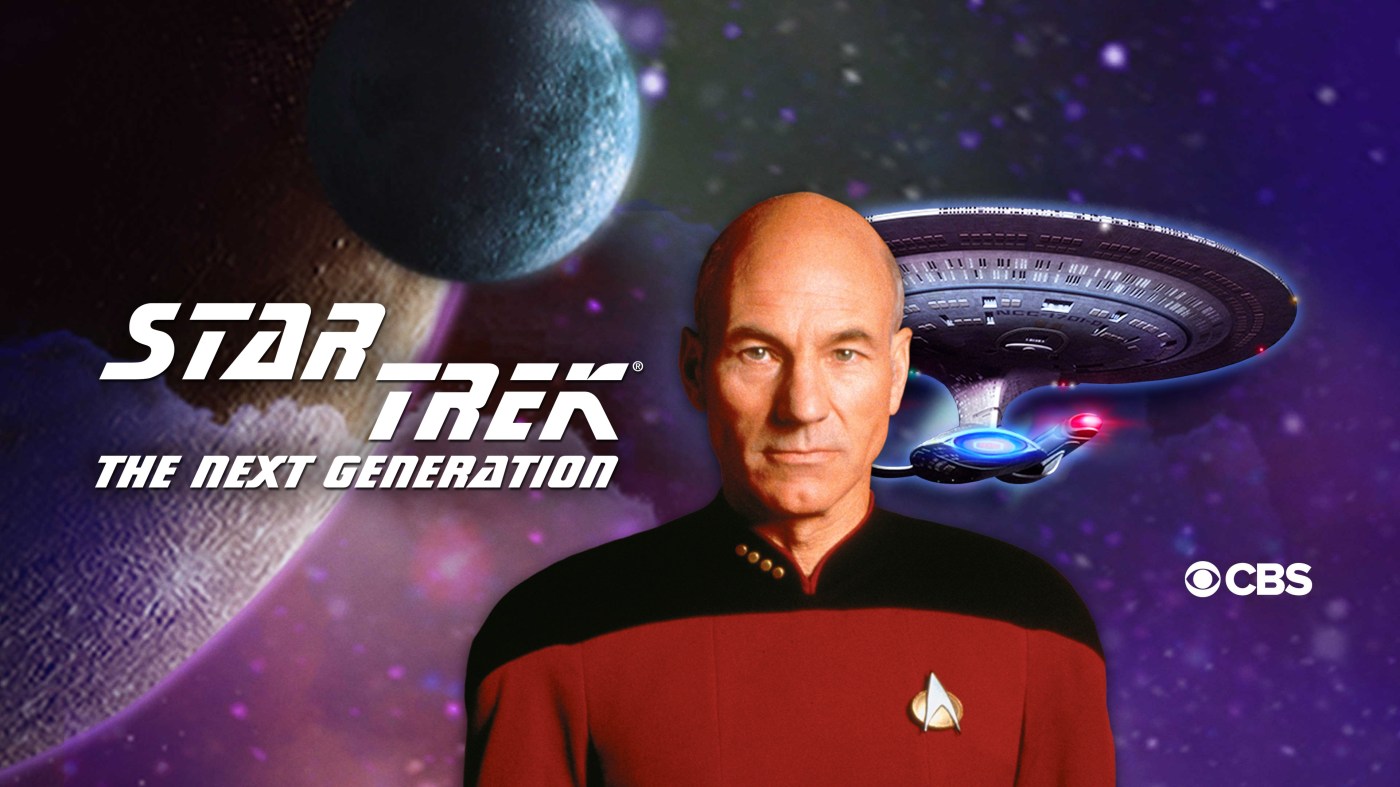
Captain’s log, stardate 81368.3: The derelict Enterprise-C emerges through a temporal rift, rewriting history for the crew of the Enterprise-D. The Federation is losing a war to the Klingons, Tasha is still alive, and the crew of the Enterprise-C must return to their own past to restore the timelines.
What a glorious fucking episode of Trek “Yesterday’s Enterprise” is. And that’s not just my opinion, virtually everyone loves this episode! Denise Crosby, unsurprisingly, adores it, and even Jonathan Frakes (who otherwise still doesn’t understand what happened) at least liked the look of the show. Hell, Russell T Davies himself has said that this is his favorite episode!
And for me personally? It’s why I’m here co-writing this book. It’s why TNG is my favorite Trek, with Picard and Lower Decks in second and third place. If I hadn’t watched it when I was in college, I would not be doing this right now. It is, as my wife put it, the perfect episode of Star Trek, and I agree with her.
The reasons why I love this episode so much have shifted and changed as I’ve gotten older. The first thing that appealed to me was the whole “alternate timeline” angle, what with the heavy alterations to the bridge and the uniforms and whatnot, but in the last four years or so I’ve really come to appreciate Tasha Yar’s arc throughout more as well.
Obviously, the main thrust of the episode is to give Tasha a death that actually means something. In season 1, she just got struck down by a talking puddle of black goo with an attitude problem, like she’s a fucking red shirt and not one of the regular cast. Now she gets a second chance, and what better way to die than sacrificing oneself in order to prevent a costly, traumatizing war? For the possibility of peace between the Klingons and the Federation?
But put that aside for a second. In the space of 45 minutes, we are reminded of what she was like at tactical compared to Worf, she’s given a love interest in the form of Richard Castillo, and even in the face of learning shocking truths that would frighten anyone else and maybe send them hiding under the bed, she just steels herself and decides to make the best of it.
This is how I want to remember Tasha Yar. Not as a Romulan sex slave, but as a dyed-in-the-wool, tough-as-nails Starfleet officer who isn’t afraid of anything, not even death itself. Add in expanded universe material like Jean Lorrah’s wonderful novel Survivors, and the whole picture of Tasha is that of a stone-cold badass in any timeline.
***
“Yesterday’s Enterprise,” if memory serves, was the very first episode of TNG (and Star Trek in general) that I ever watched. Prior to then my memories of the show largely consisted of my parents having it on TV during reruns, and little me getting very excited whenever The Reading Rainbow Guy (LeVar Burton) would show up. It wasn’t until I was in college that I actually gave Trek a chance, and I fell in love at first sight.
Why this episode? Well, part of this was because I’d recently devoured Assimilation2, the 8-issue comic book miniseries that crossed TNG over with Doctor Who, as of the late Smith years, and wanted to know more about the people that Eleven and the Ponds encountered in that story, since I didn’t really know them very well.
The other reason essentially boiled down to “I like alternate timelines,” and Doctor Who does them a lot. So, an episode of Trek that involved the creation of an alternate timeline due to the after effects of time travel? That was like catnip to me back in the day. There’s just something about taking a group of characters we know well, changing one thing, and exploring the resulting consequences that I find to be interesting, both as a writer and a consumer of popular fiction.
While the changes to the norm aren’t as dramatic as, say, TOS’s (in)famous mirror universe, there’s still a lot here worth noting: everyone wears gun belts all the time, Picard is short tempered in a way that he hasn’t been since early season 1, Riker is more contrary than he usually is, and the whole atmosphere of the ship is different. Starfleet has always been a military organization to one degree or another, but this time we really get to see that aspect of it in action.
Still, I suppose now is as good a time as any to unpack why I like the episode so much, in ways that go beyond surface-level details. After all, this episode runs counter to so much of what Gene Roddenberry wanted Star Trek to be. And while I have a considerable number of problems with Mr. Roddenberry, I’m not about to stand up and call him a fool for wanting to imagine a world where humanity grows beyond its bullshit. I like that optimism, and gods know we could use a lot of it in this day and age.
So, then, why is this one my stated favorite when, by all appearances, it’s the kind of Trek that Andy Weir would like? We’re talking about a guy who looked at all of Star Trek and decided that what it should really be is a shoot-em-up action show: “As a…’Star Trek’ fan, it’s always bothered me that there is a presumed ‘responsibility’ within ‘Star Trek’ shows to talk about social issues. I just want to watch Romulans and the Federation shoot at each other.”
By his own logic, “Yesterday’s Enterprise” is a perfect episode for him and a terrible episode of TNG that I should despise. It contains no discussion on social issues, unless being willing to sacrifice oneself for the good of the many counts. One could also say it is entirely lacking in that Roddenberryian optimistic streak, given that the Federation is losing this war with the Klingons and is almost certainly doomed. And of course, it has two big battle sequences, filled with lasers and people dying and exploding consoles and all the rest.
Well, guess what. I am an avowed pacifist, and yet I worship a war goddess. Isn’t that contradictory as well?
Not exactly. Because the Morrigan isn’t just a goddess of war, she’s a goddess of peace too. She doesn’t revel in war as some people think she does. She fights because she has to, because someone or something is under threat and a battle is the only thing that will finish it. In the story of the Second Battle of Mag Tuired, her people (the Tuatha De Dannan) have been subjugated by the Fomorians thanks to their traitorous king, Bres – who is half Tuatha and half Fomorian.
Eventually, the Tuatha have enough of this and, at the Great Queen’s urging, they take the fight to the Fomorians. Gallons of divine blood gets spilled before the end – in one telling, Macha (one of the Morrigan trinity) and Nuada, a former king of the Tuatha, die together in battle. The fighting only stops when Lugh (also a Tuatha-Fomorian hybrid) successfully slays Balor, the Fomorian king and his own grandfather.
In the aftermath, the Morrigan recites a peace blessing – the battle is done, and now it is time to rest, heal, and recover from the traumatic experience.
To quote from Priestess of the Morrigan by Stephanie Woodfield: “The peace the Morrigan offers us is not the peace of hippies in tinted glasses or a pacifist’s peace akin to Gandhi. It is the peace that comes after hardship. It is the peace we must claim when we come back from our struggles with haunted eyes and shattered souls. […] Winning the peace is about thriving, and knowing the blood we spilt, the sacrifices we made, and the scars we bare were the price of better things to come. They are the coin we use to pay for our self-knowledge and freedom.”
And this is why “Yesterday’s Enterprise” is my favorite. Because look at what Tasha says in that last ready room scene, after she’s talked to Guinan: “But Captain, at least with someone at Tactical, they will have a chance to defend themselves well. It may be a matter of seconds or minutes, but those could be the minutes that change history.”
Ultimately, Tasha is fighting for peace, just like the Great Queen did at Mag Tuired. She knows she will not live to see that peace, but that’s okay with her, because her sacrifice may mean that others will live to see it. That the billions who have died in this 20 year war against the Klingons will instead survive, and not find themselves on the wrong end of a disruptor.
I feel like Andy Weir and those of his ilk, who want Star Trek to be about warfare all the time at the expense of literally everything else, have entirely failed to understand what Star Trek is in the first place. They think shooting up people is the coolest thing ever. They demand a belly full of blood, and they do not see war for what it is.
Hell.
But the Morrigan does. She knows how wrong these people are. In one of many stories Woodfield tells about her experiences with the Great Queen, our goddess says of her devotees: “I will see them off the battlefield. I will see them to victory. I would have my ravens thrive. What good are they to me broken and dead upon the battlefield?”
The Great Queen is not a goddess of infinite, endless war. She is a goddess of victory, of healing, of peace. Yes, there will be dark times – at Mag Tuired she foretells not just a time of peace, but also a time of strife and conflict. But these cycles balance each other as day balances night, as spring balances winter, as Beltane balances Samhain.
And so the Klingon war ends the only way it could. The Enterprise-C goes back through the rift, and the timeline is restored. Nobody realizes anything happened, so Picard just drops off a probe and our heroes fly away to somewhere else…
But Guinan? She remembers. She knows that Tasha sacrificed herself, and that’s why she asks Geordi to talk about her, so that she might better understand the woman who gave her life in order to win the peace, and return the timeline to normal.
That’s what this episode is about. Peace, as high as the skies. May it be nine times eternal.


Leave a Reply