Back to solo Beatles again, and this time there’s some news! Paul’s latest studio album, The Boys of Dungeon Lane, will be released on May 29th, but since that’s a Friday and my Beatles related pieces come out on Mondays, there’s a gap that needs filling! The Dungeon Lane post will go out on June 1st, followed by a quick tribute to both Paul and Stephen Colbert, in tribute to the recently concluded Late Show.
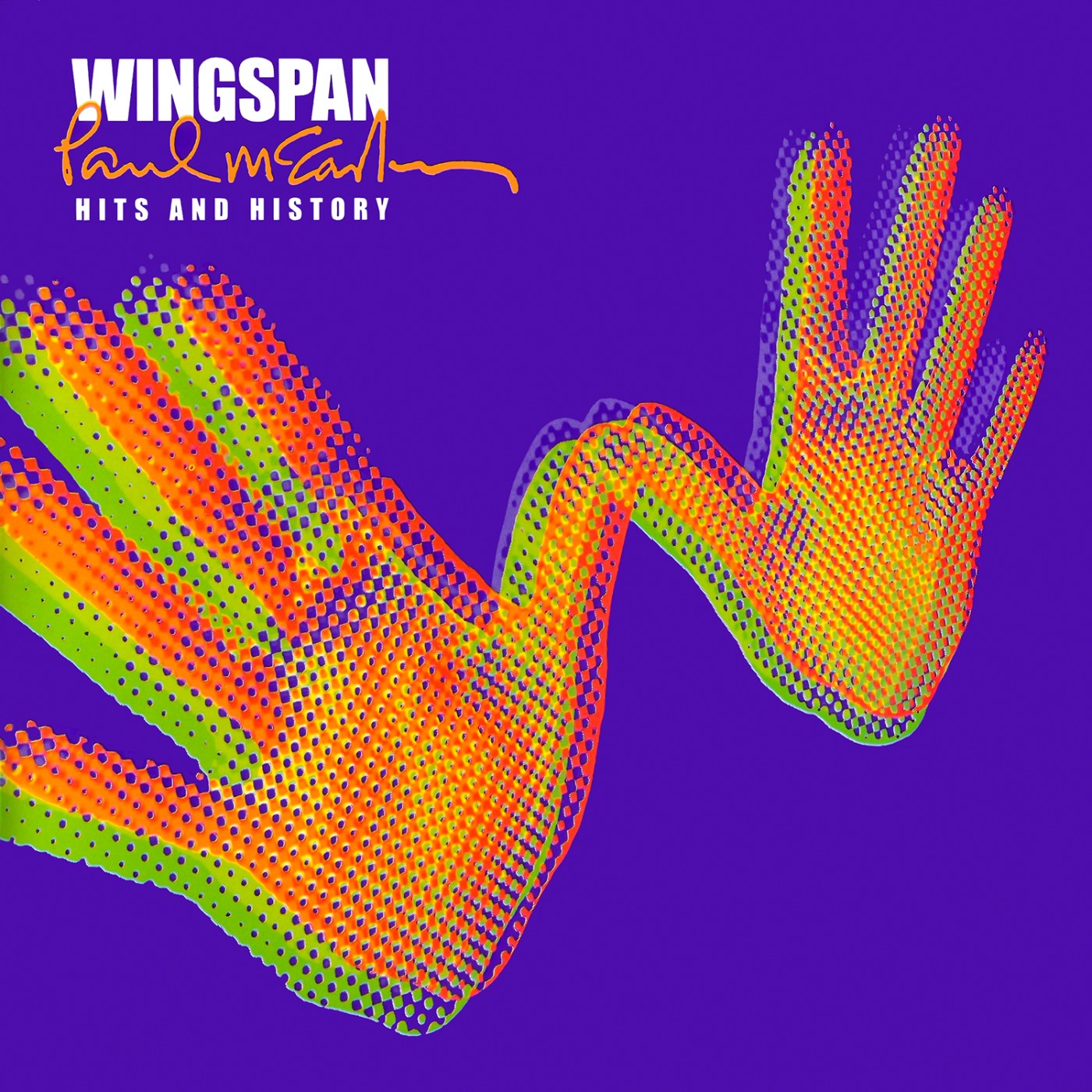
For now though, we rewind the clock back to 2001 and revisit what I’m pretty sure was the album that turned me on to Paul’s solo work: Wingspan, two discs of his music stretching from 1970 all the way through to, of all times, 1984. I seem to remember that my original copy of this album wasn’t legal – for a long time I owned a burned version that skipped on “Live and Let Die.” It was given to me by a friend of my mom’s, who claimed Paul as her favorite Beatle. (Other gifts from this person included a paperback version of the Anthology book and Rubber Soul with the first two tracks switched around.)
Nowadays I have a legal version, and the different printings of that album that exist in the world are a fascinating subject by themselves! Per Wikipedia: “American and British editions of the album vary slightly, as the UK edition contains the studio version of “Coming Up”, while the US edition contains “Coming Up (Live at Glasgow)”, which was more popular there. The Japanese version of the album also includes “Eat at Home”, which had been issued as a single in Japan.”
I’d sure like to know exactly why we like the live version of “Coming Up” more, but I’m not sure I ever will. Even stranger than that is the inclusion of songs from albums that were made long after Wings ceased to exist: Tug of War, Pipes of Peace, and Give My Regards to Broad Street. I can almost see the logic in the first one of those (because Paul first tried to make it as a Wings record but gave up) but the other two are more confusing.
Still! That’s what we have, so on with the music:
Disc 1
‘Listen To What The Man Said’: A classic optimistic McCartney love song, The Paul McCartney Project describes the lyrics thusly: “Even though love may be blind or may cause separated lovers to suffer, the singer believes that love will prevail,” accentuated with a tenor sax solo by Tom Scott, and kiss sound effects by Linda. It was released as a single in 1975, and became a hit.
Band on the Run: Recorded with just himself, Linda, and Denny Laine, the song is a triptych, with three sections that sound completely different from each other… not unlike the medley that goes through half of Abbey Road, actually. A lot of the song has to do with freedom and escape, and “If we ever get out of here” was a nod to something George had said during an Apple meeting in 1969.
Another Day: In which Paul writes an observational song about a lonely woman and her miserable existence… and not for the first time! What we have here is basically “Eleanor Rigby” for the 1970s, focused this time on the doldrum daily routine of an unnamed woman. Going by the lyrics, it sure sounds like she suffers from depression, with a dash of suicidality as well. (Her boyfriend is no help either.) Heavy shit indeed, but that’s just part of how Paul operates. For every “Silly love song,” there’s something like this that really makes you think.
‘Live And Let Die’: Paul’s first and only Bond theme, though I read somewhere they wanted to get him for Diamonds Are Forever but it went to Shirley Bassey again. Inaugurating the Roger Moore years of the Bond movie series, the lyrics have very little to do with 007, but who cares?! It’s a great fucking song. Allegedly, the producers originally wanted to have someone other than Paul sing, but George Martin convinced them to stick with Paul’s recording.
Jet: In case you thought that “Live and Let Die” was a flash in the pan, here comes Paul with a good-old fashioned early 1970s rock song, named for his and Linda’s Labrador Retriever. Exactly what the song is about has never been made entirely clear. But who cares?! It’s Paul rocking out again in the way that only he can do! This is one you want to play as loudly as possible!
My Love: A love song from Paul to Linda, in the style of “The Long and Winding Road,” down to Paul trying to do a Ray Charles voice. (But with electric piano, because this is the 1970s.) For me it sounds like an attempt to write “Something,” and not entirely succeeding. But it’s a Linda tribute song now, so I can’t really complain.
‘Silly Love Songs’: Paul returns with a rebuttal to music critics who didn’t like that he mainly wrote happy, poppy love songs. Given this was the 1970s and Paul was widely viewed as the villain in the story of the Beatles’ breakup, I kind of feel like that might’ve had something to do with how he was critically received. After all, no one complained about a profusion of love songs when John, George, and Ringo were there.
‘Pipes Of Peace’: The title song from his 1983 solo release, “Pipes of Peace” combines the children’s song idea with a peace anthem, ala Lennon’s “Imagine,” but with a focus on climate change and the dangers thereof – and this is 1983, back when we had way more time to do something about it than we do now.
C Moon: C Moon is a reggae-styled song that was released in 1972 as Wings’ third single – I first heard it as a kid when I checked out Back in the US from the library. The full single version includes backing vocals from Heather and Mary McCartney, two of Paul’s daughters.
Hi, Hi, Hi: Wings’ fifth single, in which Paul entirely abandons the concept of metaphor and just does a rock song that is blatantly about sex and drugs. It was a huge hit when played live during a Wings European tour in 1972, but it led to the band getting arrested for possessing marijuana in Sweden. And if that wasn’t all, the single was yet another of Paul’s to get banned by the BBC. Still a great rock song though.
‘Let ’Em In’: While the lyrics are nothing to get too excited about, the melody they are sung to is absolutely fantastic, and the snare drum gives the track an almost military vibe. When it was released as a single later in 1976, it did a lot to boost Speed of Sound’s flagging sales.
“Goodnight Tonight”: Wings goes all disco! According to Paul: “That was all based round some rhythm. I do like dance records: when you listen to records, you’re often down a club and want to dance with someone – I like dancin’, actually!”
Though it was a big hit on the singles charts, reaching #5, John Lennon didn’t like it very much – though he did praise Paul’s bass guitar work. It was recorded during the Back to the Egg sessions, but was left off the album – instead, it’s become a mainstay of various McCartney compilations.
Junior’s Farm: A single from later in 1974, that version was recorded in Nashville in July of 1974, Tennessee, and Paul’s visit there inspired the song’s lyrics. Personally, I’m just enjoying Paul doing another of his rock songs – easily my favorite mode of his. Kind of reminds me of “Helen Wheels,” another single from the Band on the Run period.
Mull of Kintyre: A gorgeous tribute to the area of Scotland where Paul has owned High Park Farm since 1966, and by some distance, Wings’ biggest hit as a band. It was one of the best selling singles of all time in the UK, where it became the 1977 Christmas number one. When it was released, it sold more copies than “She Loves You” had in 1963. And while I’m Irish, not Scottish, even I know a beautiful song when I hear it.
‘Uncle Albert/Admiral Halsey’: One of Paul’s recurring stylistic trademarks is to string together some unfinished works into one piece – this is how you get stuff like “A Day in the Life,” or the Abbey Road medley. It’s one of my favorite early Paul songs, particularly the first half about Uncle Albert. No wonder it became his first number one single!’
‘With A Little Luck’: Another Paul’s sunny optimistic songs, this track was a smash hit for Wings when it was released as a single in March 1978, reaching #1 in the US and Canada, and #5 in the UK. It’s a song that, like so much of the album, is soaked in synthesizers – neatly anticipating the synth-driven music of the ‘80s.
“Coming Up” (Live at Glasgow): Paul’s hit single from 1980, it’s a delightful slice of classic McCartney optimism, enlightened with Paul’s heavy use of a vari-speed machine: a favorite trick of the Beatles in the mid-Sixties. In this case, he uses it to make his voice sound younger, just like on “When I’m Sixty Four.”
“No More Lonely Nights”: The theme song from Paul’s 1984 cinematic disaster, Give My Regards to Broad Street, though notice I don’t use the phrase “title song” there. According to The Lyrics, it took not doing a title drop for him to find inspiration to come up with the rest.
Lyrically, it’s another of Paul’s many love songs, but the real stand-out performer on this track is David Gilmour, best known as the lead guitarist of Pink Floyd. Gilmour spent a large part of the mid-80s recording stuff outside of Floyd – you can also hear him on the songs “The Promise” and “Missing” by Arcadia, a spinoff of Duran Duran.
Disc 2
Let Me Roll It: There are love songs, and then there are love songs by Sir James Paul freaking McCartney. No one, and I mean no one, can write them like he can. This is one of his best by far, and it’s been a staple of mine and Sophie’s joint playlist since we got together. And best of all? If you squint you can take it as Paul expressing his love for John, years after their musical argument in 1971. (I like to think of this song as paving the way to their brief reunion during the Walls and Bridges sessions of 1974.)
‘The Lovely Linda’: Not much to say here, just Paul with an acoustic guitar singing a cute song about his wife. He even affects an American accent on the words “flowers” and “hair,” and it sounds much better than when he tried it on “Till There Was You” back in 1963. It was recorded mainly to test the recently-installed Studer 4 track tape machine, but much like the White Album Esher demos, that’s hardly a bad thing at all.
“Daytime Nighttime Suffering”: Paul writes a feminist anthem, and unlike John’s attempt at a similar idea in 1972, this one does not contain any racial slurs. Instead, it’s a wonderful late 70s rock song that has a lot of imagery involving rivers and streams.
As Paul explained in 2001: “That’s a pro-women song. “What does she get” for all of this? “Daytime nightime suffering.” It’s like the plight of women. You were saying about the Beatles stuff and my stuff being very humanistic. And I say that’s what I would be most proud of — as would any artist.”
I was absolutely obsessed with this song growing up, and now that I think of it, it makes sense – even then, I knew I was a girl.
‘Maybe I’m Amazed’: By far and away the best song on McCartney I, and the best love song Paul has ever written, which is no small feat considering how many of them he’s written over the years. In one of the darkest periods of his life, he had a shining light in the form of Linda, and his love for her shines through every note. He even brings back his “Oh! Darling” vocal stylings back!
Helen Wheels: Paul comes out with another of his car songs, named for the Land Rover that he and Linda used to drive around Scotland and down to London – the route they took is described in the lyrics. Also listen for some throwbacks to “Band on the Run.” This song was originally a single, but got an album release on the US version of Band on the Run – the first time since 1966 that a Beatles-related album had a different tracklist there than in the UK.
Bluebird: Paul’s third-ever bird related song, this is absolutely a spiritual successor to “Blackbird” from 1968, since it deals with similar themes – true freedom, and flight as a way to accomplish it. The main difference is context: “Blackbird” was about the civil rights movement and the plight of Black America, whereas in “Bluebird,” freedom comes from love and sharing in it with others.
‘Heart Of The Country’: One of the happiest of Paul’s solo songs, this one really is just him gushing about how much he enjoys living on that farm in Scotland that he bought in the mid-sixties. It’s an acoustic driven piece in the tradition of “Mother Nature’s Son,” but uptempo. I love it.
‘Every Night’: At last, an actual song! This song has had actual effort put into it, and it really shows – it was recorded at good old Abbey Road, and the lyrics are the closest Paul ever gets to discussing the pain he’d been going through in the aftermath of the Beatles’ split. He pairs that with newfound optimism and joy in the solace he had in his marriage to Linda, in true McCartney fashion. (Also note the melodic reference to “You Never Give Me Your Money.”)
‘Take It Away’: Of all things, the lyrics make this song sound a bit like a 1980s equivalent to “Listen to What the Man Said,” and I gotta say, I like it a lot. Note also that this song includes a very special guest – Billy Shears himself, Ringo Starr, on drums. He and Paul have worked together repeatedly on Ringo’s albums, but this is the first time he’s appeared on one of Paul’s releases.
‘Junk’: A simple acoustic ballad, describing the contents of a junk shop. This song has been hanging around since the late Sixties – Paul tried to include it on the White Album and Abbey Road, but the other three Beatles rejected it – so, of course it got recorded for this album. It’s not much of a song, but the melody is nice.
‘Man We Was Lonely’: As with some of the other songs on this album, this track deals very obliquely with the drama surrounding not only the Beatles’ break-up, but the contemporaneous lawsuits Paul was initiating in order to actually get that divorce John said he wanted. And in all things, Linda is his guiding light – she even sings backing vocals with him on this song, for the very first time ever. It’s quite sweet, honestly.
‘Venus And Mars’/‘Rock Show’: A two song medley, the first song is one of Paul’s many introductory type songs, in the tradition of something like “Sgt Pepper” or “Magical Mystery Tour.” “Rock Show” is a surrealistic description of, well, a rock and roll concert circa the mid-1970s, the beginning of the arena rock period. I like both of these songs (especially the spoken word section of “Rock Show”) but Paul finds it a bit embarrassing.
Sir, you wrote “My Love.” That is embarrassing. “Venus and Mars”/“Rock Show” is just a bit of mid-70s indulgence. What’s wrong with that? I’d like to know…
‘The Back Seat Of My Car’: Paul has always been the Beatle most likely to write a car song, or even songs just inspired by traveling to other places. (Given how much he loves touring, I am not remotely surprised.) This track is another of his late-60s/early-70s car songs, in the vein of “Two of Us” and “Helen Wheels,” but with sexual entendre that harkens back to, surprise surprise, “Drive My Car” from Rubber Soul, filtered through a more grown-up sensibility.
‘Rockestra Theme’: Largely an instrumental piece, featuring a veritable Who’s Who of the late ‘70s British rock scene. According to Beatles Bible: “They included Pink Floyd’s David Gilmour, The Shadows’ Hank Marvin, The Who’s Pete Townshend, Led Zeppelin’s John Bonham and John Paul Jones, The Faces’ Ronnie Lane and Kenney Jones, and The Attractions’ Bruce Thomas.” Basically, an orchestra made entirely of rock musicians! It’s amazing, and also very impractical.
‘Girlfriend’: If you’re wondering why Paul is doing a Michael Jackson impression, that would be because this song was originally written for Jackson when they met in 1975 and ’76. Jackson would end up recording it for his Off the Wall album in 1979, and of course, he and Paul would go on to collaborate quite a bit in the early 1980s. But this song, of course, is where it all started.
‘Waterfalls’: A heart wrenching ballad of sorts, anchored by electric piano, synth strings, and a lovely acoustic guitar solo. Paul’s lyrics are, as usual, love-themed, but with a very haunting quality as his protagonist implores the object of his affections not to do dangerous things – after all, he needs her desperately. Paul thinks the song is somewhat underproduced, but I disagree – the simplicity of the arrangement is what gives it so much power and beauty.
‘Tomorrow’: The optimistic sequel to the famous “Yesterday” from his Beatles period, describing hope that the future will be brighter than the darkness of the past. As noted by Beatles Bible, “Aside from the similar titles, the two songs share the same opening chords – D, C#m7, F#7, Bm7,” though the differing keys make the similarities a little hard to spot.
‘Too Many People’: Ohhh boy. There is no song that has ever engendered as much controversy as this one has, except maybe “Give Ireland Back to the Irish.” “Too Many People” is four minutes of Paul McCartney inventing the diss track, all with the goal of pissing off John Lennon… but because this is Paul, the comments are quite veiled.
‘Call Me Back Again’: A bluesy New Orleans soul number, Paul turns in a vocal performance like we haven’t heard since “Oh! Darling” in 1969, which this song more than slightly resembles. Lyrically, it feels like the thematic inverse of “You Won’t See Me,” with Paul wailing desperately for a phone call that will never happen. It is incredible.
‘Tug Of War’: Beginning with the sounds of people grunting as part of a real tug of war, “Tug of War” does for its namesake what Sgt. Pepper did fifteen years earlier, introducing us to the main themes of the album. This is a record about “the struggle of opposites,” hence the title, and again like Pepper before it, the ending of this track fades into the next one on the album – here it just fades out.
‘Bip Bop’/‘Hey Diddle’: On the complete opposite end of this scale is this little ditty. Cute, but it doesn’t amount to much. Even Paul didn’t think so, describing it as “The weakest song I have ever written in my life”, until Trevor Horn from Frankie Goes to Hollywood said he liked it. (Which makes perfect sense – they’re Liverpudlians as well, after all.)
‘No More Lonely Nights’ (Playout Version): A great song wrecked by a terrible dance arrangement that veers into disco in places.
Out of all the Paul compilations that have come out in the last 5 decades, this one will probably always be my favorite. Yes, it somewhat exceeds its remit compared to 2025’s Wings, and since it’s limited to the 1970s and 80s that means we miss some of his late-career bangers like “The World Tonight” and “Flaming Pie,” but that’s okay.
This album works both as a salute to Paul’s music from the era when he was still trying to compete with his younger self, and also as an introductory album to those who may not have been aware of this chapter in his life. When I was growing up, I was pretty much All Beatles All the Time, much to my mother’s consternation – this album showed me there was more.
And we’ve all got to start somewhere, don’t we?
Next time: we jump forward to 2026 and Paul’s first new album in nearly six years! It’s The Boys of Dungeon Lane!


Leave a Reply