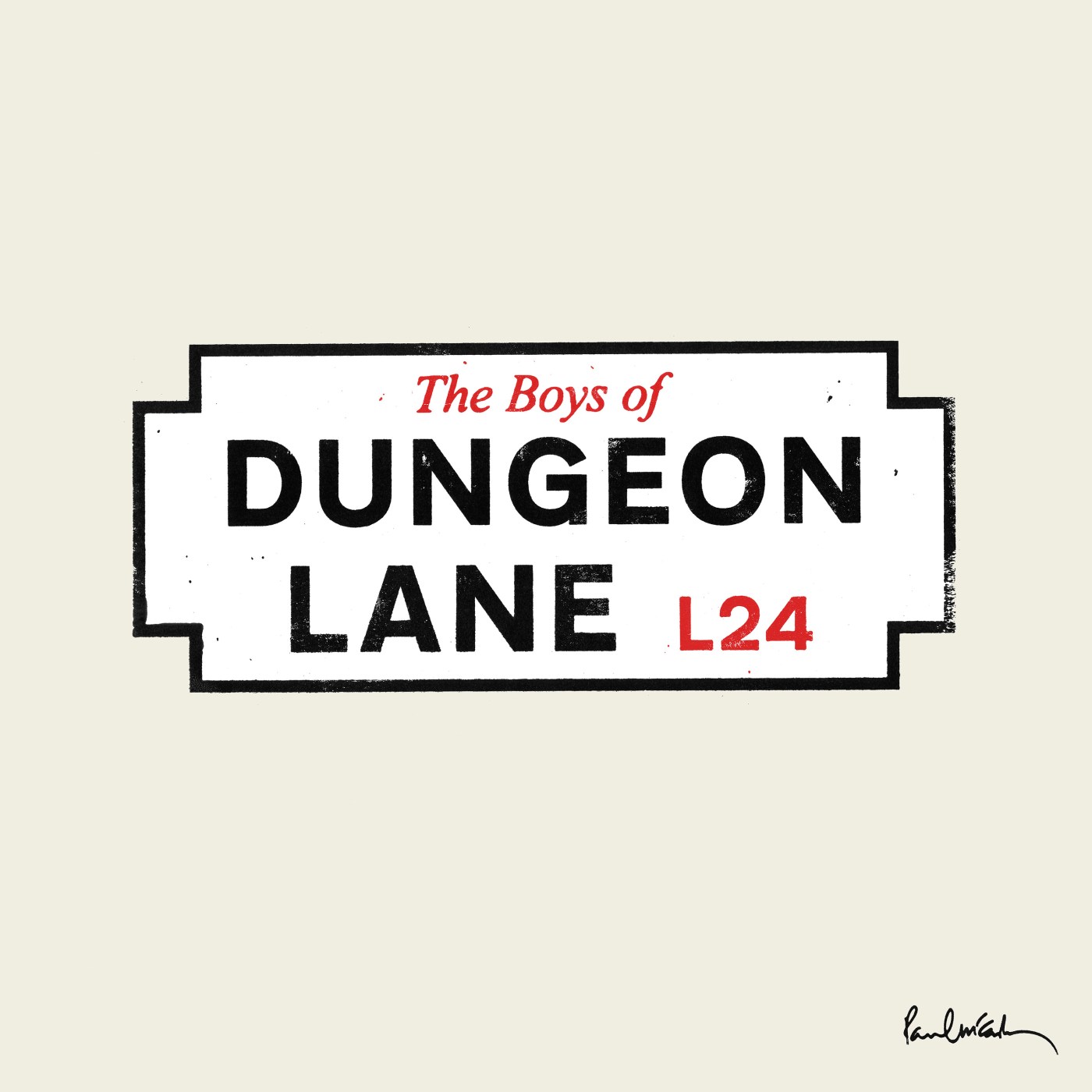
Well dear reader, it happened again! I tend to plan very far ahead when it comes to blogging projects, and just in the couple years that have passed since this one came to be, (Feb. 7th, 2024 per my notes) Ringo has released two new albums, and Paul has finally released the one that I was thinking about in December of last year. It’s called The Boys of Dungeon Lane, and as with so many of Paul’s recent projects, it’s a nostalgic look at the past… but that’s not all it is.
Per the press release, “With The Boys Of Dungeon Lane, Paul McCartney turns the lens inward, revisiting the formative years that shaped his life. Paul now tells the most personal story of all, his own. The Boys of Dungeon Lane is his most introspective album to date and takes the listener back to where it all began.”
“These new songs find Paul in a candid, vulnerable and deeply reflective mood, writing with openness about his childhood in post-war Liverpool, the resilience of his parents, and early adventures shared with George Harrison and John Lennon long before the world had ever heard of Beatlemania.”
At this stage in his life, who can blame Paul for wanting to get even further back, as it were? And like Paul’s best work, it’s as wondrously eclectic as the man himself, as he plays all the instruments, just like on the McCartney albums or Chaos and Creation in the Backyard.
Since it’s the first new album by a Beatle that I’ve had the chance to listen to and write about since my blogging career began, this post will be more of a “first impressions” type of thing than an attempt to explain where the album fits in the longer span of Paul’s career. (We’ll get to George soon, I promise.)
So! Let’s hear what Paul has for us this time:
‘As You Lie There’: We begin with acoustic guitar and bass – hopefully that Hofner he found last year. Unusually for a Paul album, the verses are delivered as spoken word, only the choruses are sung. But what an opening! It sounds fantastic, particularly when he cranks up the rock and roll dial and screams his lines in a way that will be immediately recognizable to anyone who played “Sliding” from McCartney III.
As for who the woman he’s referring to, get this! Her name is Jasmine Howe, according to the British tabloid The Sun. They add that she “left [Liverpool] and resettled in Hertfordshire before retiring to the New Forest in Hampshire. And the now 83-year-old’s family were stunned to learn of the £800million rock legend’s youthful infatuation — revealing she had “absolutely no idea” about his fondness for her.”
The New Forest might ring a bell for some of you. That was where Gerald Gardner and his friends in the coven based in that area did their famous “Operation Cone of Power” ritual in 1940. Paul wasn’t born yet, but Ringo (born in July of that same year) would’ve been around a month old.
Funny how things work, isn’t it?
‘Lost Horizon’: According to Paul, this song dates back to sometime in the early 2000s at least, which could be anywhere from Driving Rain to Memory Almost Full. Per Billboard: “The late Eddie Klein, who worked with the Beatles at Abbey Road and then with McCartney at his studio in Sussex, England, found the track that McCartney said he didn’t remember writing or recording. In England, “we produced it exactly like the cassette,” McCartney said, and then brought it to Los Angeles to add guitar parts. The chugging, mid-tempo track is a nostalgic look back, with lyrical reminders that “time makes every moment count” and “you gotta live for now.”
‘Days We Left Behind’: The first single from the album, released on the day of the album’s announcement. Paul sings in his higher register here, acoustic guitar and piano predominate. Primarily a memory song, there’s a sly reference to Paul’s youth with John – he’s the one referred to in the verse about the secret code. It’s gorgeous, and I can see why it came out first. I love it!
‘Ripples In A Pond’: A good-old fashioned pop song, and the latest in a long line of Paul’s love songs to his many wives. There’s use of autotune here in places, but it’s not that distracting, at least to my ears. Sonically, it feels like this could’ve come straight from Memory Almost Full, it matches the vibe of that record perfectly.
Per Variety: “McCartney described it as “basically a love song to Nancy,” to considerable awww-ing from the small congregation. He originally wrote it in the third person, about a “she,” “but I decided it is much better to just do direct. So I changed the ‘she’ to ‘you,’ so it just means a bit more.”
‘Mountain Top’: A psychedelic number now that according to Paul, was inspired by music festivals like Glastonbury. He told Variety: “It’s like Coachella and Glastonbury … kind of people going off for the weekend to trip out and get stoned. And we go to quite a few festivals these days. We would’ve gone to Glastonbury this year, but it’s not on this year. I was trying to get that feeling of a young girl at the festival, tripping out.”
It’s another excuse for Paul to show off just how talented he is, just check out the list of instruments he plays here! Acoustic guitar, Bass, Bongos, Book slap, Brenell loops, Drums, Electric guitar, Harpsichord, Maracas, Moog, Moog bass, Piano, Producer, Tambourine, Vocals, and Wurlitzer! Also listen for Nancy making an unexpected appearance near the very end of the song.
‘Down South’: A tribute to George now, concerning various hitchhiking trips he went on with the future Beatles lead guitarist: “The great thing is, it really bonds you, because you’re just stuck with each other, and so you learn each other’s humor and each other’s likes and dislikes.” Listen for a couple of lyrical Beatles references, particularly to their cover of “Twist and Shout.”
‘We Two’: The origin story for this song has its roots in 1979, when Paul acquired a lot of old Abbey Road gear, including a Studer tape machine used on Beatles records and a couple of instruments: the harmonium from “We Can Work It Out,” and the spinet from “Because.” This song was written specifically for the purpose of being recorded on the 4-track Studer, with bouncing down and all the other Sixties recording tricks Paul used so liberally back then. Analog gear – there’s nothing like it!
‘Come Inside’: A rocker so straight, not even Paul could find much to say about it! “It’s basically a rocker, not much more to say except it’s terrific.” He is particularly proud of the final chord, known in music theory as a “Picardy third.” (No relation to the Starfleet captain, I assume.)
‘Never Know’: Inspired by Laurel Canyon in California, some of the lyrics seem reminiscent of John’s work, particularly the lines referring to love and peace. Also listen for some Revolver-esque reversed guitar work, and some flutes, like at the end of “You’ve Got to Hide Your Love Away.”
‘Home To Us’: From the opening sound of drumsticks, you know exactly who’s on this track – it’s Ringo! The second single from the album, built around a drum part he played at Andrew Watt’s studio in Los Angeles. It’s incredibly Beatles-y, and is known for Paul and Ringo trading vocal lines in a duet, ala Paul and Michael Jackson on “Say, Say, Say.” The lyrical content? Growing up in the rougher areas of Liverpool, particularly the Dingle, where Ringo lived.
I think this is probably my favorite track, just for these two singing and playing together like the old days. There’s so much joy here, and I think it sums up the album’s themes perfectly. It’s nice to hear Ringo do some rock and roll again after two country records too. It’s a Beatles reunion, with backing vocals by Chrissie Hynde and Sharleen Spiteri.
‘Life Can Be Hard’: Now here’s something – this song dates from 2020 during lockdown, and an early version was heard in the 2021 documentary McCartney 3, 2, 1. I’ve not seen that doc in a while – I should pull it up and listen for it. It’s a genial, simple little song, meant to provide a bit of optimism in that way only Paul can do.
‘First Star Of The Night’: An acoustic number concerning rain, a favorite subject of Paul’s going all the way back to 1966. Something about the guitar part here brings to mind the Esher demos from the White Album, though the lyrics actually have more to do with… well, stars! Paul explains: “The first star of the night is always a sort of special thing when you see it — it always gives me a bit of hope.” You could play this alongside George’s “Here Comes the Moon” and it would fit perfectly!
‘Sailsman Saint’: A tribute to Paul’s parents, describing the lives they led during the Second World War. Adding to the old-fashioned vibes, Paul’s vocal on the first half of the song has been processed to make it sound like it’s coming from an old radio. Listen for 1920s-style horns and strings conducted by Ben Foster and Giles Martin, both of whom worked with Paul on “Now and Then.”
‘Momma Gets By’: We end with an elegiac piano-driven number that sounds like it might’ve come from Chaos and Creation in the Backyard. Paul explains: “Sometimes in writing a song, you don’t draw on memories or or anything in particular except just you’re making up a story. Like ‘Lady Madonna,’ it’s about not particularly people I know.”
As Rob Sheffield noted in Rolling Stone recently, this is exactly the kind of song that Paul has been writing for sixty years now, ever since he penned “Eleanor Rigby.” He was 24 then, inspired by the view he got in his room at Jane Asher’s house in London, and he decided to write a song mourning the lonely old spinster who never got loved by anyone, not even Father MacKenzie.
Here, Eleanor gets to live a better life, and Paul tells her story in a voice that’s been weathered with age, but that’s not a problem. This is an album meant to be sung by a man who’s three weeks out from his 84th birthday. And he’s still fucking got it!
By now, I feel like I’ve said a lot about Paul McCartney and how lucky we are to have him in the world. I can hear more clearly now why Andrew Watt has been getting so much work by aging Sixties rock stars recently, between this and his recent material with the Rolling Stones.
The Boys of Dungeon Lane continues Paul’s unbroken streak of great records, now approaching its 30th consecutive year if you count from 1997’s Flaming Pie. His voice is in fine form – I’d even say it actually sound better here than it has in a while! All that touring he’s been doing has clearly helped him.
Considering he’s 83 years old, I’ll take literally anything Paul wants to throw at us, musically. His work is a precious gift, and I treasure each and every new song he comes out with. After all, who knows how long the tunes will keep coming?
Hopefully, for a long time to come. 🙂
Love you, Paul. Blessed be. ❤


Leave a Reply