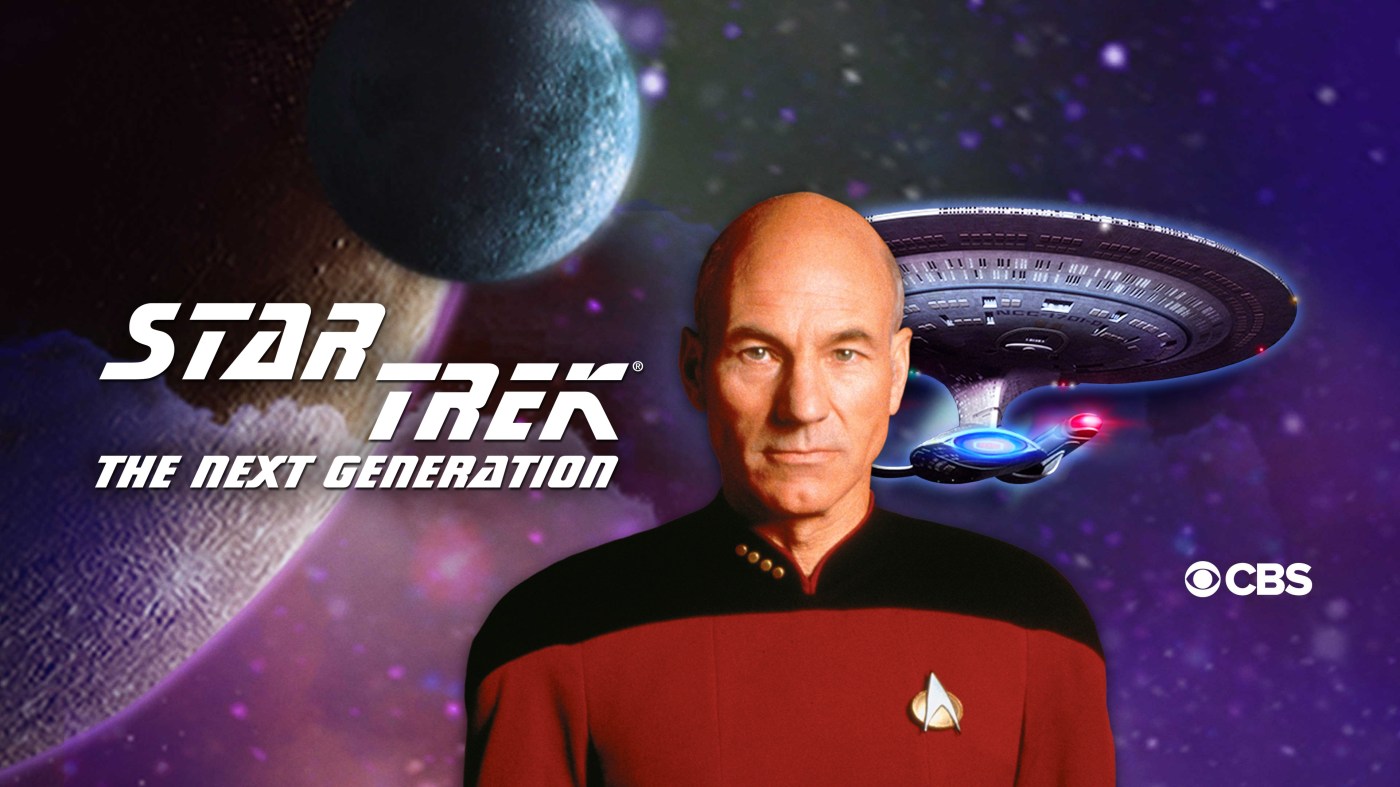
Captain’s log, stardate 81578.1: Lt. Cmdr. Shelby, joins the crew as they investigate the latest planet victimized by the Borg. The Borg soon intercepts the Enterprise and does critical damage, later boarding the ship and kidnapping Picard.
Riker leads a fleet of 40 starships to Wolf 359 to confront the Borg, but the fleet’s efforts are in vain – every starship save one is annihilated. An away team boards the cube and kidnaps Locutus to return him to the Enterprise.
This week, The Big One. We reach the end of season 3 with TNG’s first two-part episode since “Encounter at Farpoint,” the legendary Borg-themed storyline that would go on to not just ensure that TNG got a fourth season (then a fifth, sixth, and seventh) but would define the franchise all the way to the third season of Picard, when the Enterprise-D and her crew face our cybernetic menaces one last time.
Now that we’re here, I have to admit: it’s difficult to know what to write about this one, because it just looms so large in the tapestry of TNG. Part 1’s famous cliffhanger, where Picard makes his dramatic entrance as Locutus of Borg and Riker orders Worf to fire at the cube, remains one of the most epic moments in the history of television. Without that moment, the sci-fi revival that TNG wound up launching would never have happened.
I kind of wish I could have a time machine so I could go back and watch this episode as broadcast in mid-June 1990, just to gauge reactions to that scene. Because from the jump, if you go in blind you have no idea what’s coming – until Act 4, when Picard gets kidnapped, it plays out like any other episode of TNG. And even then, it’s the first appearance of Locutus that really kicks things up a notch.
And yet, for all that the story focuses on Picard, this is really a Riker show. He has been offered command of yet another starship and has, as usual, refused it, leading to a conversation between him and Picard in the latter’s ready room:
PICARD: Will, what the hell are you still doing here?
RIKER: Sir?
PICARD: You’ve been offered the Melbourne.
RIKER: I’ve decided not to pursue that commission at this time.
PICARD: She’s a fine ship, Will.
RIKER: Yes, but she’s not the Enterprise. With all due respect, sir, you need me. Particularly now.
PICARD: Indeed? Starfleet needs good captains, particularly now. Reconsider your decision.
RIKER: Are you telling me to leave, Captain?
PICARD: I’m asking you to look at your career objectively. Will, you’re ready to work without a net. You’re ready to take command. And, you know, the Enterprise will go along just fine without you.
From part 2, we know what would’ve happened in the alternate timeline where Riker did choose to command the Melbourne rather than stay on the Enterprise: He would’ve been creamed as newly minted captain of a ship whose first engagement was with an intractable enemy. As seen in “Emissary,” the pilot episode of Deep Space Nine, only one ship survived the massacre at Wolf 359, and it wasn’t the Melbourne. Frustrating as it might’ve been for Starfleet, Riker’s refusal to leave the Enterprise may have saved the Federation.
The bulk of part 2 instead finds a newly-promoted Riker in command of the 1701-D, though it’s still Picard that gives the “final frontier” speech in the opening credits. Personally I think they should’ve gone the whole hog and had Frakes do it. And maybe credit Stewart as a “special guest star” before putting everything back the week after. But that doesn’t happen, because of course Picard is rescued and Riker goes back to being a commander again, though the reason why is never made explicit.
Still! Up to that moment I can see why Starfleet was so insistent that Riker be moved to a new ship, because he does have what it takes – even if he does have a crisis of confidence early on, staring at Picard’s empty ready room chair and asking what he (Jean-Luc) would do in that situation. Guinan helps him to see that he needs to do what William T. Riker would do instead, and the end result? Execute a daring mission with all the guts you’d expect of the man who, the previous season, was talking to Worf about guile. This is the guy who will, in around 12 years, go on to command the USS Titan.
As you’d imagine, this episode proved to be hugely influential to future generations of Trek writers. As Memory Alpha notes, the Borg went on to be used to provide end-of-season cliffhangers for Star Trek on three further occasions: TNG’s “Descent”, and the VOY episodes “Scorpion” and “Unimatrix Zero”. They also went on to reappear in the feature-length premiere of DS9 (“Emissary”), the feature-length finale of Voyager (“Endgame”), and their big-screen debut in Star Trek: First Contact, the latter of which loosely continues the storyline from this episode.
For all the grief I gave the TNG writing staff a couple of weeks ago about their treatment of women, even I have to credit that Michael Piller did a great job in terms of not only giving Crusher and Troi things to do, but to have them Be Involved in the plan to save Picard in a way that lesser writers wouldn’t have even attempted. The Star Trek: The Next Generation Companion notes that the two female main characters play important roles in saving Humanity; it is Dr. Crusher who determines the Borg’s fatal flaw, and Troi who realizes that Picard is attempting to fight through his Borg programming.
In this episode’s story outline, Michael Piller stated, “This is a story about Riker and Picard’s relationship. It is a rite of passage all men face – the son who must discover his own strength and power… and, in order to do so, must vanquish the father upon whom he depends on and dearly loves.” And had Stewart’s contract negotiations not gone through, Picard would’ve died at the end of the episode, with Riker advancing to command the Enterprise full time. Honestly, I’m glad things went the way they did.
The other thing about this episode, that I don’t think gets remarked upon as much, is that it watches very well even if you know what happens at the end of the first half. True, you lose the surprise factor of the ending, or the tension of whether or not they’ll save Picard, but on the other hand you get to watch the Enterprise crew figure out how to save their altered captain and prevent the Federation from becoming Borg chow.
Is “Best of Both Worlds” what I want Star Trek to be all the time? No, but at least for just this once, it’s a good thing to be. The genre television revival we’ve been enjoying for the last 36 years wouldn’t have happened if TNG’s production staff hadn’t dared to boldly go where no one had gone before and put their captain in genuine danger and peril. While it is true that everything wraps up neatly at the end, that long, haunted stare Picard gives out his ready room window reminds us that nothing will ever be the same again.
Honestly, I’d go so far as to say that this episode is why Trek made it to 60 years. And for me, that’s reason enough to celebrate.


The response to this in 1990 was absolutely incredible! This was TNG’s first real season, finale, cliffhanger, ending, and by far their best.
We had no Internet back then and there were actually rumors of Patrick Stewart wasn’t going to return to TNG, something about his contract.
But like a lot of two part episodes, part one actually eclipse the conclusion in part two.
As for me, once I saw the Enterprise D crew get out of this relatively unscathed, I knew that they could get out of anything.
LikeLike