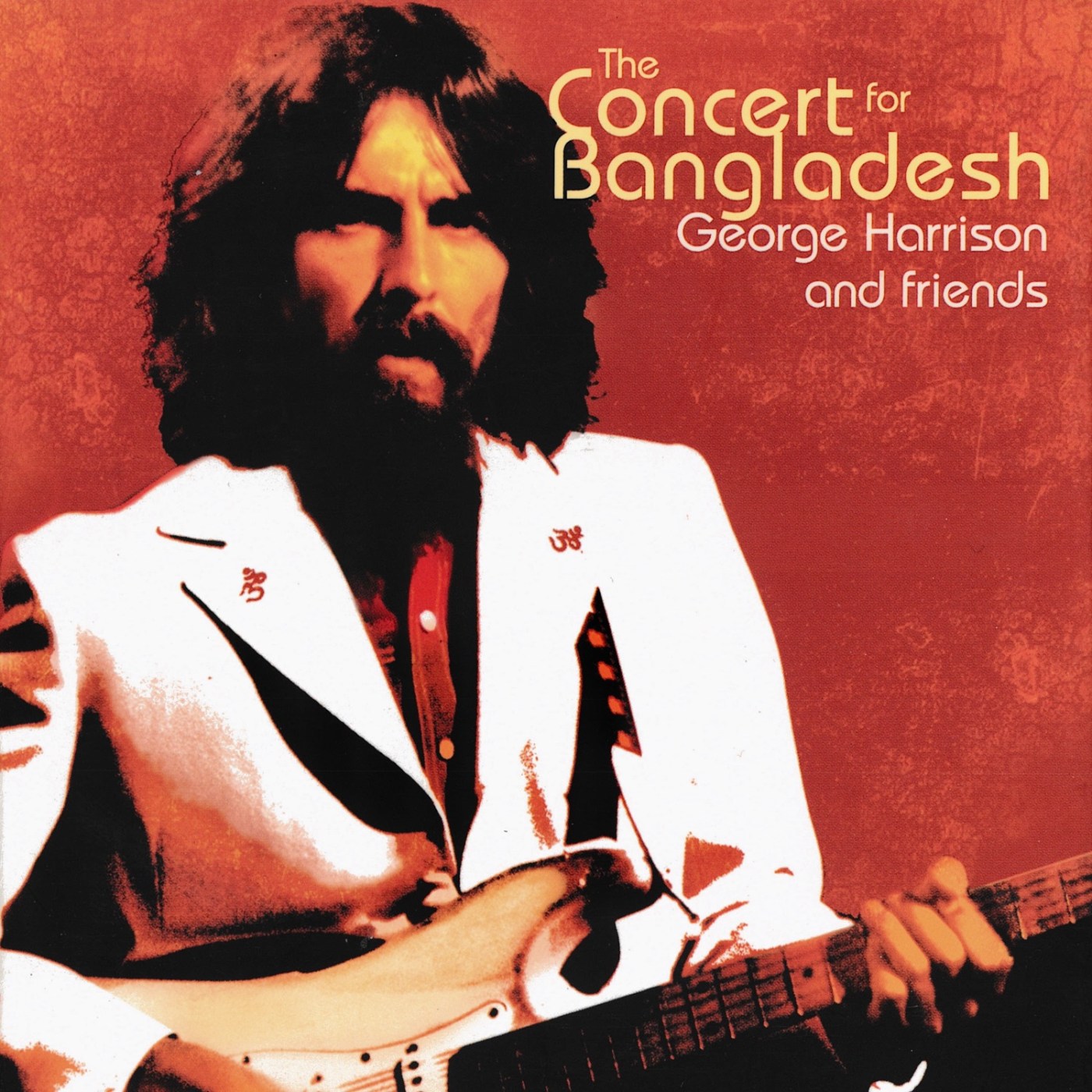
In 1971, George Harrison essentially invented the benefit concert. To quote Beatles Bible: “The borders of Bangladesh had been drawn in 1947 during the partition of the British Indian Empire, which resulted in the creation of two states, India and Pakistan. Eastern Bengal became part of the new state of Pakistan, despite the two regions being over 1,000 from each other and separated by India. The area now known as modern-day Bangladesh was initially termed East Bengal, and later East Pakistan.
Political power was concentrated in West Pakistan, and many in East Pakistan became increasingly aggrieved by perceived economic exploitation. The Bhola cyclone of November 1970 had killed an estimated 500,000 people in East Pakistan and West Bengal, displacing hundreds of thousands more.
In March 1971 an election, won by the East Pakistani party the Awami League, was ignored by the West Pakistani establishment, leading to rising discontent and nationalism, and brutal suppression by West Pakistan.
The violent crackdown led to the Awami League declaring East Pakistan’s independence on 26 March 1971 as the state of Bangladesh. The Pakistani government ordered the military to restore order, beginning the Bangladesh Liberation War. The military crackdown led to widespread atrocities including the genocide of hundreds of thousands of people and the systematic and widespread rape of Bengali women.
There was also sectarian violence by Bengali nationalists against minority groups, mainly Biharis, with up to 500,000 murdered. An estimated 30 million people were displaced during the conflict, and 8-10 million sought refuge in India.
India entered the war on 3 December, following preemptive Pakistani air strikes on the north of the country. The war on two fronts overwhelmed Pakistani forces, who surrendered in Dacca on 16 December 1971.
Ravi Shankar was in Los Angeles during the war, recording the soundtrack to the film Raga. The musician, whose father had been born in eastern Bengal, was both shaken by the unfolding tragedy and perplexed by Western indifference.”
Shankar decided to approach his longtime friend and student, George Harrison, for help. As he explained at the time: “I was in a very sad mood, having read all this news, and I said, “George, this is the situation, I know it doesn’t concern you, I know you can’t possibly identify.” But while I talked to George he was very deeply moved … and he said, “Yes, I think I’ll be able to do something.”
The something, it turned out, was a non-album single simply titled Bangla Desh, and a hastily organized benefit show held at Madison Square Garden on August 1st, 1971. As well as George and Shankar, Eric Clapton was there, along with Billy Preston, Bob Dylan, and Ringo Starr – the only other Beatle to attend. (Paul wasn’t interested and John was on vacation.)
Though there were some financial disasters, the concert did succeed in raising awareness to the happenings in that part of the world, and musically, ended up serving as the model for future benefit concerts like Live Aid. On 5 June 1972, in recognition of their “pioneering” fundraising efforts for the refugees of Bangladesh, George Harrison, Ravi Shankar and Allen Klein were jointly honoured by UNICEF with its “Child Is the Father of the Man” award.
The Concert For Bangladesh was released in the United States on 20 December 1971, and on 10 January 1972 in the UK. The price of the lavish package was $12.98 in the US, and £5.50 in the UK, prices seen by many as exorbitant. Harrison had attempted to persuade the British Treasury to waive their tax entitlement for each sale which, if successful, would have lowered the prices.
Despite the high cost, The Concert For Bangladesh was a bestseller, and topped the charts in the Netherlands, Norway, and United Kingdom, as well as going top 10 in Australia, Canada, Italy, Japan, Spain, Sweden, and the USA.
Since this is a George project though, I’m going to focus on his songs. Four come from All Things Must Pass, along with the aforementioned “Bangla Desh,” the first ever rock charity single, and 3 late-period Beatle tracks, making him the first Beatle to play any of the band’s songs in a live setting.
Let’s hear the live cuts:
‘Wah-Wah’: All four members of the band processed the breakup in different ways: Paul tackled it indirectly by focusing on his terrible mental state in the aftermath and how Linda helped him cope, while John (as ever) went right for the jugular, savagely attacking all sorts of institutions and pop culture pillars including the Beatles.
George’s approach is somewhere between those two extremes. It’s just as angry as anything John came out with, but it’s not as vicious as something like “God” or “I Found Out,” because George’s anger is balanced out with his spiritual fulfillment and his joy at finding freedom away from the Beatles – his equivalent, in other words, of Paul’s verses in “Every Night” where he sings about Linda.
Opening with an electric guitar riff that can only be described as snarling, this song dates from January 10th, 1969 – the day George left the Beatles following an argument with Paul. He wrote this song that afternoon, expressing his frustrations with the rapidly-disintegrating rock band and his junior partner status within the band, culminating in the realization that he doesn’t need Beatle bullshit anymore. Frankly, good for him.
‘My Sweet Lord’: If “Imagine” was John’s signature song, this is George’s equivalent, as spiritual as the former was decidedly agnostic in its outlook. Lyrically, this is his first big engagement with his faith since 1968, and the first time he’s invoked Captal-G God by name ever. The whole track is George expressing his desire to know and be near his god, complete with the backing vocals switching from “Alleluia” to the entire text of Vedic Sanskrit prayer.
And I gotta say, that hits real differently now that I am a practicing Wiccan. It was not until I read Drawing Down the Moon for the first time, back in 2024, that I realized I too felt the same yearning for spiritual connection that George writes about here. Compared to the Christian god, who too felt impersonal for my taste, Cernunnos, Danu, Cerridwen, and the Morrígan all felt (and still do) Present in my life. The night I Claimed myself was a powerful spiritual experience – I felt welcomed, warm, and safe in their embrace, and that’s still true even after all this time. My sweet lord, and ladies, indeed.
‘Awaiting On You All’: In which George writes a gospel number, albeit one from a distinctly Hindu perspective. As he explains in I Me Mine: “‘Awaiting On You All’ is about Japa Yoga meditation which is repetition on beads (mala) of mantras. […] Most mantras for Japa utilize the many names of God, and the maha-mantra has been prescribed as the easiest and surest way for attaining God-Realisation in this present age.”
Not content to merely evangelize, George also spends some time tearing down everything from John and Yoko’s Bed-In for Peace, visas and travel, the stock exchange, Pope Paul VI, and all the trappings of organized religion, from churches and temples to rosary beads and holy books. All of these, in George’s view, are completely unnecessary – worship can be done with chanting alone.
Respectfully, I disagree. While it is true that we may not need the various trappings of organized religion, we still use them because we find some or all of them valuable – for example, I have a little deity altar on the windowsill above my desk, in direct line of sight with my computer, where four bronze statues of my gods sit on top of a blue and silver altar cloth. Any time I look out my window, I see Cernunnos, Danu, the Morrigan, and Cerridwen there as well, keeping me company and reminding me of their presence.
I find the fact that George denounces rosary beads in specific to be amusing, given that I have a set of Morrigan-themed prayer beads sitting on my desk at all times, and I will often hold them when I pray to her each day. I got them last Yule, and the instant I opened the box, I heard the Morrigan say: “Use them daily.” I have, and I am happy to say they’ve proven to be extremely useful in strengthening my relationship with Her.
So, I don’t know, George. All that chanting clearly worked for you, but just because it worked for you doesn’t mean it works for everyone. I don’t bang pots and pans each morning in order to get the Morrigan’s attention – just sitting at my altar and talking to her, like I would a friend, seems to be enough for both of us.
George’s Hinduism was and is valid. So is my paganism, so is my partner’s Judaism, so is my wife’s Islam, so is Christianity, so is atheism and agnosticism. There is no “right” religion, only different religions, each with their own practices and ways of relating to the divine, whether you worship one god, one goddess, or multiples of both.
And I really wish George had written a song about that instead.
‘Beware Of Darkness’: According to George: “‘Beware Of Darkness’ was written at home in England during a period when I had some of my friends from the Radha Krishna Temple staying: ‘Watch out for Māya’ – the cosmic illusion (that which is not). I like the melody – it’s sort of strange. The lyrics are self-explanatory.”
As well as warning of nonsensical things like “falling swingers” and “soft shoe shufflers,” I like how he advises looking out for sadness and greedy leaders. The line about Weeping Atlas Cedars is a reference to the trees that he, John, Paul, and Ringo were standing near during the last Beatles photo session in August 1969.
‘While My Guitar Gently Weeps’: The first of three live Beatles songs, this one taken from the White Album. This is one of my all time favorite songs of his, serving as it does as a commentary on the band’s rapid disintegration. The only bad part is the inclusion of Eric Clapton, a noted racist piece of shit. I get that he was George’s friend, but I really question George’s taste, to say nothing of his decision to gloss over Clapton’s racism over the ensuing decades.
‘Here Comes The Sun’: Brightening the mood after the last song, here comes George with the happiest Beatles song he ever wrote. The song has only gotten more popular in recent years, and in fact, it was the first Beatles track to reach a billion streams on Spotify. Given the anxious times in which we live, a little burst of Harrison’s sunny optimism is exactly what we all need.
‘Something’: If there was ever any doubt that George Harrison had grown by leaps and bounds during his Beatles days, this should put those doubts to rest. Abbey Road was his happiest album, perhaps because he suspected that this part of his life was over. “Something,” as a love song, is one of the best ballads anyone ever did, and I appreciate it even more now that I’m married to Sophie and Ariel, and dating Katie, Alice, and Mixie. I’m an exceptionally lucky woman, and I will not let these loves of mine go for anything.
‘Bangla Desh’: Released 3 days before the MSG shows and recorded in early July, the single became a top ten hit in the United Kingdom and elsewhere in Europe, and peaked at number 23 on America’s Billboard Hot 100. Lyrically, George avoids the politics behind the problem – the first two verses sketch out how he came to know of the situation, with the remainder of the track serving as a call to action.
Originally released as a non-album single, its first album release came in 1976, after the ex-Beatles’ contracts with EMI expired, allowing EMI/Capitol to do whatever they wanted with the Beatle back catalogue – this is how the weird mid-70s Beatles compilations Rock and Roll Music and Love Songs came about. The album was called The Best of George Harrison, and contained no India-inspired music – instead, half the tracklist was Beatles songs and only a few solo-era hits.
It now lives on as a bonus track on the 2014 remaster of Living in the Material World.
It’s easy these days to mock the benefit concert. Just look at how Andy Kershaw, who anchored coverage of Live Aid in 1985, described that show in his autobiography: “Musically, Live Aid was to be entirely predictable and boring. As they were wheeled out – or rather bullied by Geldof into playing – it became clear that this was another parade of the same old rock aristocracy in a concert for Africa, organised by someone who, while advertising his concern for and sympathy with the continent, didn’t see fit to celebrate or dignify the place by including on the Live Aid bill a single African performer.”
In the modern era, you can take the cynical view and assume that a parade of rich and famous musicians nominally performing for a good cause don’t really care about the thing they’re there to help out with.
But with the Bangladesh shows, none of that is true. George’s generosity and willingness to help people who need it are legendary in Beatle lore, and this episode in his life is one of the reasons why. He went on this campaign not to suit himself (as people accuse Bob Geldof of doing) but because of a genuine desire to help his friend and use his platform as a former Beatle for good.
John and Paul would go on to undertake similar benefit shows later in the 1970s, with John doing two shows at MSG in 1972 on behalf of children at the Willowbrook institution in Staten Island, while in 1979, Paul’s band Wings played what would turn out to be their final concerts that December to raise money for the victims of war-torn Cambodia.
After all, if you’re going to be a Beatle, you may as well use that legendary status for something.


Leave a Reply