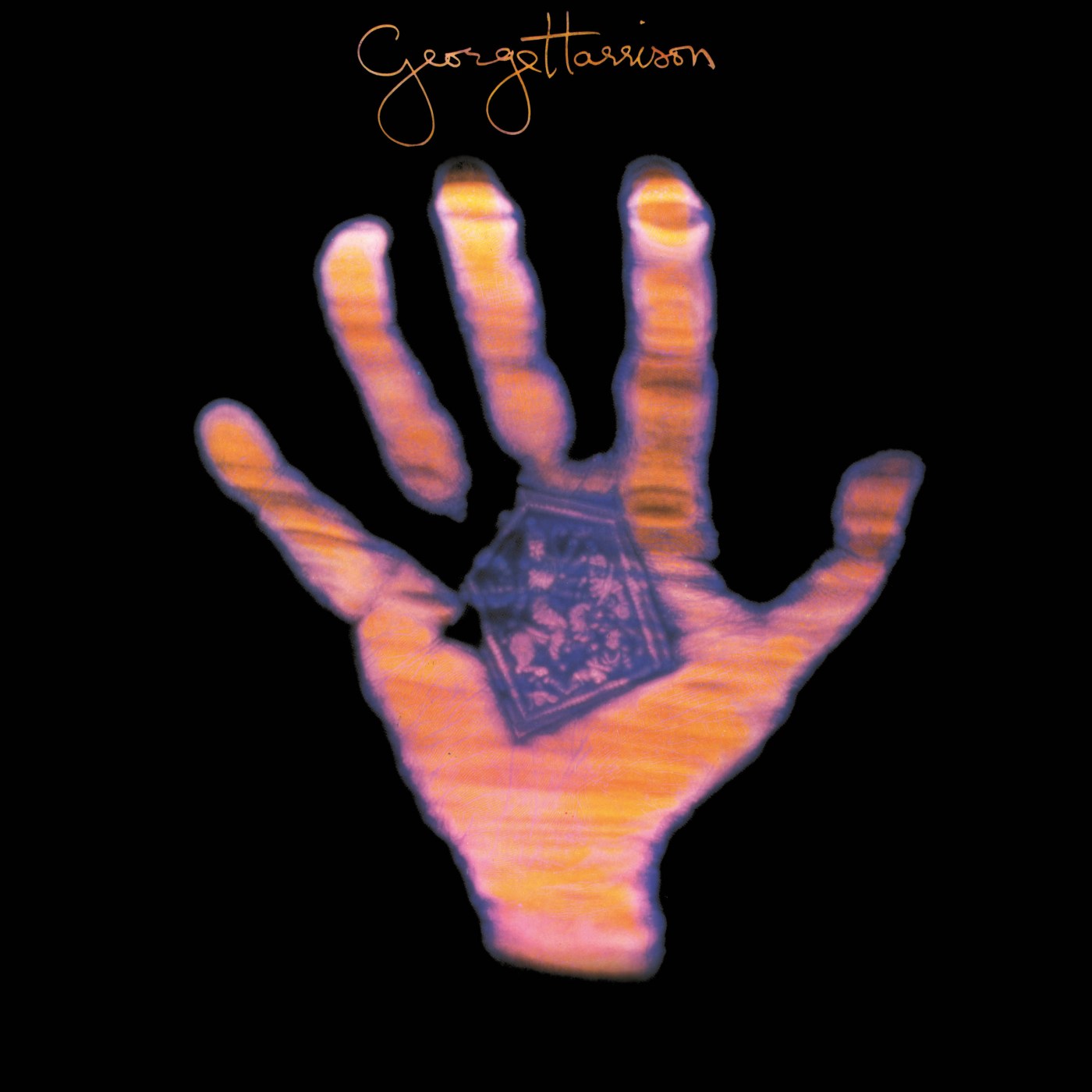
Unlike John and Paul, George’s solo career is filled with gaps of varying sizes. This album, released in 1973, finds him in a difficult place. His marriage to Pattie Boyd has hit the skids, he’s navigating yet another lawsuit, starting his own record label, and like Ringo he’s returning to the movie business, only as a producer rather than an actor. His first producing role is for Little Malcolm, featuring John Hurt, but it too ends up caught in the legal drama surrounding him, Ringo, and John divesting themselves of Allen Klein.
Given everything going on in George’s life, it’s no surprise that the thing keeping him anchored is his religion. As he explains in I, Me, Mine: “From my point of view, the material world is not necessarily just down to money or gain or wealth or power, but material in the sense of the physical… the physical world as opposed to a spiritual world. So the material world is where we live. We live subject to the laws of relativity; which is good and bad and up and down.”
When it was eventually released at the end of May 1973, critical reception was largely positive. Biographer Simon Leng describes Living in the Material World as “one of the most keenly anticipated discs of the decade” and its unveiling “a major event” Rolling Stone said: “Happily, the album is not just a commercial event, it is the most concise, universally conceived work by a former Beatle since John Lennon/Plastic Ono Band.”
In fact, 1973 is the only year in which all four ex-Beatles release an album: John has Mind Games, Paul has Red Rose Speedway and Band on the Run, Ringo has his eponymous almost-reunion album, and George has this. It’s a much simpler affair than ATMP – just George, Nicky Hopkins, Gary Wright, Klaus Voormann, and Jim Keltner on most tracks. And where ATMP was nominally a Phil Spector record, this one was largely produced by George himself, as Spector had become too unreliable to be of real use.
Let’s see if it fits the hype:
‘Give Me Love (Give Me Peace On Earth)’: As George wrote in his autobiography, “This song is a prayer and personal statement between me, the Lord, and whoever likes it.” And it’s something I can relate to far more strongly now as I’ve developed as a Wiccan. My deities may be very different from George’s, but in the end, we’re both yearning for the same thing – connection.
‘Sue Me, Sue You Blues’: No prizes for guessing where this song came from. Poor George found himself mired in legal problems ever since the end of 1970 when Paul sued the other three Beatles in order to legally break up the band. And if that wasn’t bad enough, 1971 found George as the subject of a lawsuit by Bright Tunes Music Corporation, alleging copyright infringement of The Chiffons’ ‘He’s So Fine’ in “My Sweet Lord.” By the time the album was released, he, John, and Ringo chose to sever ties with Klein, which led to further lawsuits for the trio.
Outside of the legal drama, this is the only secular composition on what is otherwise a pure gospel record, inspired by an English square dance and featuring considerable Dobro resonator guitar by our lead vocalist. Lyrically, it’s surprisingly Lennon-esque, with one lyric “Now, all that’s left is to find yourself a new band” seemingly referencing Paul’s formation of Wings in 1971.
‘The Light That Has Lighted The World’: While it started as a song for Cilla Black and a commentary on fame, very rapidly it turned into George responding to his critics who’d had only negative things to say regarding the spiritual content of his lyrics on ATMP. As he wrote in 1980: “The strange thing about change is that people are always saying ‘Oh he’s changed’ as if change is a sin, but the whole of life is a change. Would they rather everything were stuck in one place forever?”
Spiritual experiences do tend to change people! I mean geez, two and a half years ago I believed in and prayed to no gods at all, and now I worship four of them. Of my gods, both Cerridwen and the Morrigan are about change, being shapeshifters and all. Knowing them both has changed me, the same with Cernunnos and Danu. Being Wiccan and a Celtic polytheist has fundamentally reshaped how I look at and move through the world, and I wouldn’t have it any other way.
George gets it. More power to him.
‘Don’t Let Me Wait Too Long’: Despite what the title might imply, this is not a sequel to “Blue Jay Way” from Magical Mystery Tour. Instead this is more like a remake of “What Is Life,” a love song where you can’t tell if he’s singing to a mortal woman or a deity. Personally I think it’s a woman, and likely Pattie, given the terrible state of his marriage by this point in his life… though I will note that these problems were entirely self-inflicted, between the affairs he was having and his ever-growing commitment to religion.
I mean, I get it. Sometimes my work with the Morrígan feels like I got married to a goddess, but that doesn’t mean my responsibilities to my mortal partners come to an end.
‘Who Can See It’: To quote the man himself: “‘Who Can See It’ is once again an open-tuning song and has all kinds of suspended chords I would not have found with regular tuning. It is a true story meaning – ‘Give us a break, squire’ and reminds me of Roy Orbison for some reason. He could do this good.” Beatles Bible posits that this is a reflection on his Beatle past and the freedom he now enjoys as a solo artist, though personally I see it as George singing about his reclamation of his personal sovereignty, and his firm conviction that only someone who can accept that will earn his love.
‘Living In The Material World’: The song was inspired by AC Bhaktivedanta Swami Prabhupada, the founder and leader of the International Society for Krishna Consciousness (ISKCON), the Hare Krishna movement. John, Paul, and Ringo each get a shout-out, with the latter referred to as “Ritchie,” as the other three Beatles liked to call him. (Short for Richard, his actual given name.)
The second half of the song reads like an evolution of a theme George expressed in “My Sweet Lord,” his desire to abandon material existence in favor of living in the spiritual world instead. He writes in I, Me Mine: “No matter how good you are you still need ‘grace’ to get out. You can be a yogi or a monk or a nun but without God’s grace you still can’t make it.”
Comments like that make me very glad that my religion doesn’t go in for the concept of sin, no matter what people say about the Three-Fold Rule. I don’t have to worry about receiving the grace of the gods in order to reach the Otherworld, it just happens. Even Christian Day, a man who gives the rest of us pagans a bad name simply by calling himself a warlock, will reach the Otherworld… though he’s probably going to get reincarnated faster than I will, because the Goddess and God will not need his bad vibes stinking up the joint.
‘The Lord Loves The One (That Loves The Lord)’: Remember on “Awaiting On You All” where I wrote an essay-with-an-essay essentially tearing George a new one for being a bit too evangelical in songwriting? Here he is doing it again! Just look at this chorus: “Now, the Lord loves the one that loves the Lord. And the law says if you don’t give, then you don’t get loving. And the Lord helps those that help themselves. And the law says whatever you do’s gonna come right back on you.”
A lot of music critics hated this one in 1973, and it’s not hard to see why. It is profoundly Christian in its sentiments, which is again very ironic given that George was a Hindu. For my part, all I see is a list of reasons why I could never cut it as a Catholic myself – I simply do not believe that divine love should be conditional, nor do I believe it should be granted to a select few and denied to others.
To me, that kind of framing smacks of divine callousness and outright cruelty. And I disagree, in the strongest possible terms, with the assertion that the gods are either one of those. It reminds me somewhat of something Lora O’Brien asserted earlier this year, when I made the mistake of attending one of their Morrigan workshops:
“But the point is that when you begin working with the Morrigan, she’s not going to expect anything of you because she doesn’t give a shit about you. Basically, you were one in a thousand, one in a million of potential pieces that she could work with in her big 5D chess game that she’s playing. […] This is a goddess. You’re nothing to her. Like in the grand scheme of things, I’m nothing to her in the grand scheme of things. That is just how it is.”
No, Lora, that isn’t just “how it is.” Bluntly, if the Morrigan were as cold as O’Brien portrays her, I wouldn’t be working with her in the first place. When I formally dedicated myself to her at Samhain 2024, near the end of the ritual I felt this surge of rabid, wild joy from her, she was thrilled that we’d entered into a relationship together.
My own experiences tell me that she cares very deeply for her ravens, as any goddess or god worth worshipping would do. I mean, look at Badb as the Washer at the Ford. As Woodfield tells it, she doesn’t just wash the clothes of those destined to die, but grieves and keens with us for those we’ve lost. That kind of empathic quality doesn’t seem to enter into O’Brien’s framework at all.
While the assertions George is making in this song are quantifiably different from O’Brien’s, they still make me feel a certain kind of way. Divine love, whether you believe in one god or multiple, shouldn’t be a competition. It should be something given out to everyone, as I believe it is. Any god worth worshipping is going to care, very deeply, for the people under their care, whether you know them as Vishnu or Great Queen.
While I respect that George believed this with all his heart, (otherwise he wouldn’t have written the song) I can, and do, reject his starting premise, simply because his worldview as a Hindu and mine as a pagan are almost orthogonal to each other. A lot of the world’s problems start from the assumption that some people are more deserving of divine love than others, and I have zero patience whatsoever for that logic.
Love should just be love. We shouldn’t need qualifiers.
‘Be Here Now’: To quote George: “‘Be Here Now’ was written in Nichols Canyon, Los Angeles, a week after ‘Miss O’Dell’ (I moved from Malibu as it was too far to drive to the studio each day). I was almost falling asleep, I had the guitar in bed and the melody came fast.” It contains upright bass as played by Klaus Voormann in the bathroom of the studio where the song was recorded.
‘Try Some Buy Some’: To me this song reads like George reflecting on his mid-Sixties drug use, as he discusses in some detail during The Beatles Anthology docuseries. And it’s not just me saying this, David Bowie thought so too! He covered this song in 2003, saying at the time: “It’s overstated about most rock artists leaving drugs, it’s such a bore to read about it. But when I first heard the song in ’74 I was yet to go through my heavy drug period. And now it’s about the consolation of having kicked all that and turning your life around.”
‘The Day The World Gets ’Round’: Written straight after the Bangla Desh shows, the problems of the world were clearly on George’s mind. He decided to respond to them by writing what is (for him) the closest he gets to one of John Lennon’s more political songs, and depressingly, much of what George wrote about it in 1980 remains as true now as forty six years ago:
“Let’s face it, the whole problem and how to solve it lies within the power of the governments and world leaders. They have resources, food, money and wealth enough for twice our world’s population, yet they choose to squander it on weapons and other objects that destroy mankind.”
In the 1970s it was nukes. In the 2020s it’s still nukes, but also generative AI programs and data centers, all of which are making this particular summer incredibly brutal. As I write, Europe has spent most of the past couple months either baking in extreme heat or burning to a crisp, as in France and Spain. My former hometown of St. Louis recently recorded heat indices of 124° Fahrenheit/51° Celsius. Global warming is accelerating, and exactly none of the politicians in the world, be they in America, Britain, or Ireland, care enough to do anything about it.
I hate it. George’s anger is entirely justified.
‘That Is All’: In I Me Mine, all George had to say was this: “There is nothing particularly to say about ‘That Is All’. The melody came to me and I then had to think of lyrics. That’s all.” It’s the last track on the album, featuring an orchestra and choir arrangement by John Barham. Musically, it feels a bit like a throwback to some of his Beatles era work – the lyrics and chord progressions recall “Something,” while the bridge section is evocative of “I Want to Tell You” from Revolver.
It’s not hard to see why this album, despite the positive reviews it got upon release, has spent the ensuing 53 years largely being ignored – on one side you have the extravagant majesty of All Things Must Pass, and on the other side is Dark Horse, the album where an overworked George is barely able to carry a tune. The end result was such a disaster that George’s solo career never really recovered after that, and so this album was left in the dust, overshadowed by the two extremes of his solo work.
And yet. In listening to it, I find something in that I like. This is George’s most spiritual album – it informs almost every song on here but one, and given the subject of that one exception, you get why. Something about centering your creative work on your faith, whether that’s Hinduism or Wicca, makes that thing incredibly personal. This is George’s version of Plastic Ono Band, only he substitutes John’s anger for love of, and for, his god.
And you know what? That works for me. Creativity as an act of devotion informs my own practice as a witch, and it’s plain as day that while he might’ve used different terms, George understands the meaning all the same.
All we need is love.


Leave a Reply