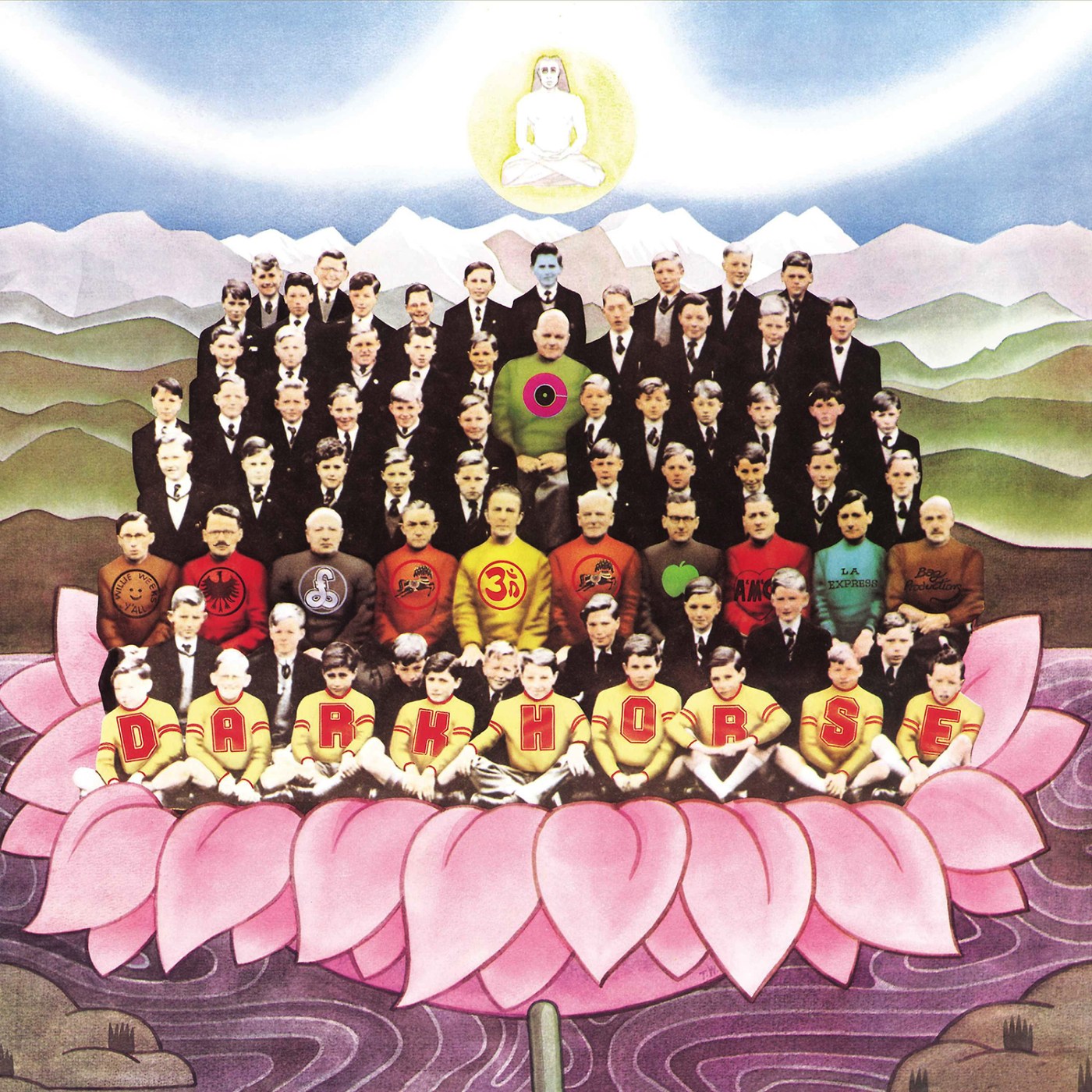
It’s 1974, and things seem to be going way off track for George. Pattie officially left him for Eric Clapton with this album, and though he put on a happy face in public, the truth was he was absolutely crushed, and that shows through in some of the songs from this album – “Bye Bye Love” in particular.
As George himself explains: “There was a bad domestic year, 1974. All that splitting up around the house. ‘Simply Shady’ that song is about it. At the same time I was doing a Splinter album and a Ravi Shankar album and my own album and then during rehearsals, I was trying to finish my album and in the end [business manager] Denis O’Brien carried me out of the studio to my first concert (in Canada) because I was trying to finish the album in time to get it out to coincide with the tour, which is the way the ‘business’ needs it.”
That tour, which ran at the tail end of 1974, was generally regarded as being a critical and commercial disaster. Though it was the first visit by any Beatle to North America since the final Beatles tour in 1966, George had no desire to revisit his Beatle past – he wanted to focus on new stuff. And when he did sing Beatles songs, he butchered them, thanks to his exhaustion and his vocal problems.
I mean, just look at what Rob Sheffield writes in Dreaming the Beatles about his performance of “In My Life,” a song he didn’t even write: “Each night’s “In My Life” is horrifying in its own way—slow, sludgy, half-loud reggae, jazzy marimba, horns, the world’s smarmiest version of the Saturday Night Live goodnight theme. It’s unrecognizable for the first minute, until George begins singing, and you can hear the crowd wake up—hey, this one. Suddenly there’s an audience in the room. The excitement is electric—it ripples through the air. It lasts for a couple of lines, and then there’s an audible chill. He can’t sing it. […] For the big climax, he rasps, “I love God more.” It’s like he summoned up an intimate memory for the fans just to tell them it doesn’t mean shit to him.”
In essence, Dark Horse is an album about the collapse of its writer’s commercial fortunes. While he certainly has plenty more albums in his discography from this point, he never reaches the ATMP highs again. This album marks the point at which the music press fell out of love with George, even as they were falling in love with Paul.
Still, let’s see what we can make of this:
‘Hari’s On Tour (Express)’: One of exactly two instrumentals in George’s entire discography, the title refers to George’s impending set of concerts that would be held in November and December. A slide guitar-based composition, the track also features saxophonist Tom Scott and the latter’s jazz-rock band L.A. Express, who were touring as Joni Mitchell’s backing group at the time.
‘Simply Shady’: The second track to come out of the session that also produced the album’s opener, this and the next few songs are astonishingly raw and personal for George. He explained in 1980: “‘Simply Shady’ is about what happens to naughty boys in the music business. I suppose I got the idea here, at home, and then I escaped to India after that, and I wrote it in Bombay – it was a funny sort of song to be writing in Bombay – especially after the one about Karma!”
Karma sure got him, alright.
‘So Sad’: “I started ‘So Sad’ in New York City in 1972. I like this song a lot as a melody and lyrically, except the only problem with it is it’s depressing. It is so sad. It was at the time I was splitting up with Pattie,” wrote George in 1980. It’s the oldest song on the album, and while his heartbreak is undeniable, the track is let down by George’s weak vocal performance – laryngitis is a bad thing to have, particularly for George, since his vocal work during the early ‘70s has never been as strong as John or Paul’s. (Or hell, his own during the Beatle era.)
‘Bye Bye, Love’: A cover of a song by the Everly Brothers, with new lyrics referencing Pattie and Eric’s new relationship. Unusually for George, it contains no other musicians – that’s him on vocals, acoustic guitar, electric guitar, bass guitar, electric piano, and for the first time ever, he even drums. We’re used to this kind of thing from Paul, but from George it’s a genuine surprise!
‘Māya Love’: “‘Māya Love’ was written purely as a slide guitar tune with the words added later,” wrote George in 1980. The track is heavily inspired by funk rock, and like George’s other slide guitar songs, uses an open E tuning rather than standard. Listen for Billy Preston, a mainstay on George’s solo albums, with the electric piano material.
‘Ding Dong, Ding Dong’: Released near the end of 1974, this is George’s holiday song, in the tradition of John’s “Happy Xmas (War is Over)” or Paul’s “Wonderful Christmastime.” Just to be different, it instead focuses on New Year’s Eve and Day, with lyrics inspired by inscriptions found around Friar Park.
The music video builds on the fresh start theme by featuring George wearing two old Beatle outfits: his collarless suit from the “I Want to Hold Your Hand” single cover, and his Pepper-era outfit, complete with hat. Also making an appearance in the video: The Rickenbacker 12-string that he used so extensively on A Hard Day’s Night.
He wrote in 1980: “‘Ding Dong, Ding Dong’ was the quickest one I ever wrote. It took me three minutes, except it took me four years of looking at the thing, which was written on the wall at my home.”
‘Dark Horse’: Our title song, inspired by some wordplay George remembered from his youth in Liverpool: “When I was a kid, I always remember them saying, ‘Oh, have you heard about Mrs Penguin from the Co-op? She’s knocking off Mr Jones. Oh, she’s a dark horse.’ It was always that sort of thing. I was brought up knowing that dark horse was a phrase like that.”
As well as serving as the album’s title track, the song also gave George the name for his new label, Dark Horse Records – the logo for which is included on the cover art. George would gradually transition to that label after releasing his final Apple record, 1975’s Extra Texture.
‘Far East Man’: Quoth George: “The idea came about because the Faces had done a tour of the Far East – and Woodie came into the session wearing a tee shirt with the wording ‘Far East Man’ (far out man!).” Woodie is Ronnie Wood, former lead guitarist of the Faces, and since 1975 a member of the Rolling Stones. He and George would each record their own versions, though of the two only George has vocal duties on both tracks – on Wood’s version, he sings backup to Wood’s lead.
‘It Is ‘He’ (Jai Sri Krishna)’: Dark Horse marks something of a change for George – with his album he moved away from direct references to his faith, something that had colored each of his previous two studio albums. This is the only one to contain any mention at all of Krishna, and includes a Moog synthesizer – not heard any of George’s albums since 1969’s Electronic Sound.
Dark Horse isn’t the worst album in the solo Beatle canon – that dishonor goes to Paul’s Give My Regards to Broad Street. Dark Horse instead feels like a lesser cousin of John’s Walls and Bridges, as both albums capture their musicians at low points in their careers… except in John’s case, he turns in some excellent vocal performances, while George’s tracks are let down by his inability to sing very well.
It’s an album that finds George in a bit of a rush. He’s overtaxed and undercooked, leading to the worst vocal performance of his life and definitely some of his worst reviews, particularly from Rolling Stone, which described Dark Horse as a “chronicle of a performer out of his element, working to a deadline, enfeebling his overtaxed talents by a rush to deliver new ‘LP product.’”
Record buyers in Britain agreed: the album failed to chart at all in George’s home country, though it did okay in the US, reaching #4 in Billboard, Cash Box, and Record World. It received a gold disc from the RIAA in late 1974.
As for me? It’s an album that exists. I can’t say I have any interest in listening to it again.


Leave a Reply