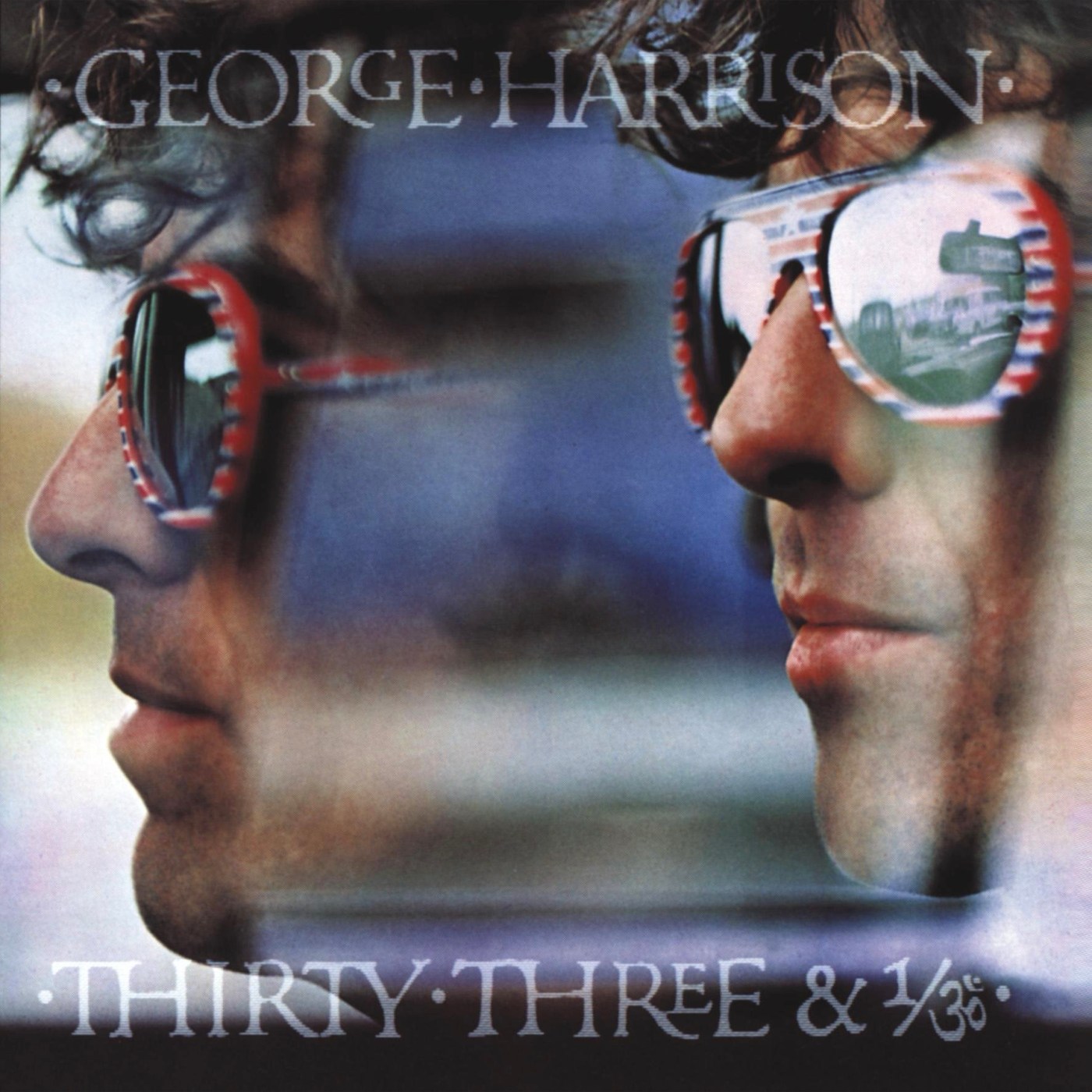
This week, a new era for George as he breaks free of Apple Records and begins releasing albums on his own label, Dark Horse. Up first is his first release on the new label, Thirty Three & ⅓ from 1976. I’ve always really liked this album – George commands his own destiny now, and you can hear it in the music.
There’s a confidence to it that his last two releases largely lacked, along with a good amount of humor, including the title: a reference to the speed at which an LP revolves around a turntable, and George’s own age. (Shades of Revolver in that, actually – another record with a confident-sounding George.)
The reviews were equally ebullient. Billboard magazine described the LP as “a sunny, upbeat album of love songs and cheerful jokes that is his happiest and most commercial package, with least high-flown postures, for perhaps his entire solo career.” The reviewer rated the production “top-notch” before concluding: “And Harrison’s often-spectacular melody writing gift gets brilliant display here.”
Let’s dive in, shall we?
‘Woman Don’t You Cry For Me’: Our opening song, beginning with a rat-a-tat-tat drum part by Alvin Taylor. According to George, it was written in Sweden in 1968, and like a lot of his songs, it’s in the key of E. It was written for bottleneck guitar, and almost got recorded for All Things Must Pass, only for George to change his mind and use it here instead.
‘Dear One’: After avoiding the subject entirely on Extra Texture, George’s spirituality returns with a song dedicated to Premavatar Paramahansa Yogananda, who wrote Autobiography of a Yogi. According to Ravi Shankar, “that was where his (George Harrison’s) interest in Vedic culture and Indian-ness began.”
It seems to me, then, that AOAY was for George what Margot Adler’s Drawing Down the Moon is for me: the book that set us down on our respective spiritual paths, and changed our lives forever. (The other book that got me to where I am today is probably The Book of the Great Queen by Morpheus Ravenna, the scholarly text about the Morrígan.)
‘Beautiful Girl’: A true love song from George now, begun in 1969 and demoed in 1970 for ATMP, but left unfinished until now, where it became a love song for Olivia. George wrote: “I started ‘Beautiful Girl’ in 1969 – I’d been working on a Doris Troy record and Stephen Stills had a very good twelve-string guitar which he loaned me for the evening. I wrote the tune then on that guitar but I couldn’t get past the first verse with the lyrics, and so the song sank back into the distance, but I remembered it during 1976 and finished the lyrics. I related it then to Olivia.”
‘This Song’: In which George satirizes the ongoing lawsuit he’d been going through with Bright Tunes Music regarding his alleged plagiarism of the song “He’s So Fine” by the Chiffons for “My Sweet Lord.” Listen also for the voice of Eric Idle, who makes a cameo appearance during the bridge doing his middle-aged woman routine from Flying Circus. (Idle and George were good friends, with George making cameo appearances on Idle’s show Rutland Weekend Television, which begat the TV movie All You Need is Cash – a satire of the Beatles’ rise to fame.)
‘See Yourself’: Probably the oldest song on the album, the track dates to 1967, surrounding the controversy regarding Paul’s admission to the British press that he, and the other three Beatles, had all taken LSD in the mid-1960s. All George had to start with was the opening verse, the rest of the song was written in 1976.
‘It’s What You Value’: You may not know this, but George was a bit of a petrolhead, as the English expression goes. After starting out with a Ford Anglia 105E, Brian Epstein gifted him a Jaguar E-Type with dash-mounted record player for his 21st birthday in 1964. This song, inspired by Jim Keltner’s request for a Mercedes in lieu of money for his work on George’s 1974 tour, quickly became a motoring number.
‘True Love’: The song was written by Cole Porter, and first appeared in the 1956 musical High Society. A duet between Bing Crosby and Grace Kelly, it was nominated for the Academy Award for Best Original Song. The music video for George’s cover was directed by Eric Idle.
‘Pure Smokey’: A love song with a specific target in mind: One Smokey Robinson, one of George’s favorite musicians, complete with a throwback to the song he and John sang together on With the Beatles: “And anyone who hears, hears that voice so free/He really got a hold on me/And I thank you Lord for giving to us pure Smokey”.
Mr. Robinson was reportedly quite touched, saying in 2014: “That was a wonderful, flattering thing for him to feel like that, and to write about it, so that the world could know that he felt like that. It was wonderful to me, and I’m very flattered by that.”
George wrote in 1980: “‘Pure Smokey’ started out with nice chord changes. I’ve always liked Smokey Robinson and he’s probably one of the best songwriters around.
He writes great lyrics and great melodies, and he is fantastic to see in concert, because one tends to forget how many good tunes he has written.”
‘Crackerbox Palace’: A cheerful and slightly surreal little number inspired by the home of one of George’s favorite comedians. As he explained in 1980: “I was in Cannes for the Midem Music Festival in 1975 and I met a man and talked to him and said ‘I don’t know if this is an insult or a compliment, but you remind me of Lord Buckley’. He said ‘I managed him for eighteen years’, which was an incredible coincidence.” […] “So I was talking with this guy, George Greif, in France, about Lord Buckley, and he said Buckley lived in an old beaten-up house in Los Angeles which he called ‘Crackerbox Palace’. I thought ‘Ah, that sounds like a song’ and wrote it down on a cigarette pack.”
‘Learning How To Love You’: The final song on the album, originally written for Herb Alpert, trumpeter and co-head of Harrison’s record label A&M Records. (A&M were the original distributors of Dark Horse, but the late delivery of the album masters led to yet another lawsuit and George deciding to move to Warner Bros. Records instead.)
After spending much of the 1970s in the musical doldrums, it’s nice to hear George get his spark back. While this album wasn’t a worldwide smash as ATMP had been, it was still pretty highly regarded at the time. Ray Coleman of Melody Maker called it George’s best album since Rubber Soul with the Beatles.
When the album was remastered in 2004 for the Dark Horse Years box set, Mac Randall of Rolling Stone named “Beautiful Girl” as “one of the many highlights of his upbeat return to pop form, Thirty-Three & 1⁄3”. Writing for The Word that year, Paul Du Noyer referred to the album as “the lost treasure” among Harrison’s Dark Horse Years reissues, and in a concurrent review for Blender, he highlighted “Crackerbox Palace” and “Learning How to Love You” as the standout tracks.
I think if I had to decide which of George’s albums was my favorite, this one would probably be my pick. For all the storm and stress that George was going through in the course of making the thing, all you hear on the record is his joy at having cut the last remaining ties to his Beatles era. This is George feeling refreshed, with a new love and a new label, ready to do things his way rather than anyone else’s.
More power to him!


Leave a Reply