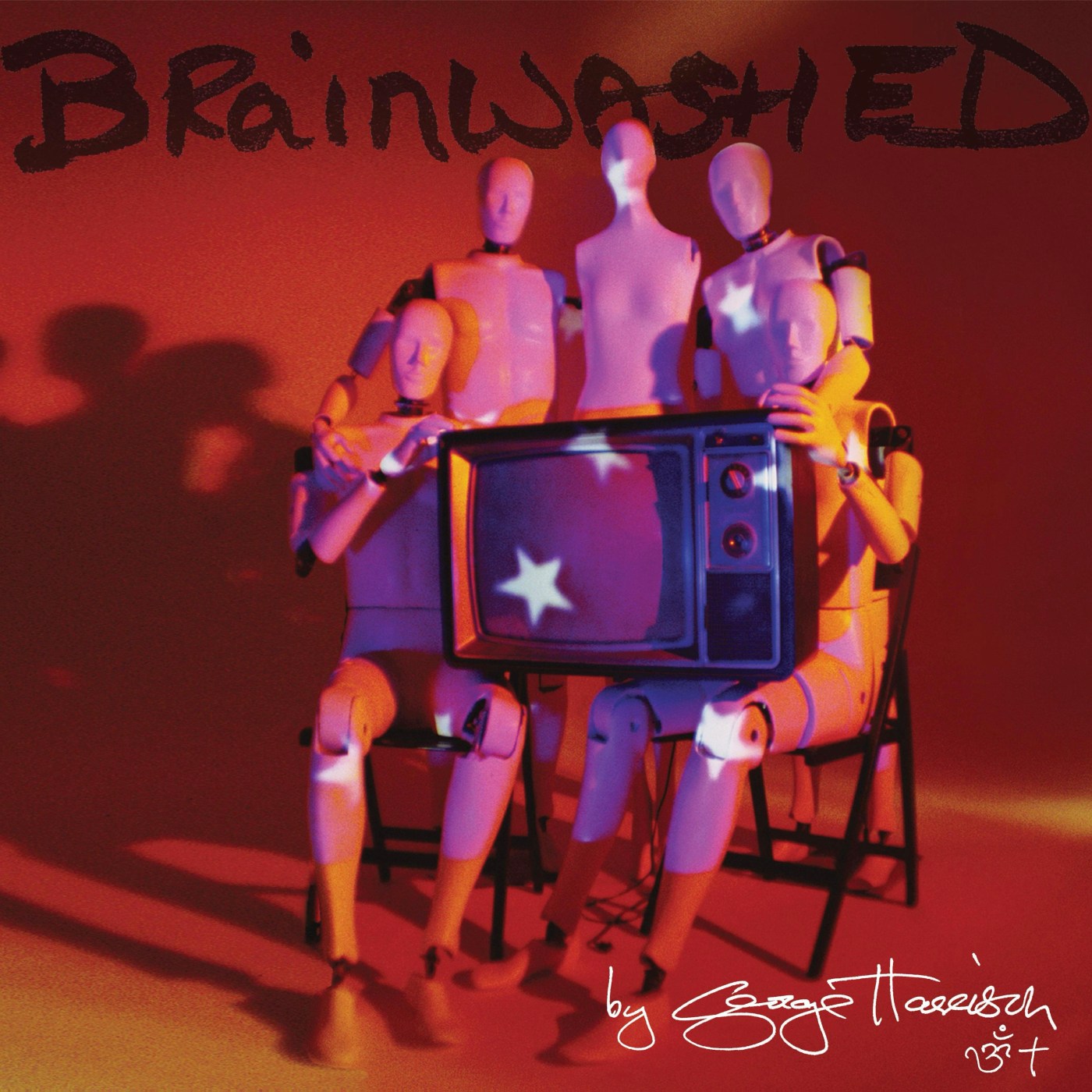
It all had to end sometime, but what no one could’ve imagined was that George’s final release of new music, like John’s in 1984, would come after the artist himself was dead. George Harrison passed away on November 29th, 2001, following a battle with cancer. (Mainly from all the smoking, but an assassination attempt in 1999 certainly didn’t help either.)
Still, the question remains: why exactly didn’t George come out with any new music in the time between Cloud Nine and this album? You’d think, with how refreshed he sounded on that album, he’d end up doing what Paul did and spend most of the 1990s putting out album after album after album of new material. But alas, all we had was the Wilbury recordings and Live in Japan, album-wise. What happened to him in the meantime?
Simple: He just got really busy, as so often happened with George and his increasingly sporadic releases. As Wikipedia offers: “Harrison began recording the tracks that eventually were issued on Brainwashed as early as 1988 (with “Any Road” being written during the making of a video for “This Is Love” from the album Cloud Nine) and continued to do so in a sporadic manner over the next decade and a half, but mainly from July 1999 to October 2001. Progress was delayed by business problems with Harrison’s former manager, Denis O’Brien, as well as his work with the Traveling Wilburys and Ravi Shankar, and by his work on The Beatles Anthology.”
After being diagnosed with cancer in 1997, George seemed to realise that his time on Earth was coming to an end. By the time his work on the album began in 1999, he had a huge backlog of songs ready to go, just like on All Things Must Pass, and spent as much of 2000 and 2001 trying to finish everything he could, along with leaving extensively detailed notes for Jeff Lynne and Dhani Harrison on what he wanted for overdubs, and even the cover art.
Exactly how much did he manage to do before he died? Well, according to Wikipedia, “The project was so close to completion that [Dhani and Lynne] used the exact timetable and session bookings that Harrison himself had originally planned.” Damn, George. After a few months away from the project, both Lynne and Dhani returned to working on Harrison’s final songs and added the appropriate instruments, as per George’s specifications, to the recordings.
Jeff Lynne said in 2020: “His life was in those final songs, the things he got up to each day, like riding down the River Thames. Lots of very personal stuff. Some of them are really good. We gradually just filled them in. It was just about mixing them and making them sound like George would like them.”
And now, 25 years to the month since George’s death and 24 since the album release, let’s jump in to his final farewell:
Any Road: If I think back far enough, this was probably the first solo George song I remember hearing. I was eight years old when Brainwashed was released in November 2002, and I don’t think I realised George had died the previous year. I definitely remember liking the music video, especially the clips of George’s appearances on The Simpsons.
Harrison began working on the song during the sessions for Ravi Shankar’s Chants Of India album in 1996. The following year he played it briefly during an appearance on VH1. Like the rest of Brainwashed, the final album version includes overdubs by Jeff Lynne, Dhani Harrison, and old standby Jim Keltner on drums.
‘P2 Vatican Blues (Last Saturday Night)’: It’s been a while since George has criticised the church of his upbringing, and as a former Catholic myself, I really vibed with a lot of his criticisms here. He takes a more humorous view here than he did back in 1970 with “Awaiting On You All,” which I appreciate.
‘Pisces Fish’: In June 1999 George invited Billboard writer Timothy White to Friar Park. The interview was granted to coincide with The Beatles’ Yellow Submarine Songtrack, yet that album was barely touched upon. Instead Harrison spoke about his projects, including the reissue of his back catalogue and a forthcoming album which he claimed would be titled Portrait Of A Leg End.
The interview shone a light on Harrison’s home and working life, and included several tantalising snippets of information. His next album, we were told, would include a cover version of Bob Dylan’s ‘Every Grain Of Sand’, a “potent power ballad” titled ‘Valentine’, and three songs which made it onto Brainwashed: ‘Pisces Fish’, ‘Run So Far’, and the title track.
‘Looking For My Life’: As with “Isn’t It A Pity,” this song isn’t about what you think it’s about. This isn’t a cancer song, it’s a “George speaks to God” song, but with the urgency in his wording you can see why people think it’s a cancer song. Lynne reflected: “The song ‘Looking For My Life’, when I first heard that, was in the sessions when I started to mix all the songs, and work on the songs, and fix some of them up. That was one that wasn’t finished, but as soon as I heard the lyric, with that tune, it was just… And he was crooning on there, ‘Looking for my life,’ he was singing so well. It was astonishing.”
Rising Sun: Written in the early ‘90s during the Japan tour, Dhani Harrison and Jeff Lynne explained how the final album mix came to be:
“He wrote everything down, a lot of stuff. A lot of it would be just legal pads and you’d go through and the whole thing would be full, and you’d get another one underneath it and the whole thing would be full. He never wrote instructions, he’d just write notes, like “‘Rising Sun’, cello, chunky cello part with wobble,” you know, something just in his language. And Jeff [Lynne] looks and is like, “Oh great, wobble, yeah, we’ll put a bit of wobble on there and a bit of chunk there.” They obviously knew what they were talking about.”
“On ‘Rising Sun’ I used this room which is the big room at my house, and it was actually wonderful. We had two cellos and a bass, which you’d call contrabass, I think, in classical terms, but I call double bass, because I’m from Birmingham. And that was a really great sound. We had eight violins all set up in here, all at once, and it was just an incredibly good sound.”
Marwa Blues: One of only two instrumentals in George’s solo catalogue, this one is based loosely upon ‘Raga Marwa’, a classical Indian raga traditionally played at sunset, which Harrison first heard in the 1960s. It’s a truly gorgeous showcase of his slide guitar work, and the Indian flavouring brings it all back home. If you had to play only one song to describe George as a person, this would be my choice.
‘Stuck Inside A Cloud’: This one is a cancer song, and a reflection on his terminal diagnosis. Its placement as track 7 was apparently intentional, according to Dhani: “My dad’s favourite number was seven, and a lot of things that he did were according to the number seven, whether he meant it or not. And that was the highest honour I could have given a track on the album, was to put it track seven. That is my favourite, that track. I love it.”
‘Run So Far’: The song was originally recorded by Eric Clapton for his 1989 album Journeyman. Harrison also offered Clapton two other more rock-oriented songs: ‘Cheer Down’ and ‘That Kind Of Woman’. Clapton’s version of ‘Run So Far’ included a third verse not on Brainwashed.
‘Never Get Over You’: A love song to rival his best, it would have been a worthy contender on any of his post-Beatles albums, and all for Olivia. As final goodbyes go, it’s a great one.
‘Between The Devil And The Deep Blue Sea’: The only non-original song on the album, ‘Between The Devil And The Deep Blue Sea’ was first recorded by Cab Calloway in 1931. The music was by Harold Arlen, and lyrics by Ted Koehler. George’s version was recorded at a George Formby convention in Blackpool, England, on 3 March 1991, It was filmed for UK TV show Mister Roadrunner and first broadcast on 6 June the following year. The show was presented by Jools Holland, who plays piano on the recording. (The album version is a remix of that recording.)
‘Rocking Chair In Hawaii’: George taped a brief version of this song during the All Things Must Pass sessions on 30 June 1970, although it was never properly recorded for the album, so he dusted it off for Brainwashed. Given that the ATMP 30th anniversary release was coming up around this time, he might’ve heard the 1970 recording and decided to do it for real.
Olivia explained: “He didn’t have all the words to it and he was sort of yodelling around in the background. I was really surprised because I thought ‘Rocking Chair In Hawaii’ was written since living in Hawaii but it actually had been around in some form since way back when.”
‘Brainwashed’: The final song is also the title track, in which George describes all the ways in which modern society brainwashes us, from the stock market to our governments and technology. (My favourite lyric is “They even got my grandma when she was working for the mob.”)
While it is a bit surreal to hear someone of George’s age sing about mobile phones, it’s certainly prescient. George didn’t live long enough to see the advent of modern social media, I have zero doubt whatsoever that he would’ve looked at things like Elon Musk’s X platform and said “See? This is what I was talking about.”
We have all been brainwashed by our mobile phones.
‘Namah Parvati’: Despite the 6 minute running time, “Brainwashed” only lasts about four minutes. The track continues for another two minutes with this, a traditional Sanskrit prayer, chanted by George with a harmonium and tabla backing, played by Bickram Ghosh. Dhani joins him as well, creating a duet between father and son. It’s a quiet, final bit of spirituality from George, and the perfect way to end his last album.
It seems almost unfair to try and critically analyse this album, since it’s the last one George ever made. “It’s not going to be the end – it’s going to be one of lots of records,” he said in 2000, and considering he died at the age of 58, he would’ve had all kinds of time to work on them. (Who knows, maybe the Otherworld has a recording studio, and he’s done a bunch of stuff with John and Roy Orbison.)
In 2004, Brainwashed’s “Marwa Blues” won the Grammy Award for Best Pop Instrumental Performance. The album was nominated for Best Pop Vocal Album, as well as Best Male Pop Vocal Performance (for the track “Any Road”). Rolling Stone gave it 4 stars in their review, as did entertainment.ie, and it went gold in the US, UK, and Canada.
But all of that, if you ask me, is a nice bonus. This is a beautiful final goodbye from George, and that’s all that really matters.


Leave a Reply